EasyManua.ls Logo

Simpson 260 Series - Decibel Measurement Procedures

Simpson 260 Series
68 pages
Print Icon
To Next Page IconTo Next Page
To Previous Page IconTo Previous Page
Loading...
Operation
d.
Connect
the
test
leads
across
the
circuit
being
measured
with
the
black
test
lead
to
the
ground
side.
e.
Turn
on
the
power
in
the
test
circuit.
Read
the
output
voltage
on
the
appropriate
AC
voltage
scale.
For
the
0-2.5V
range,
read
the
value
directly
on
the
scale
marked
2.5
VAC.
For
the
10V,
50V,
or
250V
ranges,
use
the
red
scale
marked
AC
and
read
the
black
figures
immediately
above
the
scale.
413
DECIBEL
MEASUREMENT
(—20
to
+50
dB)
4.13.1
In
some
industries,
measurements
are
made
in
terms
of
voltage
or
current
ratios
(decibels)
based
on
a
specific
reference
level.
The
dB
scale
on
the
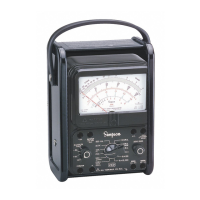
260-7P
serves
this
purpose
and
is
cali-
brated
to
a
reference
level
(zero
dB)
of
0.001
watt
into
600
ohms.
The
scale
calibration
of
—20
to
+10
dB
is
for
the
0-2.5V
range
(zero
dB
0.775V).
Higher
ranges
may
be
used
by
adding
an
appropriate
dB
value
to
the
reading
in
accordance
with
the
chart
below.
a.
Review
the
safety
precautions
in
paragraph
4.2.
b.
Refer
to
Figure
4-6
for
switch
settings
and
jack
connections.
c.
Use
operating
instructions
for
AC
VOLTAGE
MEASURE-
MENT,
0-2.5/10/50/250/500V
RANGES
(paragraph
4-10
).
Do
not
use
the
500V
range
for
decibel
readings.
d.
Read
decibels
on
the
bottom
scale
marked
dB.
For
the
10/50/250V
ranges,
add
the
appropriate
factor
from
the
chart
below:
Voltage
Range
dB
Range
Reading
0-
2.5V
—20
to
+10
read
directly
0-
10
V
-
8
to
+22
add
+12
dB
to
reading
0-
50
V
+
6to
+36
add
26
dB
to
reading
0-250
V
+20
to
+50
add
40
dB
to
reading
4-15

Related product manuals