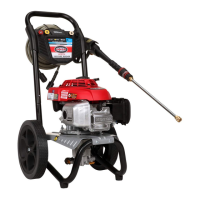
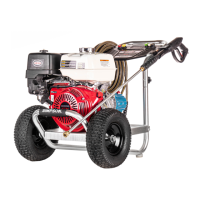
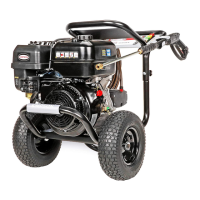
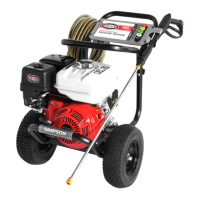
This document is an instruction manual for a SIMPSON professional pressure washer, providing comprehensive information on its function, usage, and maintenance.
Function Description
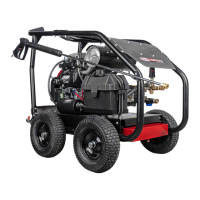
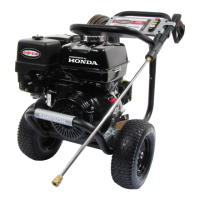
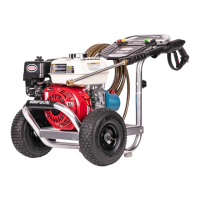
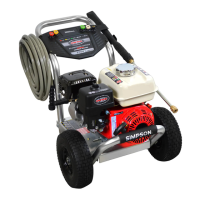
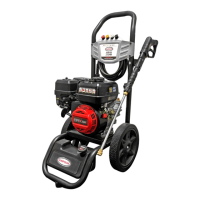
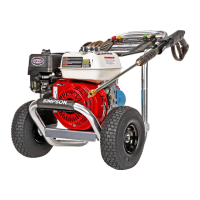
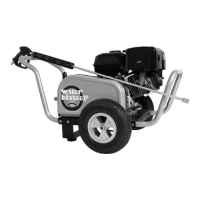
The SIMPSON professional pressure washer is a robust cleaning tool designed to increase the pressure of a water supply for various cleaning tasks. At its core, the device consists of a high-pressure pump driven by an engine. The pump is responsible for taking in water from a source and pressurizing it, while the engine provides the necessary power for this operation. The pressurized water is then delivered through a high-pressure hose to a spray gun and a quick-connect spray wand, which allows the operator to control the water flow rate, direction, and pressure. An integrated detergent siphon hose enables the mixing of cleaning agents with the water, enhancing cleaning effectiveness. The unit is designed for outdoor use in well-ventilated areas, emphasizing safety due to the high pressures involved and the potential for carbon monoxide exposure from the engine exhaust.
Usage Features
The pressure washer offers several features to facilitate effective and safe operation. Before starting, users must ensure the engine oil and pump oil levels are correct, and the fuel tank is filled with fresh, unleaded gasoline (with less than 10% ethanol). The water supply hose connects to the pump inlet, and it's crucial to purge air from the hose before connecting it to the pump. The unit requires a minimum water supply of 5 gallons per minute at 20 PSI.
The quick-connect spray wand is a key feature, allowing for rapid changes between various high-pressure nozzles. These nozzles are color-coded to indicate different spray patterns and recommended uses:
- Red (0°): A powerful pinpoint stream for spot cleaning hard, unpainted surfaces or high-reach areas. Not recommended for wood.
- Yellow (15°): An intense cleaning stream for unpainted hard surfaces like grills, driveways, concrete, or brick walkways.
- Green (25°): A standard cleaning nozzle suitable for most applications, including yard tools, sidewalks, lawn furniture, unpainted siding, stucco, gutters, and eaves.
- White (40°): A wider, less powerful spray pattern for cleaning painted or delicate surfaces such as auto/RV, marine, wood, painted brick, stucco, vinyl, and painted siding.
- Black (Low Pressure): Designed for applying cleaning solutions, safe on all surfaces, provided compatibility with the cleaning solution is verified.
For applying chemicals or cleaning solvents, the detergent siphon hose is attached to a barbed fitting near the high-pressure hose connection. The other end of the hose, with its filter, is placed into the cleaning solution. The black (low pressure) nozzle must be installed on the spray wand for the chemical injection system to function. After chemical application, the system should be rinsed thoroughly with clean water to prevent pump damage.
Pressure adjustments can be made by varying the distance from the surface, changing to the 40° nozzle, or by turning the pressure control knob on the pump. Turning the knob counter-clockwise lowers the pressure, while turning it clockwise until it stops returns it to the factory setting.
Safety is paramount during operation. The trigger lock on the spray gun should always be engaged when the gun is not in use to prevent accidental spraying. The unit should not run for more than two minutes without the gun trigger being pulled to avoid overheating and pump damage. If the pump temperature rises too high, a thermal relief valve will open to release water and lower the internal temperature. Users are warned against directing the spray stream at persons, live animals, or electrical outlets, and to wear ANSI-approved safety glasses and protective clothing.
Maintenance Features
Regular maintenance is essential for the efficient operation and longevity of the pressure washer. The manual outlines a routine maintenance schedule, with more frequent checks recommended for unusual operating conditions.
Engine maintenance requires consulting the separate Engine Owner's Manual. The engine drain plug is located at the rear of the unit.
Pump maintenance includes checking and changing the pump oil. The pump is factory-filled with SIMPSON® Premium Pump Crankcase Oil (or SAE 15W-40 if unavailable). The first oil change is recommended after 50 hours of operation, and every 100 hours or 3 months thereafter. The oil level should be visible in the middle of the sight glass. To change the oil, the fill plug and drain plug are removed, the old oil is drained, and then new oil is refilled.
Connections on the pressure washer hoses, gun, and spray wand should be cleaned regularly and lubricated with light oil or lithium grease to prevent leakage and damage to the o-rings.
Nozzle cleaning is crucial if the nozzle becomes clogged, which can lead to excessive pressure or pump pulsation. To clean, the pressure washer is shut off, the water supply is turned off, and the high-pressure nozzle is removed. Obstructions are cleared with the provided nozzle cleaning tool, and the nozzle is backflushed with clean water.
The water inlet filter screen should be checked periodically and cleaned by removing it from the pump inlet, flushing it with water, and re-inserting it with the convex side facing out. The pressure washer should not be operated without this filter properly installed.
For storage, especially for periods longer than 30 days or when freezing temperatures are expected, the manufacturer recommends using SIMPSON® / POWERWASHER® Pump Guard or an equivalent. This helps lubricate internal pump seals. Before storage, the pressure washer should be turned off, hoses disconnected, and any chemicals rinsed from the system. For engine storage, the fuel tank should be filled with fresh gasoline and a fuel stabilizer, and the engine run for 10 minutes. Then, the fuel valve should be turned off, and the engine run until it stops from lack of fuel in the carburetor.


 To Next Page
 General