EasyManua.ls Logo

Singer 251-2 - Understanding and Adjusting Tensions

Singer 251-2
44 pages
Print Icon
To Next Page IconTo Next Page
To Previous Page IconTo Previous Page
Loading...
From the library of Superior Sewing Machine & Supply LLC - www.supsew.com
15
TENSIONS
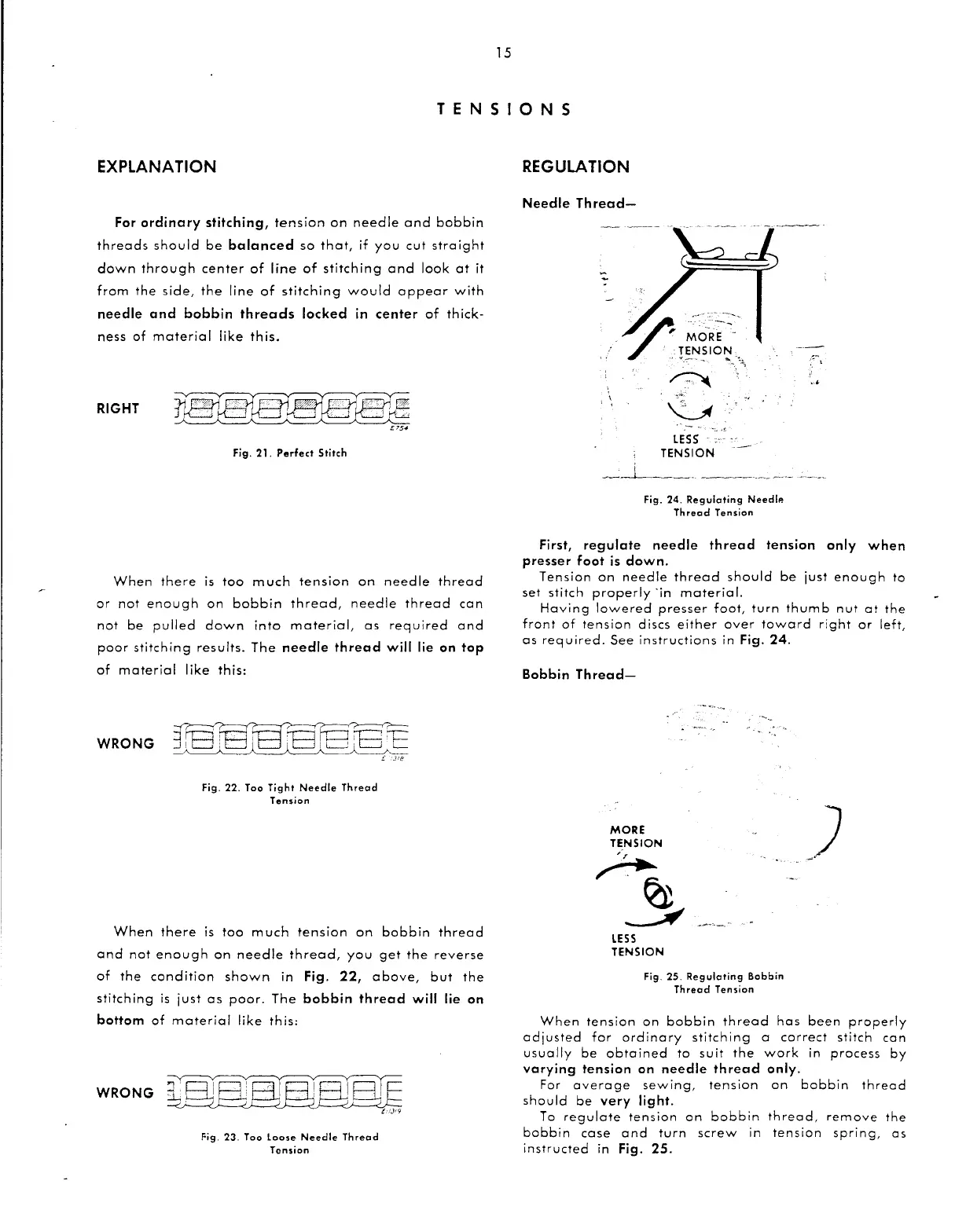
EXPLANATION
For
ordinary
stitching,
tension
on
needle
and
bobbin
threads
should
be
balanced
so
that,
if
you
cut
straight
down
through
center
of
line
of
stitching
and
look
at
it
from
the
side,
the
line
of
stitching
would
appear
with
needle
and
bobbin
threads
locked
in center
of
thick-
ness
of
material
like
this.
RIGHT
Fig.
21.
Perfect
Stitch
When
there
is
too
much
tension
on
needle
thread
or
not
enough
on
bobbin
thread,
needle
thread
can
not
be
pulled
down
into
material,
as
required
and
poor
stitching
results.
The
needle
thread
will
lie
on
top
of
material
like
this:
WRONG
Fig.
22.
Too
Tight
Needle
Thread
Tension
When
there
is
too
much
tension
on
bobbin
thread
and
not
enough
on
needle
thread,
you
get
the
reverse
of
the
condition
shown
in Fig.
22,
above,
but
the
stitching
is
just
as
poor.
The
bobbin
thread
will
lie on
bottom
of
material
like
this:
WRONG
Fig. 23. Too
Loose
Needle
Thread
Tension
REGULATION
Needle
Thread-
\
..
LESS
TENSION
Fig. 24.
Regulating
NeedlP.
Thread
Tension
First,
regulate
needle
thread
tension
only
when
presser
foot
is
down.
Tension
on
needle
thread
should
be
just
enough
to
set
stitch
properly
·in
material.
Having
lowered
presser
foot,
turn
thumb
nut
at
the
front
of
tension
discs
either
over
toward
right
or
left,
as
required.
See
instructions
in Fig.
24.
Bobbin
Thread-
MORE
TENSION
~
~
__::,,
LESS
TENSION
Fig.
25.
Regulating
Bobbin
Thread
Tension
_)
When
tension
on
bobbin
thread
has
been
properly
adjusted
for
ordinary
stitching
a
correct
stitch
can
usually
be
obtained
to
suit
the
work
in
process
by
varying
tension
on
needle
thread
only.
For
average
sewing,
tension
an
bobbin
thread
should
be
very
light.
To
regulate
tension
on
bobbin
thread,
remove
the
bobbin
case
and
turn
screw
in
tension
spring,
as
instructed
in Fig.
25.

Related product manuals