61
1. Coloque la tela abajo del prensatelas.
2. Coloque el botón debajo del pie, asegurándose de alinear la abertura del botón con la del pie.
3. Alinee la posición de la aguja (posición izquierda) para que la aguja penetre en la (abertura) el oricio del lado
izquierdo del botón. (Siempre haga una prueba del ancho girando el volante manualmente antes de coser).
4. Cosa 3 o 4 puntadas para asegurar la punta del hilo
5. Seleccione la Puntada Zigzag.
6. Coloque el ancho de puntada para despejar ambos oricios al moverse de izquierda a derecha. (Haga siempre una
prueba del ancho, girando su volante manualmente antes de coser).
7. Cosa 4 ó 5 Puntadas Zigzag.
8. Seleccione Puntada Recta.
9. Asegúrese de que la aguja esté alineada con el oricio izquierdo del botón
10. Cosa 3 ó 4 puntadas para asegurar la punta del hilo
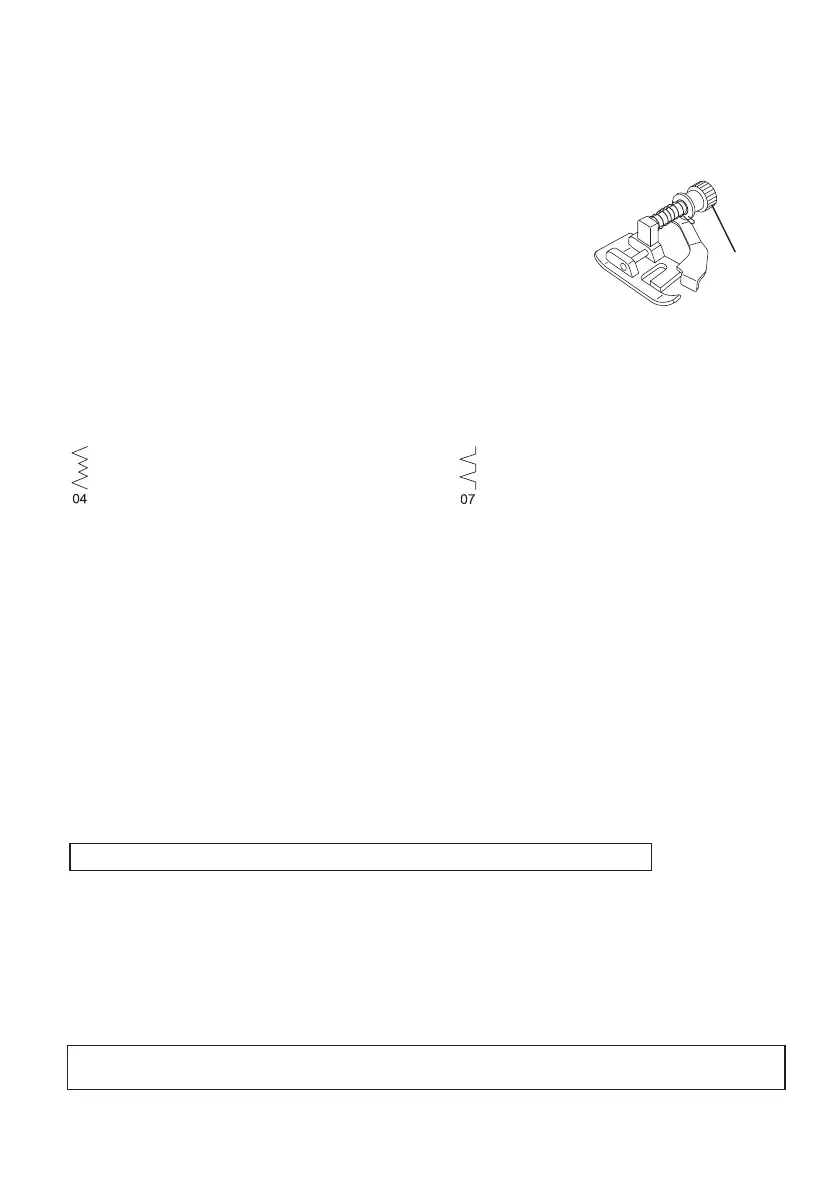
Blind Stitch Foot
Pied Point Invisible
Prensatelas para Dobladillo Invisible
The Blind Stitch Foot is primarily used for creating nearl
yinvisible hems on curtains, trousers, skirts, etc.
Le Pied Point Invisible est principalement utilisé pour confectionné des rebords
pratiquement invisible sur des rideaux, pantalons, robes, ect.
El prensatelas para Dobladillo Invisible se usa principalmente para dobladillos casi invisibles en
cortinas, pantalones, camisas, etc.
Machine Preparation
Préparation de la Machine
Peeparacion de la Maquina
B
A
• Install the Blind Stitch Foot
• Select Stitch: 04 or 07
• Tension set at 5
• Colocar el prensatelas para Dobladillo Invisible
• Seleccionar puntada: 04 ó 07
• Colocar la tensión en 5
• Installez le Pied Point Invisible.
• Séleectionnez le Point: 04 or 07
• Réglez la Tension a 5
Elastic Blind stitch for soft, stretchable fabrics.
Puntada Dobladillo Invisible en telas elásticas delicadas.
Point invisible pour les tissus extensibles.
Regular blind stitch for normal woven fabrics.
Puntada Dobladillo Invisible para telas de
lana normales.
Point ourlet invisible régulier pour tissu tissé.
Sewing Instructions
Instructions de Couture
Instrucciones de Costura
1. With matching thread nish the raw edge. On ne fabric turn up and press a small 1/2" or less hem.
On medium to heavyweight fabrics overcast the fabric's raw edge.
2. Now fold the fabric as with the wrong side up.
3. Place the fabric under the foot. Turn the handwheel towards you (counter-clockwise) by hand untill the
needle swings fully to the left. It should pierce the fold of the fabric. If it does not, adjust the guide (B) on
the Blindhem Foot (A) so that the needle just pierces the fabric fold and the guide just rest against the
fold. Sew slowly, guiding the fabric carefully along the edge of the guide.
4. When completed, the stitching is almost invisible on the right side of the fabric.
Note: It takes practice to sew blind hems. Do a test sew rst.
1. Avec un l qui se marie, cousez le rebord coupé. Sur un tissu léger faite un rebord d'environ 1/2" ou
moins et repasser. Sur un tissu moyen ou épais surjeter le rebord coupé.
2. Maintenant, pliez le tissu avec l’envers tournée vers le haut.
3. Placez le tissu sous le pied. Faites tourner le volant à la main vers vous (sens antihoraire) jusqu' à ce
que l’aiguille se déplace complètement vers la gauche. Elle ne devrait percer que le repli du tissu.
Si ce n'est pas le cas, ajusté le guide (B) sur le Pied Point Invisible (A) de façon à ce que l'aiguille
transperce juste le rebord du tissu et que le guide s'appuie sur le rebord.
Coudre lentement, tout en guidant soigneusement le tissu le long du bord du guide.
4. Lorsque l’ourlet est terminé, les points sont presque invisibles sur l’endroit du tissu.
Note: La couture d’ourlets invisible demande de la pratique. Pour débuter faites un essai
de couture.


 To Next Page