37
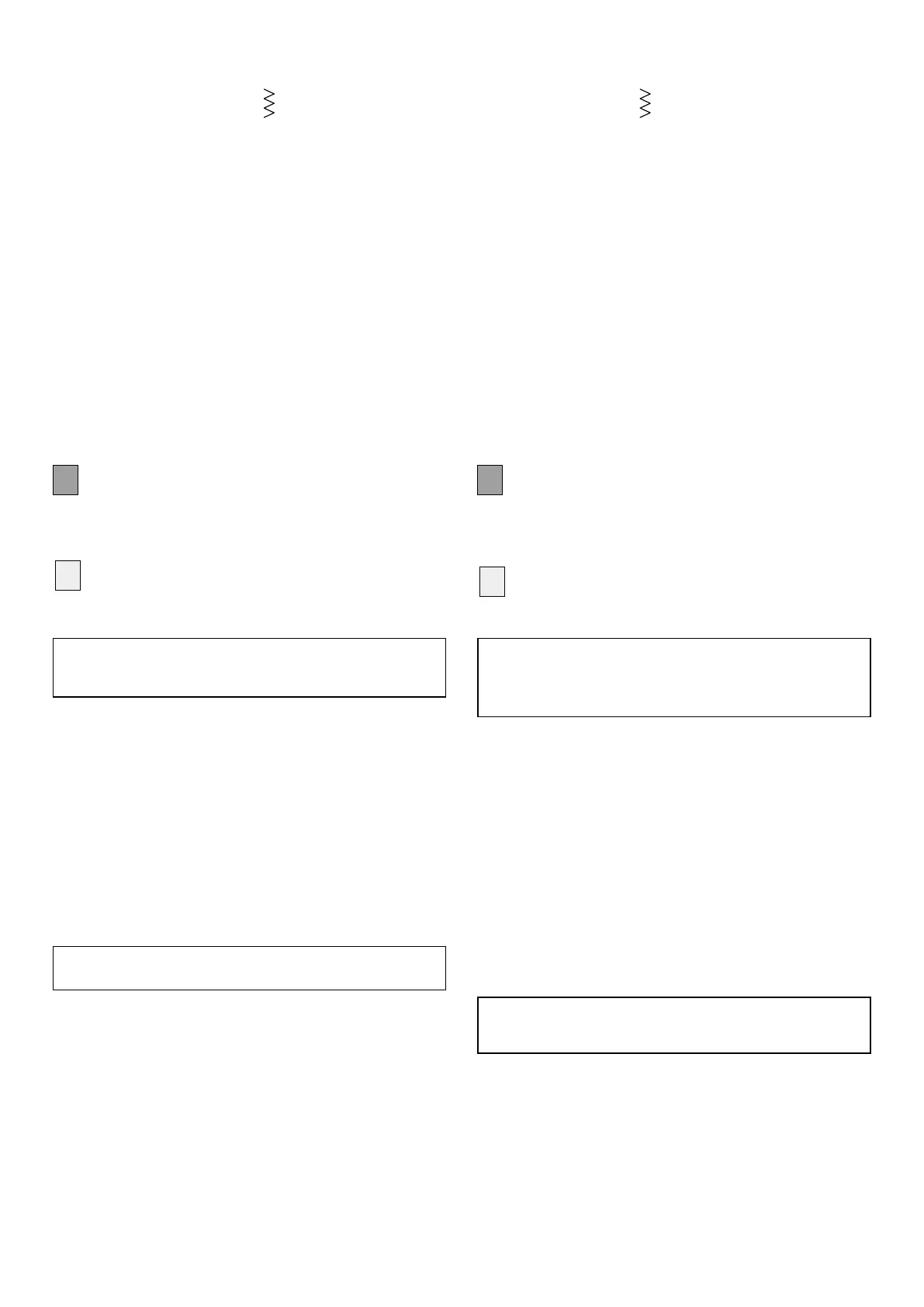
POINT ZIGZAG
Le l supérieur peut paraître sur l’envers, en fonction du l, du
tissu et de la vitesse de couture, mais le l de la canette ne
doit jamais paraître sur l’endroit.
Si le fil de la canette tire vers le haut ou si des fronces se
produisent, réduisez légèrement la tension à l’aide de la
commande de tension du l.
RÉGLAGES :Pied presseur - Pied universel
:Réglage tension du l supérieur - AUTO
Une case gris foncé indique la valeur automatique/par
défaut réglée automatiquement lors de la sélection du
motif.
Pour le motif zigzag, la longueur du point est de 2 mm et
la largeur du point est de 5 mm.
La case gris clair indique toutes les options de
préférences personnelles disponibles pouvant être
réglées manuellement.
POSITIONNEMENT DES MOTIFS
La largeur de point augmente selon la position de l’aiguille
centrale, comme indiqué sur l’illustration.
POINT BOURDON
Des points zigzag serrés sont appelés point satin. C’est un
point décoratif qui sert pour les applíqués, les brides. Lorsque
vous utilisez ce point, pensez à diminuer la tension supérieure.
Régler la longueur de point entre 0.5 et 2.0. Plus le point
est large, plus la tension doit être diminuée. Si vous voulez
réaliser un point satin sur un tissu très n, entoilez votre tissu
en premier lieu. De cette manière, le tissu ne froncera pas et
le l inférieur ne sera pas apparent.
Faire un essai sur un morceau de tissu que vous allez utiliser.
Remarque: Lorsque vous cousez un point bourdon
dense (à points serrés), IL FAUT utiliser le pied pour
point bourdon.
RÉGLAGE DE LA LARGEUR ET DE LA
LONGUEUR DE POINT
REMARQUE: Les valeurs montrées dans le graphique
sont des longueurs et des largeurs de couture
actuelles et ne correspondent pas aux marques
d’échelle et de nombre de la machine.
ZIGZAG STITCHING
The top thread may appear on the bottom depending on the
thread, fabric, type of stitch and sewing speed, but the bobbin
thread must never appear on the top of the fabric.
If bobbin thread is pulling to the top or you are experiencing
puckering, slightly reduce the tension with the Thread Tension
Control.
SETTINGS :Presser foot - General Purpose Foot
:Thread tension control - AUTO
Dark grey box indicates the Auto/default value set
automatically when the pattern is selected.
For the Zigzag Pattern the stitch length is 2 mm and the
stitch width is 5 mm.
The light grey boxes indicate all the possible personal
preference options available to set manualy.
PLACEMENT OF PATTERNS
The satin stitch increases from the center needle position;
making for a center tapered stitch as illustrated.
SATIN STITCH
This is a closely spaced attractive stitch for appliqué, bar-
tacking, etc. Slightly loosen the top thread tension and
manually adjust the stitch length between 0.5 and 2.0 for satin
stitching.
Use a backing of stabilizer for lightweight fabrics to avoid
puckering.
Note: When sewing a dense (closely spaced) Satin
Stitch, the Satin Stitch Foot MUST be used.
ADJUSTING STITCH WIDTH AND LENGTH
NOTE: The values shown in the chart are actual
sewing lengths and widths and do not correspond to
the scale and number markings on the sewing machine.


 To Next Page