8
upright position; when doing so, make
sure no combustible materials or
inammable gases are in the proximity
• Do not store/leave the tool outdoors
• Store the tool in a dry and locked-up
place, out of reach of children
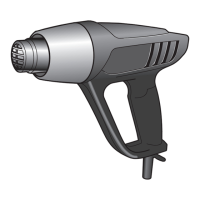
• On/o switch with 3 temperature
settings 4
2
- switch on the tool by pushing
switch A in desired position:
1 = 50°C, air ow 250 litres/minute
2 = 400°C, air ow 250 litres/
minute
3 = 570°C, air ow 500 litres/
minute
- when using it for the rst time,
some smoke may emit from the
tool; this is normal and will soon
cease
- switch o the tool by pushing
switch A in position “0”
• General use
- determine the right temperature by
testing out on an inconspicuous
part of the workpiece; start with a
low temperature setting
- the temperature falls as the
distance between the air outlet/
nozzle and the workpiece
increases
- the temperature required depends
on the material to be worked on
• Stationary use 5
- set the tool down on its rear in an
upright position
- make sure the surface is clean and
dustfree; polluted air damages the
motor
- make sure the air ow is directed
away from you
- secure the cord to prevent pulling
down the tool
- do not touch the air outlet/nozzle
- make sure nothing drops into the
air outlet/nozzle
- carefully hold the tool with one
hand while switching it o with the
other hand, and then allow it to
cool down
• Use at hard-to-reach places
- remove ring B 2, thus releasing
the metal air outlet over a greater
distance
• Holding and guiding the tool 6
- hold the tool with one hand
- keep ventilation slots E 2
uncovered
• SKIL accessories (
) 7
- glass protection nozzle F (for
deecting air ow)
- at nozzle G (for broadening air
ow)
- reector nozzle H (for reecting air
ow)
- reduction nozzle J (for
concentrating air ow)
All application examples (
) can
be performed without accessories;
however, using the appropriate
accessory simplies the work and
signicantly improves the quality of the
results
• Mounting/removing accessories
()
- simply t the accessory onto air
outlet C 2
- remove an accessory by pulling it
o to the front after it has cooled
down
• Constant heat control (overload
protection)
Protects heating element from
damage when tool is overloaded
without having to stop it and/or let it
cool down for a period of time
- when the temperature gets too
high, the heating element switches
itself o, while the motor continues
to run and produces cold air
- when the temperature has fallen
down suciently (taking only a few
seconds), the heating element will
be switched on automatically


 To Next Page