6
dangers (otherwise, there is a
danger of operating errors and
injuries)
• Supervise children (this will
ensure that children do not play
with the tool)
• Cleaning and user
maintenance of the tool shall
not be made by children
without supervision
• Always check that the supply voltage is the same as the
voltage indicated on the nameplate of the tool
• Be sure tool is switched o when plugging in
DURING USE:
•
- do not touch the air outlet/nozzle and the heated object;
they become extremely hot
- do not hold the air outlet/nozzle too close to the object
to be worked on
- do not direct the hot air ow towards the same surface
for too long
- never look down the air outlet/nozzle
- wear protective gloves and use safety glasses
- never direct the hot air ow towards persons or animals
- never use the tool for drying hair
- do not leave the tool unattended
- never use the tool in the proximity of inammable gases
or combustible materials (risk of explosion)
- when working with plastic, paint, varnish and similar
materials, inammable and poisonous gases may
be produced; inform yourself beforehand about the
materials to be worked on
- take into account, that heat may be transferred to
combustible materials out of eyesight
- to be on the safe side, have a bucket of water or a re
extinguisher handy, in case any material catches re
• Prevent electrical shock
- never poke anything down the air outlet/nozzle
- avoid body contact with earthed surfaces (e.g. pipes,
radiators, ranges, refrigerators)
- ensure the tool does not get wet
- do not use the tool in damp locations
- when used outdoors, connect the tool via a fault
current (FI) circuit breaker with a triggering current
of 30 mA maximum, and only use an extension cord
which is intended for outdoor use and equipped with a
splashproof coupling-socket
• Handle the cord with care
- always keep away the cord from the hot air ow and the
air outlet/nozzle
- keep the cord away from heat, oil and sharp edges
- do not carry the tool by the cord, and do not yank the
cord to disconnect it from the socket
- do not suspend the tool by the cord
• Never use the tool in conjunction with chemical solvents
• Make sure work area is adequately ventilated
• Keep work area clean and well lit
• Inrush currents cause short-time voltage drops; under
unfavourable power supply conditions, other equipment
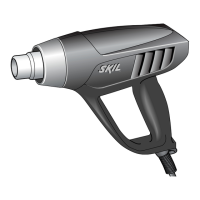
Heat gun 8003
INTRODUCTION
• This tool is intended for the removal of paint, the forming
and welding of plastic, and the warming of heat-
shrinkable tubing; the tool is also suitable for soldering
and tinning, loosening adhesive joints and defrosting
water pipes
• This tool is not intended for professional use
• Read and save this instruction manual
3
TECHNICAL DATA
1
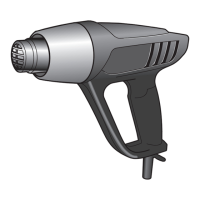
TOOL ELEMENTS
2
A On/o switch
B Protection ring
C Ventilation slots
D Glass protection nozzle
9
E Flat nozzle
9
F Reector nozzle
9
G Reduction nozzle
9
H Air outlet/nozzle
J Hanging ring
SAFETY
SAFETY INSTRUCTIONS FOR HEAT GUNS
BEFORE USE:
• Check the functioning of the tool before each use and,
in case of a defect, have it repaired immediately by a
qualied person; never open the tool yourself
• Inspect tool cord and plug before each use and, if
damaged, have them replaced by a qualied person
• Use completely unrolled and safe extension cords with a
capacity of 16 Amps (U.K. 13 Amps)
• Inspect the extension cord periodically and replace it, if
damaged
• Use the tool and its accessories in accordance with this
instruction manual and in the manner intended for the
tool; use of the tool for operations, dierent from those
normally expected to be performed by the tool, could
result in a hazardous situation
• This tool can be used by
children aged 8 and above
and by persons who have
physical, sensory or mental
limitations or a lack of
experience or knowledge if a
person responsible for their
safety supervises them or has
instructed them in the safe
operation of the tool and they
understand the associated


 To Next Page