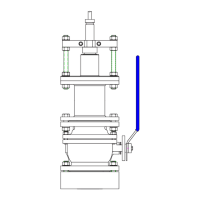
REMOVAL OF ECHO SOUNDER TRANSDUCER UNIT
The sensor unit is secured with 6 each 16 mm pinbolts with nuts and washers, and two 16mm nuts on each
16 x 300 mm safety bolts.
There should be a split pin through the hole drilled near the top of the safety bolts.
WARNING !
ON VESSELS WITH DEEP DRAFT, THE SEA PRESSURE ON THE SENSOR UNIT
IS CONSIDERABLE, AND MAY PUSH THE UNIT UPWARDS, ONCE LOOSENED, WITH GREAT
FORCE.
WHEN REMOVING THE SENSOR UNIT ON SUCH VESSELS, AT LEAST ONE OF THE NUTS ON
THE SAFETY BOLTS SHOULD BE POSITIONED CLOSE TO THE SENSOR UNIT FLANGE PRIOR
TO LOOSENING THE 6 FIXING NUTS.
After the safety bolts have been correctly arranged, the 6 remaining nuts and washers may be unscrewed.
If the transducer unit sticks in its lowered position, insert the two 10 x 60 mm hexagon “lifting bolts” in the
threaded 10 mm holes in the top ange and use them to “break lock”.
Using the lifting bolts, it is possible to lift the unit approx. 40 mm,
enough to provide room for other lifting tools.
After “breaking lock” or lifting, unscrew the two 10 x 60 mm hexagon bolts and store them for future use.
If the sea pressure is high enough to lift the unit, release the nuts on the safety bolts gradually until the
sensor unit is clear of the gate valve piston.
Otherwise, lift the unit by hand or other tools until clear of the gate valve piston.
The unit is clear of the piston when it has been lifted Min. 220 - Max. 250mm.
Do not lift more than 250 mm, as the unit will clear the upper water sealing ring,
and there will be water leakage.
Close the gate valve.
Remove the Split pins and Nuts from the safety bolt and lift out the transducer unit.
It may be necessary to let the gate valve leak somewhat while lifting out the unit, as there will be vacuum
between the gate valve piston and the transducer unit.
In installations with too low headroom, after closing the gate valve, it is possible to split the gate valve
arrangement between the gate valve element and the intermediate element.
The transducer unit may then be removed sideways while still inside the intermediate element.
It should be noted, however, that this operation is very difcult,
as the xing bolts are not so easily accessible.
Such installations should therefore be avoided.


 To Next Page
 Loading...