Need help?
Do you have a question about the Skope ReFlex RF7.UPR.1.SD and is the answer not in the manual?
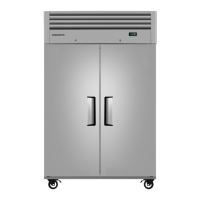
The SKOPE ReFlex Upright series includes fridges, freezers, and combo units, designed for commercial refrigeration. These units utilize hydrocarbon (HC) R290 propane as a natural refrigerant, known for its very low environmental impact. However, special service requirements are necessary due to the flammability of hydrocarbon refrigerants. Some models may also use R404A refrigerant; the specific refrigerant type for each cabinet is indicated on its rating label.
The ReFlex Upright models are equipped with a Wellington Drive SCS Connect electronic controller, which manages the refrigeration system. The controller faceplate features buttons and a display for monitoring and programming. Key indicators include Night Mode, Display (showing cabinet air temperature or alarm messages), Bluetooth connectivity, Fault/Alarm, Compressor status, Defrost Mode, and Fan status. The controller's service mode allows access to parameters, reset functions, manual tests, statistics, and system information. A 9-digit PIN is required to enter service mode via the controller, though using the SCS Connect Field app is strongly recommended.
Proper installation is crucial for optimal performance and safety. The cabinet requires adequate ventilation, with a minimum clearance of 300mm above and no side or behind clearance required, though 50mm clearance is recommended for continuous duty in climate class 7 environments (35°C ambient / 75% relative humidity). The installation surface must support the loaded cabinet, and sufficient space is needed for door opening. The cabinet should be installed within its specified climate class and not in direct sunlight or on an uneven surface. Overloading the power supply or blocking ventilation grilles should be avoided. The power cord should be routed through the opening on the wire grille at the back of the cabinet.
The cabinets are fitted with LED modular interior lights, which can be switched on or off via the controller faceplate or app. Doors are equipped with a self-closing mechanism and can be realigned or reversed (for 1-door models). Each door also features a key lock. Shelves are held by four clips and can be adjusted to different heights.
The cabinet interior and food contact surfaces should be cleaned and sanitised before first use and regularly thereafter. Only standard stainless steel cleaners suitable for food preparation areas should be used, and abrasive, corrosive, or solvent-based cleaners should be avoided on the exterior. The cabinet must be unplugged from the power supply before cleaning.
The condenser coil and air filter require monthly cleaning. The filter is located on the side of the condenser coil and can be slid off for cleaning with a vacuum cleaner and cold water. Hot water, blow-drying, or dishwashers should not be used for the filter. The condenser coil itself can be brushed with a soft brush to remove dust and fluff.
The electronic controller signals faults and alarms. Faults (e.g., over-voltage, under-voltage, high condensing temperature, excessive compressor cycling, probe failure) can often be cleared by power-cycling the cabinet after fixing the underlying issue. Alarms (e.g., estimated product temperature above/below allowable range, excessive condensing temperature, electrical over-current, failed to reach set temperature, evaporator fan over-current, controller communication/update/hardware failure, probe failure, no downward tendency, excessive automatic defrosting) may require service technician intervention. The SCS Connect Field app is recommended for fault diagnosis.
 General
| Brand | Skope |
|---|---|
| Model | ReFlex RF7.UPR.1.SD |
| Category | Refrigerator |
| Language | English |

 To Next Page