INTRODUCTION
2. Since a DC hipot does charge the item under test it becomes necessary to discharge
the item after the test.
3. DC testing unlike AC testing only charges the insulation in one polarity. This
becomes a concern when testing products that will actually be used at AC voltages.
This is a key reason that some safety agencies do not accept DC testing as an
alternative to AC.
4. When performing AC hipot tests the product under test is actually tested with peak
voltages that the hipot meter does not display. This is not the case with DC testing
since a sinewave is not generated when testing with direct current. In order to
compensate for this most safety agencies require that the equivalent DC test be
performed at higher voltages than the AC test. The multiplying factor is somewhat
inconsistent between agencies which can cause confusion concerning exactly what
equivalent DC test voltage is appropriate.
The Ground Continuity Test
The Ground Continuity test is checking to verify that there is low impedance path
between the chassis and the safety ground wire of the line cord. A low impedance ground
system is critical in ensuring that in the event of a product failure a circuit breaker on the
input line will act quickly to protect the user from any serious electrical shock.
International compliance agencies such as CSA, IEC, TÜV, VDE, BABT, and others,
have requirements calling out this test. A low current test merely indicates that there is a
safety ground connection, it does not completely test the integrity of that connection that
would be accomplished when using much higher currents in the range from 10 to 30amps.
The high current test is known as a Ground Bond test.
The Ground Continuity test verifies that the ground circuit between the Continuity and
Return panel jacks on the Hipot is below 1ohm while test at a current of 100mA. This
function can be enabled or disabled through software, when a ground circuit is not
provided on the device under test or test requirement are not needed.
The Insulation Resistance Test....
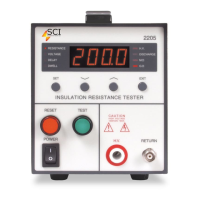
Some "dielectric analyzers today come with a built in insulation resistance tester.
Typically, the IR function provides test voltages from 500 to 1,000 volts DC and
resistance ranges from kilohms to gigaohms. This function allows manufacturers to
comply with special compliance regulations. BABT, TÜV, and VDE are agencies that
may under certain conditions require an IR test on the product before a Hipot test is
performed. This typically is not a production line test but a performance design test.
The insulation resistance test is very similar to the hipot test. Instead of the go/no go
indication that you get with a hipot test the IR test gives you an insulation value usually in
Megohms. Typically the higher the insulation resistance value the better the condition of
the insulation. The connections to perform the IR test are the same as the hipot test. The



 To Next Page