SPECIFICATIONS
11. Software calibration control.
The 2900 family of Hipots is calibrated through the front panel keypad. All
calibration information is stored in non-volatile memory. This allows the instrument
to be completely calibrated without removing any covers and exposing the technician
to hazardous voltages.
12. User selectable output voltage frequencies of 50 or 60 hertz.
The 2900 family of Hipots was designed for the global market. This feature makes it
simple for the user to select the output frequency in the AC hipot mode so that
products can be tested at the same frequency they will be used.
13. Output voltage fine adjustment.
To make The 2900 family of Hipots usable in all types of applications, the operator
can manually bring the voltage up or down in 10 volt increments by simply pressing
the up and down arrow keys. This makes it very easy to adjust the output voltage
even while the instrument is in the dwell mode so you can analyze test results at
different voltages.
14. Built-in Continuity test mode.
The 2900 family of Hipots meets ground continuity test requirements called out by UL
and other safety agencies.
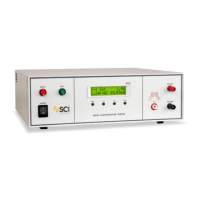
15. Flashing high voltage indicator.
A flashing LED located directly over the high voltage terminal clearly indicates when
high voltage is active to provide maximum operator safety.
16. User selectable input voltage.
The 2900 family of Hipots can be switched for either 115 or 230 volt input operation
through an easy access rear panel mounted switch to allow it to be used in any
country.
17. Low-current sense.
Monitors the minimum level of current flow, thus ensuring that the DUT is properly
connected and that the hipot test is being performed.
18. Electronic ramping.
Provides a gradual and timed method to increase output voltage to the DUT,
minimizing any damage from quickly over-applying high voltage to sensitive DUTs.
19.Test setup memories.
The operator can store and recall test setups, thus eliminating the need to re-enter
setup information.



 To Next Page