
 Need help?
Do you have a question about the Smith Little Torch and is the answer not in the manual?
Explains the meaning of various safety symbols used throughout the manual.
Details the general hazards associated with oxy-fuel processes.
Covers hazards from hot parts, fumes, gases, and gas buildup.
Warns about eye/skin burns from light rays and fire/explosion risks.
Details cylinder explosion risks, eye hazards from flying metal, and California warnings.
Provides a brief overview of the Little Torch and its intended use.
Explains backfire, sustained backfire, and flashback events and their dangers.
Details risks of oxygen recompression, fuel combustion, and oxygen's effect on burning.
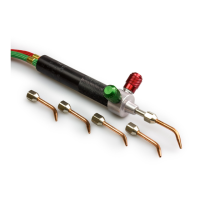
Describes the torch design, compatible gases, and available tips.
Provides guidance on inspecting and replacing torch hoses.
Answers common questions about hose replacement and lighting issues.
Addresses questions on fuel gas compatibility and tip cleaning.
Covers setup, regulator, and hose installation for disposable cylinders.
Explains how to activate, purge, and test the system for leaks.
Guides on selecting tips and safely lighting the torch.
Details procedures for extinguishing the flame, shutting down, and bleeding the system.
Covers industrial cylinder types and installing regulators.
Details connecting hoses and activating regulators for industrial use.
Explains setting pressures, purging, and leak testing for industrial systems.
Guides on selecting tips and lighting the torch with specific fuel gases.
Covers lighting with other gases and procedures for extinguishing, securing, and shutting down.
Provides step-by-step instructions for removing and installing torch hoses.
Provides detailed technical specifications for torch tips and heating tips.
Explains fuel gas properties, flame settings, and cylinder valve identification.
Describes various torch tips (straight, twin, melting, curved) and the magnetic stand.
The Little Torch® is a lightweight, versatile oxy-fuel torch designed for precision work, including fusion welding, brazing, heating, and soldering of materials ranging from 3/16 inch (5 mm) metal to ultra-fine wires. Its compact construction and highly flexible hose allow for pinpoint welding with maximum control, making it suitable for various tasks in industries such as jewelry making, where it is used for annealing, reticulation, and casting.
The torch operates by mixing oxygen with a fuel gas to produce a high-temperature flame. It is compatible with commonly available pressurized fuel gases, including acetylene, hydrogen, propane, propylene, and natural gas. The system includes regulators to control gas flow and pressure, hoses to transport gases to the torch, and interchangeable tips that determine flame size and characteristics.
The torch features six standard tips, with sizes 2 and 3 equipped with synthetic sapphires to ensure accurate gas flow due to their extraordinarily small orifices. Additionally, there are two types of heating tips: one for acetylene or hydrogen and another for propane or natural gas. These multi-orifice (rosebud) tips are designed for larger, more widely dispersed flames, ideal for brazing, soldering, or heating, and are capable of casting up to 3 oz (85 g) of gold or silver. Twin flame tips are also available, allowing for simultaneous heating of both sides of an object, which can accelerate soldering or brazing and ensure even heat distribution.
The Little Torch can be used with either disposable-type cylinders or high-pressure industrial cylinders. When using disposable cylinders, the system is activated by opening regulator valves clockwise. Before lighting, the system must be purged to prevent mixed-gas explosions. This involves opening the torch oxygen valve for 3-4 seconds with the tip removed, closing it, and repeating for the fuel gas. For high-pressure cylinders, regulators are installed, and cylinder valves are opened slowly to pressurize the system. Regulator outlet pressures are adjusted according to the recommended pressures for the specific tip being used.
Lighting the torch involves opening the fuel gas valve slightly (1/8–1/4 turn) and igniting the gas with an approved friction spark lighter. Matches or cigarette lighters should not be used. Oxygen is then slowly added until a neutral flame is achieved, characterized by a bright inner cone that reaches its shortest length without soot. For alternate fuel gases like propane or natural gas, the process involves adjusting the flame until it is about to leave the end of the tip or until soot disappears, then slowly adding oxygen to achieve a neutral flame. The size 2 tip is generally not recommended for alternate fuel gases.
Extinguishing the torch flame is done by closing the fuel gas torch valve first, followed by the oxygen torch valve. Shutting down the system involves extinguishing the flame, closing the oxygen and fuel gas regulator valves, and then bleeding the system of gases by opening the torch oxygen and fuel gas valves (1/2 turn) until the low-pressure gauges indicate zero, and finally turning the regulator pressure adjusting handles counterclockwise until no spring pressure is felt.
Regular inspection and maintenance are crucial for safe and efficient operation. Before each use, all equipment, including the torch, regulators, and hoses, should be inspected for damage, defects, or grease/oil. Threads on equipment should be clean and free of contaminants, and gauges should be intact and easy to read. All connections must be tight, and the system should be tested for leaks using an approved oil-free leak detection fluid. Leaks must be eliminated before proceeding with any operation.
Hoses should be replaced at the first sign of defects or damage, and generally every four years. Hoses must not come into contact with hot metal, molten solder, or corrosive chemicals, as these can deteriorate the hose materials and cause leaks. Replacement hose assemblies come with step-by-step instructions and a ferrule replacement tool. The orifices in the torch tips, if obstructed by flux, can often be cleaned by boiling them in water for about 10 minutes, or by using a jeweler's type steam cleaner or an ultrasonic cleaner. The torch gas valves can be replaced if damaged or worn out, with specific part numbers for oxygen (green) and fuel (red) valve assemblies. PTFE packing rings under the valves should also be replaced during this process.
 General
| Material | Brass and Stainless Steel |
|---|---|
| Tip Orifice Size | Varies by tip size |
| Type | Welding Torch |
| Fuel Gas | Acetylene, Propane, MAPP |
| Applications | Jewelry making |
| Maximum Temperature | 6300°F (3482°C) |

 To Next Page