OM-263 357 Page 21
11-2. Fuel Gas And Flame Characteristics
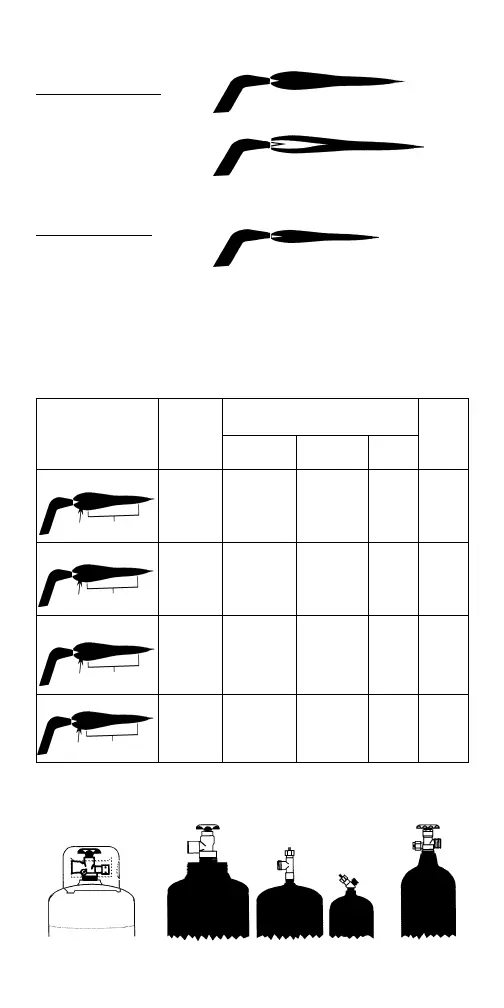
cetylene − Oxygen
fter igniting, open acety-
ene valve until soot disap-
ears from end of flame.
dd oxygen until the feather
hown on the right just dis-
ppears in the bright inner
one.
ropane − Oxygen
fter igniting, add oxygen
ntil bright inner core reach-
s its shortest point and
hen stop. Repeat process
o force as much fuel
hrough the tip as possible.
Neutral Flame
Even Mixture of Fuel and Oxyge
Carburizing (Reducing) Flame
Excess Fuel Gas
S Lower Temperature
S Less Oxidizing
Oxidizing Flame (Seldom Used)
Excess Oxygen
S Short Outer Flame
S Narrow Inner Cone
S Noisy
S Hottest
11-3. Flame And Heat Placement BTU Output Per Cubic Ft Of
Fuel Burned With Oxygen
Fuel Gas
Total BTU
Output
ft
3
Gas/hr
(L Gas/hr)
Flame Temperatures
In °F (°C)
Oxygen
To Fuel
Ratio
Compressed
Air Tips
Atmospheric
Air Tips
Oxygen
Acetylene
500 970
(41,626)
4800
(2649)
1500
(816)
6000
(3316)
25:1
Propane
250 2250
2500
(70,792)
3500
(1927)
1500
(816)
4800
(2649)
5:1
Natural Gas (City Gas)
11 900
911
(25,797)
3400
(1871)
−−
4600
(2538)
2:1
Hydrogen
55 270
325
(9203)
4000
(2204)
−−
4800
(2649)
5:1
11-4. Cylinder Valve Identification For Regulator Selection
. Compressed Gas Association connection numbers are also shown.
PROPANE ACETYLENE OXYGEN
LARGE
INDUSTRIAL
FROM
60–400 Cu. Ft.
“B”
40 Cu. Ft.
“C”
10
Cu. Ft.
ALL
SIZES
510
510
Internal
Threads
520
200
54
nternal


 To Next Page