504-2033 Iss 1j 9 April 2005
6. Check the Condition of the Input Hose
i) From 1
st
January 2002 pressure hoses are date coded and should be replaced after 5
years. Check the label on hose for replacement date.
ii) Check the hose for damage, cuts and abrasions.
iii) Check that there is no internal damage to the hose by feeling the rigidity of the hose
and looking for sloppiness.
iv) Ensure there is no delamination of the hose and no blisters or bubbles on the surface
(check again when the hose is pressurised).
v) Check union ends for signs of kinking and/or damage to hose or union.
vi) Replace hose if any of above is apparent.
7. Check the condition of the paraPAC
i) Check the ventilator looking for damage to the gas input and output fittings, the gauge
and gauge surround, the gas supply indicator, the control knobs, the case and the labels.
On the P220D check the Nebuliser outlet connection is not blocked and the
manufacturers plug is still attached to the ventilator casing. On ventilators fitted with
the EP option check that the manometer connection is secure and is not blocked.
ii) Check that the sintered filter in the input connector is clean and not obscured. Change
the input connector or filter if the filter is dirty. To change the filter, first remove the
connector and seal from the ventilator. The filter can be replaced by removing the O-
ring (W5520). The conical filter (W9151) should now be pushed from the connector.
Both O-ring and filter should be replaced. Refit the connector with a new sealing
washer (W5582).
iii) Check that the input and output connectors are secure. Tighten if necessary.
iv) Check that the control knobs move smoothly, are not loose on the spindles and do not
rub on the front panel. If the spindles are bent the knob may rub on the front panel on
one side only and the needle cartridge may be damaged.
v) Rotate each control knob to its extreme limits to verify that the knob has not moved on
the spindle.
a) The Frequency
knob should align with both ends of the calibration marks, i.e. at
8 bpm and 40 bpm but should also engage the click stop position at 12 bpm.
b) The Tidal Volume knob should align with both ends of the coloured indicator
band.
c) The dot on the On/Off (CMV/Demand) switch should align with the calibration
marks and there should be no intermediate position.
d) The dot on the Air Mix/No Air Mix switch should align with both indicated
positions with no intermediate position. The knob should click into position at
the No Air Mix position and spring back to the Air Mix position when released
from the click position. (continued)
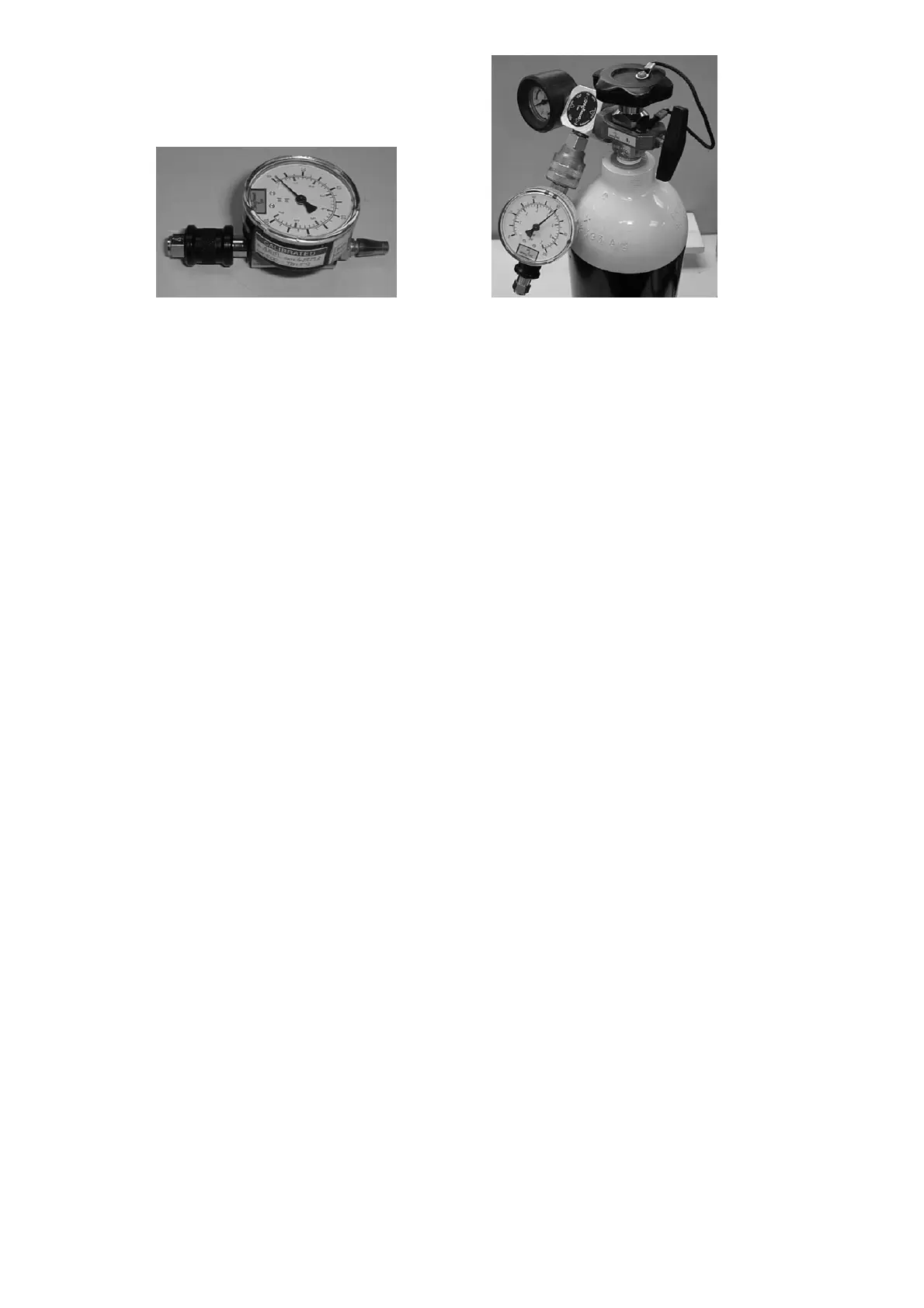
Regulator Test Unit 500-A615



 To Next Page