Setting Up Your Type A’s
The Type A has been carefully optimized to
give best performance when placed on the floor
and close to one wall. The posilion of Ihe
speakers along the wall, the exael distance from
the wall, and the angle of the speaker with
respect to the listener should be the result of
considerable experimental ion. Generally, Ihe
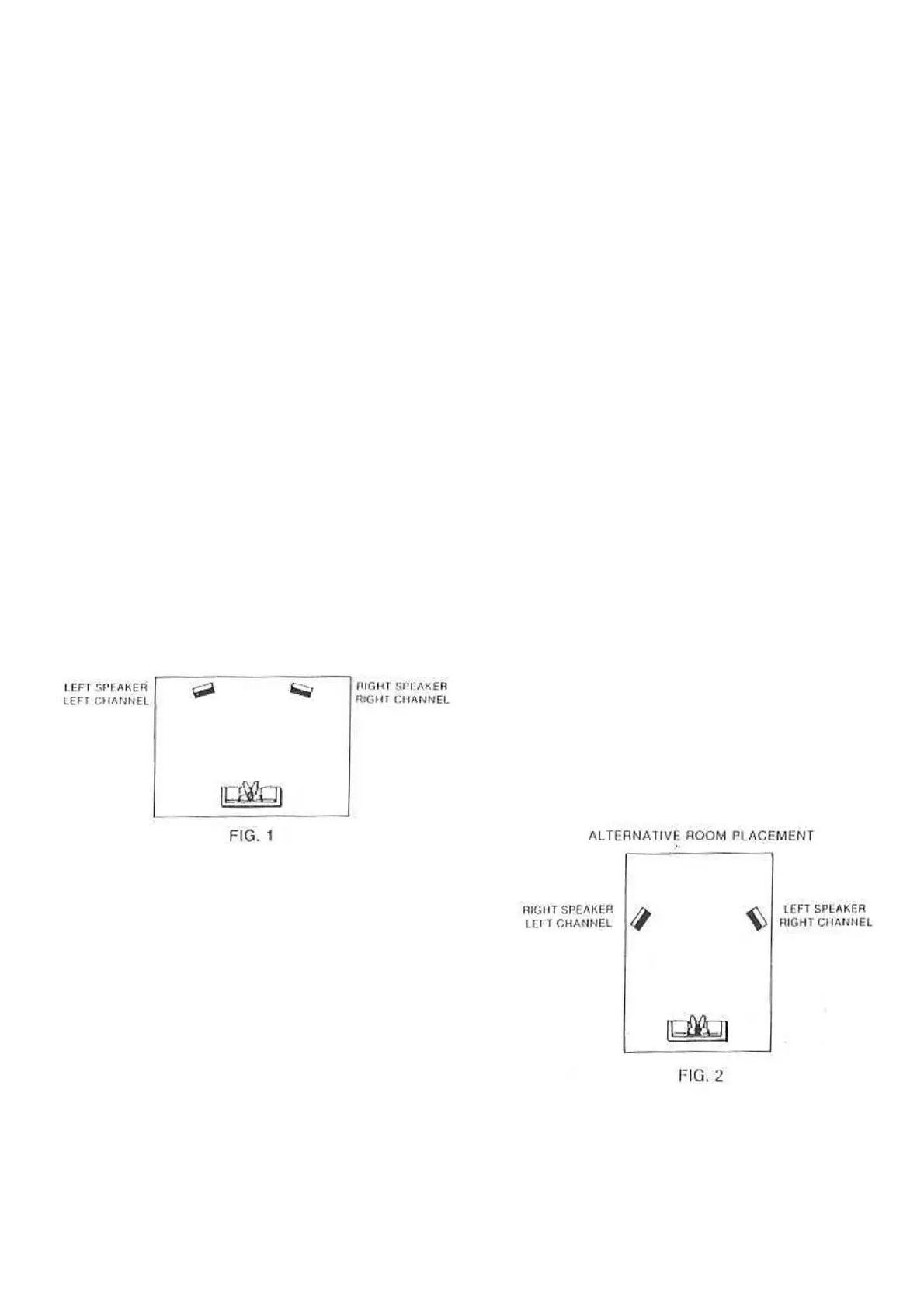
speakers should form the base vertices of an
Isosceles triangle with the listener at the apex.
In most circumstances Ihe sides should be
slightly longer Ilian the base (distance between
speakers). See figure 1. This may not be possible
in some rooms due to the presence of fire
places. hallways, stairwells or furniture. The dis
tance of the speakers from the corners of the
room will have a pronounced el feet on the
smoothness of the bass response, with the most
natural tonal balance normally occurring when
the speakers are at least several leet from the
corners. Placing Ihe speakers closer to the cor
ners will usually produce excessive bass output,
but if your listening room is lacking in bass, this
location may work successfully. If the speakers
are used near corners, aim them somewhat into
the listening area to minimize the possibility of
strong high frequency reflections from the side
walls of the rooms. In this location, bass
response will be considerably smoother il the
rear woofer ports are partially covered. A heavy
block ol wood set directly behind ihe rear ports
is adequate.
TYPICAL ROOM PLACEMENT
The distance of Ihe speaker's lower section
from the rear wall strongly influences the re
sponse through the upper bass and lower mid
range. Moving Ihe speakers closer to the wall
increases Ihe output in this frequency range. If
positioned carefully, normally seven to nine
inches from the wall, the woofer interacts with
the reflected energy off the wall in a manner
which produces exceptionally smooth response.
Once again, experimentation is called for.
Imaging and high frequency balance are
somewhat affooted by the amount of the "toe-
inVBoth suffer if the listening position is more
than 35° off-axis. The ideal amount of toe-in is
also room dependent, since rooms vary in
liveness and brightness. Ten to twenty degrees
off-axis works optimally in many rooms. Alter
natively. placing the speakers parallel to Ihe rear
wall is sometimes effective.
The listening "window" of the Type A is ex
tremely wide, and although best listening will be
attained at the apox of the Imaginary isosceles
triangle, there is a much larger listening area
where the imaging and tonal balance remain
excellent.
One situation which should always be
avoided is the placement of tall objects in front
of or to the sides of Ihe Type A's. This will result
in reflections which will affect imaging and
detail Several feel of free space will amply re
ward the listener with smoother, more accurate
reproduction of complex musical passages.
Note that Ihe speakers are labeled
"lulT'and "right". They are produced in mirror
image pairs, with Ihe left speakers having slight
ly better dispersion towards the right (when fac
ing the loudspeaker) and vice versa. When posi
tioning Ihe speakers along Ihe same wall with
their fronts facing the listener, the "left"
speaker should be to the loll of Ihe "right"
speaker.
The speaker should stand vertically. If Ihe
lloor lilts away from the wall, prop up Ihe fron!
edge of the woofer cabinet until the speaker is
vertical.
The dispersion of Ihe loudspeaker allows for
a placement which would be impossible for most
loudspeakers but works well with the 1'ype A in
certain rooms. The speakers may be placed on
opposite walls, slightly toed-in so I hat Ihe lis
tener is not much more than 25° off axis. See
figure 2. The normal orientation of the left and
right loudspeakers should bo reversed (so that
the left speakci is on the right and vice versa).
The usual cautions about corner placement
should be kepi in mind. Imaging may often be
improved in difficult rooms, but bass perfor
mance may sometimes suffer.
How?
The Type A consists of a bottom section,
containing tfie woofer, an upper section, con
taining the midrange and tweeter, and a jumper
cable connecting the two halves.



 To Next Page
 Loading...