This configuration has several advantages.
Each amplifier is dealing with frequencies in a
restricted range, thus it cannot combine high
and low frequency signals and produce sum and
difference by-products (intermodulation distor
tion. or IM). If very high power Is needed to re
produce the sound of a kickdrum, the demand
for low frequency power will not affect the ability
of the high frequency amplifier to perform nor
mally, whereas il all frequencies were repro
duced by the same amplifier its power supply
might be temporarily depleted, causing dynamic
compression or clipping of the high frequency
material. The advantage is similar to that of the
"dual monaural" amplifier design with totally
separate channels and the elimination of so-
called "dynamic crosstalk".
If one is not fortunate enough to choose an
amplifier without regard for cost, bi-amplification
allows the owner of Type A’s the ability to match
an amplifier to the frequency range (high or low)
il is most comfortable with.
The power requirements of the upper section
are slightly less than that of the lower section
so a higher quality smaller power amplifier may
often be used.
Note, however, that bi-amplification will not
mask the audible effects of a substandard am
plifier; it may even exacerbate the problem. Do
not use amplifiers of widely varying sound
quality. Do not use an amplifier having signifi
cantly less power than would be used if not hi-
amplifying.
Since only low frequencies are being sent
to the lower sections in the bi-amp mode, the
Type A is designed so that the Internal woofer
crossover is bypassed, resulting In closer coup
ling of the amplifier and woofer and increased
damping.
Overall, the improvements from bi-amplifica
tion can bo described as greatly Improved bass
impact, a more "relaxed" and dynamic high end,
and increased openness throughout the audible
frequency range.
How?
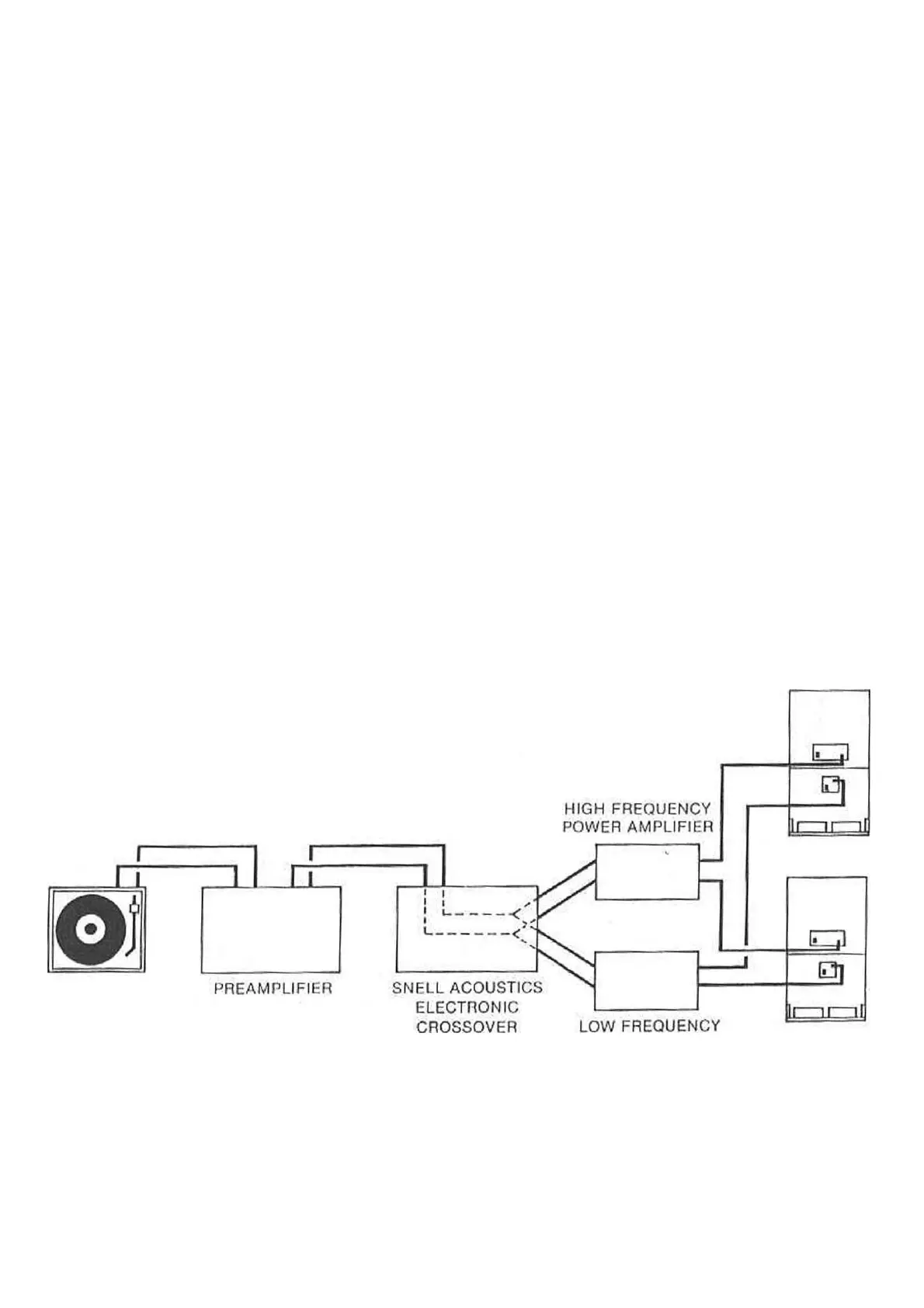
In figure 4 one sees that a Snell Acoustics
Electronic Crossover*, an extra stereo power
amplifier, and additional speaker cables and
"phono" cables are needed for bi-amplification.
If at all possible, we would suggest that the
dealer from whom you purchased the loud
speakers should do the initial set-up. If not. a
signal generator, also known as an audio oscil
lator, and a VOM may be needed for set-up.
SYSTEM WIRING FOR BI-AMPLIFICATION
POWER AMPLIFIER
FIG. 4
*Thn electronic crossover
must
have the appropriate cross
over characteristics, otherwise the sound will nut be opti
mum and damage tu tiro speaker may occur.



 To Next Page
 Loading...