Using the chainsaw
ENGLISH 16
Felling:
Felling trees is dangerous and requires training. If
you are a novice then you must not fell any trees.
You can attend a training course to learn how to fell
trees.
Before felling a tree, make sure that:
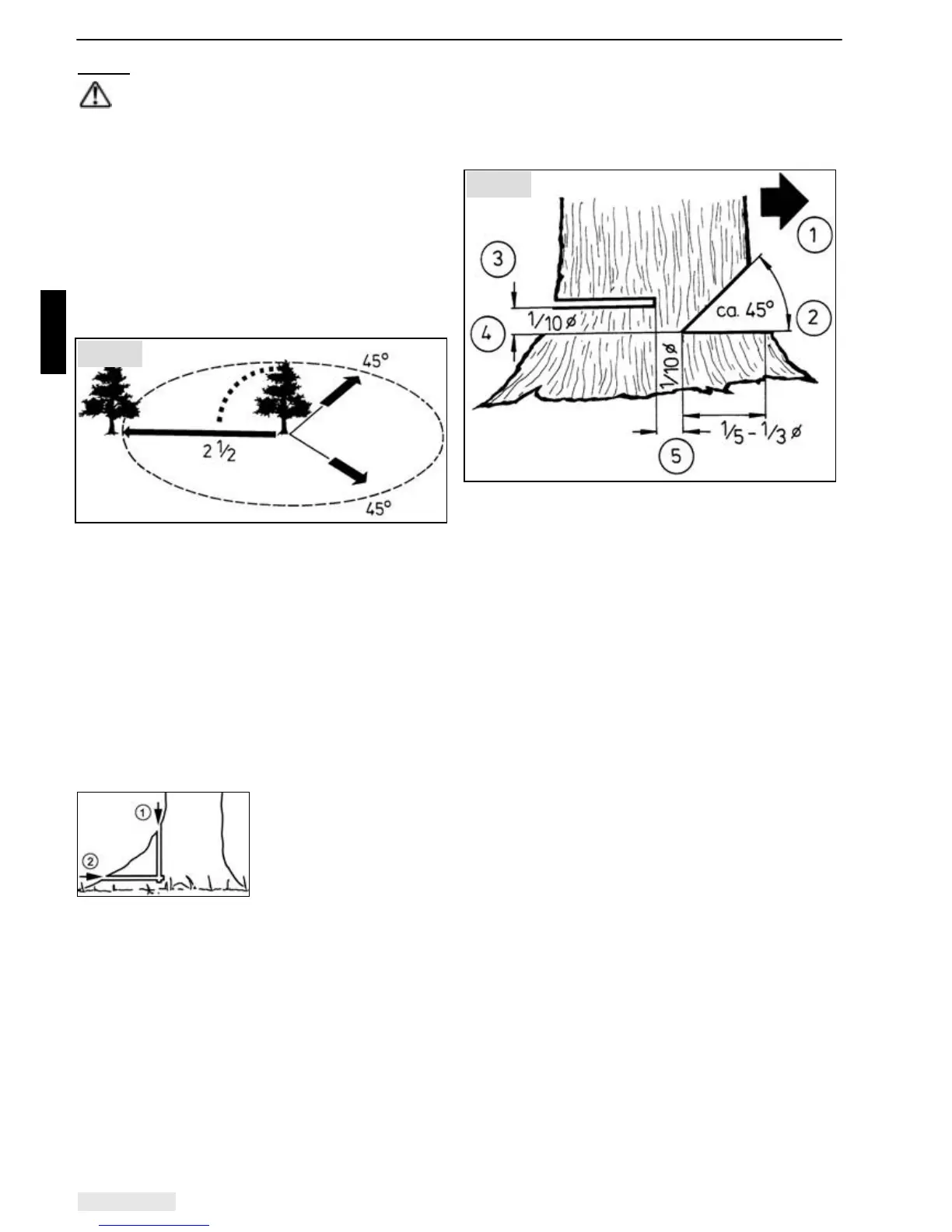
• No persons other than those involved in the felling of
the tree are in the felling area.
• Everybody involved in the felling has an
unobstructed path of escape. The path of escape
should be opposite to the planned direction of the
fall of the tree at an angle of around 45°.
• The nearest working area should be at least 2½ tree
lengths away.
Before felling a tree you need to carefully check the
direction of fall and make sure that no persons, animals
or objects are within 2½ tree lengths.
Then consider the general condition of the tree:
Hanging direction – loose or dry branches – height of
the tree – natural overhang – is the tree diseased?
You also need to take into account the wind speed and
wind direction. Do not fell a tree under heavy, gusting
winds.
The foot of the trunk must be free of all foreign objects,
roots, undergrowth and branches.
Ensure that you have a secure footing and remove any
objects which could cause you to trip.
Cutting into the buttress roots:
Start with the largest
buttress root first.
Make a vertical cut into the
root
", followed by a
horizontal cut
#.
Never cut into diseased trunks before felling them.
Note: Leave the buttress root intact as a wedge on the
side opposite the direction of fall.
Making the felling notch:
The felling notch determines the direction in which the
tree falls and helps to control the fall. It is made
perpendicular to the fall direction with a cut through 1/5 -
1/3 of the trunk diameter. The cut should preferably be
made close to the ground.
" Start with the upper cut (roof of the felling notch).
# Then make the lower cut (bottom of the felling
notch). The lower cut should meet the upper cut
precisely.
Check the direction of fall.
If the felling notch needs to be corrected, always re-
cut it across the full width. In exceptional cases it is
also possible to slope the lower cut upwards to
obtain a more open felling notch. If the tree is
situated on a slope this gives longer control over the
fall.
$ The felling cut is made higher % than the bottom of
the felling notch #. This cut must be exactly
horizontal. In front of the felling notch around 1/10 of
the trunk diameter needs to be left as a hinge &.
& The hinge must not be cut through, as this could
result in loss of control over the fall of the tree.
Wedges need to be positioned in good time. The felling
cut must only be secured with plastic or aluminium
wedges, and steel wedges must never be used.
During felling, always keep to the side of the tree.
When walking back after the felling cut has been made,
watch out for falling branches.
When working on a slope, the operator of the saw
should stand above or to the side of the trunk or tree
being worked on.
Stand back when the tree falls. Observe the crown of
the tree.
Wait for the crown to swing out.
Do not continue work under branches or trees which
have become caught.
After work ! slacken the chain tension
Fig. 14
Fig. 15



 To Next Page