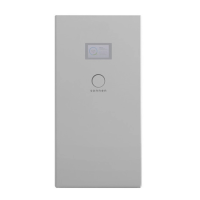
The sonnenBatterie ecoLinx is an intelligent AC-coupled energy storage system designed for residential and commercial applications. It monitors and controls energy production, consumption, and storage within a building, working with existing or newly installed PV systems. The system connects to the same distribution panel as the solar inverter, but solar modules do not connect directly to the sonnenBatterie.
Function Description
The ecoLinx utilizes two power meters to monitor solar power production and energy consumption. When solar production exceeds consumption (e.g., at midday), excess energy is stored in its lithium iron phosphate (LiFePO4) battery modules. Conversely, when consumption is higher than production (e.g., in the evening), the system releases stored energy to power loads. This intelligent management allows users to maximize solar self-consumption, reduce electricity bills, and increase energy independence.
The system offers three primary operating modes:
- Self-consumption mode: Prioritizes the use of self-generated power, even when utility grid power is available, to reduce reliance on the grid.
- Backup mode: In the event of a utility grid failure, the ecoLinx automatically isolates the microgrid from the utility grid using a 200A automatic transfer switch. It then provides grid-quality voltage and frequency, allowing grid-tied PV inverters within the microgrid to continue operating. Excess PV energy charges the batteries, and if PV is insufficient, the storage unit discharges to meet demand. To prevent overcharging in backup mode, the system performs a frequency shift to 60.9 Hz when the state of charge reaches 95%, causing PV inverters to disconnect. It reduces frequency back to 60 Hz when the state of charge drops to 89%, allowing PV inverters to reconnect after a 5-minute countdown.
- Time of Use (ToU) mode: Designed for utility billing schemes where electricity costs vary by time of day. The ecoLinx maximizes cost savings by discharging stored battery power during high-cost periods and recharging from solar or optionally from the grid at the lowest offered rates. If ToU is enabled, the system only discharges during high-tariff times and charges its batteries during the rest of the day.
The sonnenBatterie ecoLinx also features Generator Autostart functionality. It can provide a start signal for a generator if the battery modules reach a low state of charge, the grid is unavailable, and the PV system is not producing power. The generator will run until the batteries reach a pre-configured state of charge, the grid becomes available, or the PV system starts producing power.
Important Technical Specifications
The ecoLinx is available in models ranging from 10 kWh to 20 kWh usable capacity (100% DOD).
- Continuous Power Output (at 25°C): 7 kW for 10 kWh model, 8 kW for 12-20 kWh models.
- Nominal AC Current: 29.16 amps (10 kWh), 33.33 amps (12-20 kWh).
- Dimensions (W/H/D): Approximately 26" x 84" x 16" for all models.
- Weight (approx.): Ranges from 622 lbs (10 kWh) to 900 lbs (20 kWh).
- Nominal Current: 33.3A.
- Cell Chemistry: Lithium iron phosphate (LiFePO₄).
- Nominal Voltage: 120/240VAC.
- Device Protection: Short circuit, overload, over temperature.
- Ambient Temperature Range: 41°F - 113°F (5°C - 45°C).
- Maximum Humidity: 90%, non-condensing.
- Grid Integration: AC coupled.
- On-grid Nominal Power: 7kW (10 kWh), 8kW (12-20 kWh).
- Grid-outage Max Power: 100 ms - 17KVA, 5s - 12KVA, 30m - 9KVA.
- Overcurrent Protection Needed: 50A.
- Transfer Switch: Automatic, integrated, with a transfer time of < 100 ms.
- Backup Capacity: 2 kilowatt-hours per battery module, up to 20 kilowatt-hours.
- Certifications: Certified to UL 9540 Standards. UL certified components: Battery modules – UL1973; Inverter – UL1741; ATS – UL1008; AC Breaker – UL489.
- Warranty: 15 years or 15,000 cycle warranty on inverter, battery modules, cabinet, and components.
- Inverter Efficiency: 92.5% CEC weighted, 95.0% peak.
- Roundtrip Efficiency (Grid <> Battery): >= 86%.
- Communication Ports: Serial, Ethernet.
- Communication Protocols: Modbus.
- Communication and Control Standards: Control4 and Crestron Drivers Included.
- EMC / EMI Protection: FCC Part 15B.
- Total Harmonic Distortion: <5% L1-L2, <2% L-N.
- Cooling Method: Forced air.
- Noise Emission: < 35dBA.
- AC Input Rated Current: Pass through: 200 amps @ 240VAC; Power plant: 33.33 amps @ 240VAC.
- AC Output Voltage: 120/240 volts.
- AC Grid Voltage: 120/240 volts.
- Nominal Frequency: 60 Hz.
- Adjustable Frequency Range: +/- 0.7 Hz from nominal.
- Metering Capability: Power meter for load and PV production; +/- 0.5 RDG (current/voltage).
- Tare Losses (W): 60 watts.
- Transient Protection: IEEE C62.41 Class B.
- Transfer Switch Current Rating: 200 amps switching and overcurrent protection.
- Transfer Switch Voltage Rating: 120/240 VAC.
- Transfer Switch Contacts: Silver-plated.
- Transfer Switch Fault Current @ 240VAC: 22,000 amps.
- Battery Voltage: 48-56 VDC.
- Charge Current: 30A per module nominal, 70A per module max.
- Cell Discharge: 100% DoD.
- Overcharge Protection: Fuse protection.
Usage Features
- Installation: Requires a trained, electrically qualified person. Specific clearance requirements (3 ft front, 1 ft side, 3 ft top) must be met. The system is heavy and requires two people for mounting. Battery modules are installed after the cabinet is mounted, and are top-heavy until installed.
- Commissioning: Performed via the storage system's internal web server, requiring an Internet connection. The commissioning assistant guides the installer through steps including system identification, login, system updates, location settings, date/time verification, PV system information input, generator autostart information (if applicable), Time of Use settings, and meter configuration.
- Operating Modes: Easily selectable via the commissioning assistant, allowing users to choose between Manual, Backup power, Self-consumption, or Time of Use modes based on their energy needs and utility tariffs.
- Internet Portal: Provides real-time and historical data about the storage system via a web browser (https://my.sonnen-batterie.com/) and smartphone app. Internet access is a condition of warranty coverage.
- Emergency Shutoff: The system can be switched off by the main circuit breaker F1 or an external emergency switch (if installed). For non-emergencies, a proper shutdown procedure via the touchscreen is recommended to prevent damage.
Maintenance Features
To ensure failure-free operation, safety, reliability, and longevity, periodic cleaning and function control are required.
- Function Control (Every two weeks): Check the screen for any messages.
- Care of the Storage System:
- Cleaning the screen: Use a damp cloth with a small amount of dish liquid.
- Cleaning the enclosure: Use a soft, damp cloth for the exterior. Do not clean the interior.
- Checking the Storage Unit (Monthly): Inspect the area around the unit for safety hazards, debris, and chemical vapors that could degrade electrical insulation.
- Checking the Storage Unit (Annually - Trained, electrically qualified person only):
- Wear personal protective equipment (safety glasses, insulated gloves, steel-toe shoes).
- Turn off the main AC disconnect and DC breaker.
- Open the cabinet and remove orange safety plugs from battery modules (these are voltage sources when inserted).
- Check for and tighten any loose electrical connections, looking for cracked, blistered, or discolored insulation.
- Check for pitting or cracking on contactors.
- Check for and tighten any loose mechanical connections.
- Use a multimeter with a continuity test function to ensure the AC breaker opens and closes correctly.
- Storage and Transport:
- Storing the system: Store in an ambient temperature range of 41°F - 113°F (5°C - 45°C), max 90% humidity, properly ventilated, up to 9,842 feet (3,000 meters) above sea level, free of dust, corrosive/explosive gases, and vibrations. Battery modules must be charged to at least 85% before storage and recharged every six months to prevent deep discharge. Orange safety plugs must be removed during storage.
- Transporting the system: Observe the same environmental conditions as storage. Lithium-ion battery modules are hazardous materials (Class 9, UN3480, 60 lb/27 kg) and must be transported according to national and international regulations.
- Damage Detection in Transit: Inspect for open damages immediately upon receipt and concealed damages within the carrier's time limits.
- Battery Module Information: Battery modules have a rated voltage of 51.2 VDC (protective extra-low voltage) and contain no metallic lithium.
- Recycling: The system complies with RoHS and is free of lead, cadmium, mercury, hexavalent chromium, polybrominated biphenyl (PBB), and polybrominated diphenyl ether (PBDE). Do not dispose of the system or battery modules with household refuse; contact service or Call2Recycle for proper disassembly and disposal.

 Need help?

 To Next Page
 General