AR-B1474 User¡¦s Guide
3-6
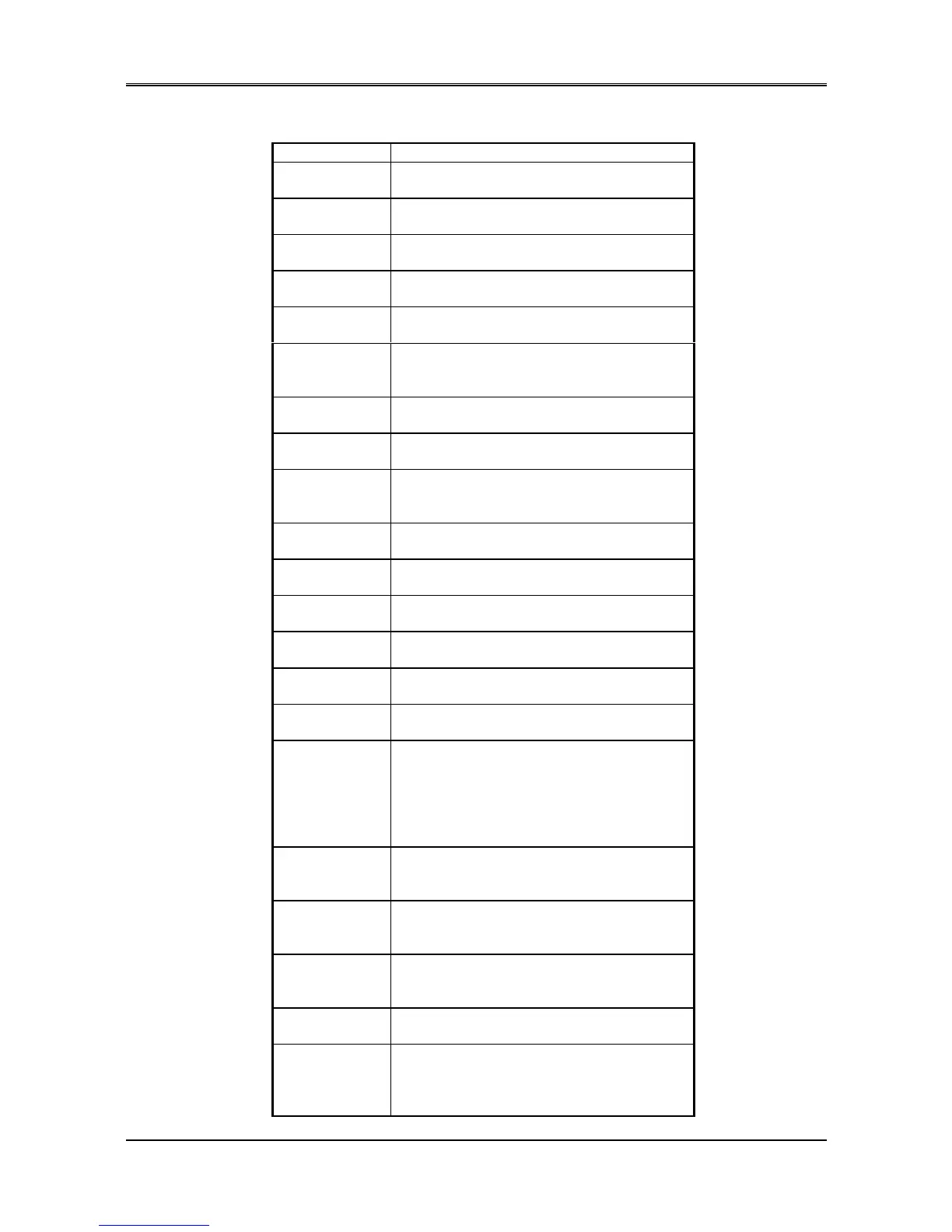
(3) PC/104 ISA Bus Signal Description
Name Description
BUSCLK [Output] The BUSCLK signal of the I/O channel is asynchronous
to the CPU clock.
RSTDRV [Output] This signal goes high during power-up, low line-voltage or
hardware reset
SA0 - SA19
[Input / Output]
The System Address lines run from bit 0 to 19. They are
latched onto the falling edge of "BALE"
LA17 - LA23
[Input/Output]
The Unlatched Address line run from bit 17 to 23
SD0 - SD15
[Input/Output]
System Data bit 0 to 15
BALE [Output] The Buffered Address Latch Enable is used to latch SA0
– SA19 onto the falling edge. This signal is forced high
during DMA cycles
-IOCHCK [Input] The I/O Channel Check is an active low signal which
indicates that a parity error exist on the I/O board
IOCHRDY
[Input, Open collector]
This signal lengthens the I/O, or memory read/write cycle,
and should be held low with a valid address
IRQ 3-7, 9-12, 14, 15
[Input]
The Interrupt Request signal indicates I/O service request
attention. They are prioritized in the following sequence :
(Highest) IRQ 9, 10, 11, 12, 13, 15, 3, 4, 5, 6, 7 (Lowest)
-IOR
[Input/Output]
The I/O Read signal is an active low signal which
instructs the I/O device to drive its data onto the data bus
-IOW [Input/Output] The I/O write signal is an active low signal which instructs
the I/O device to read data from the data bus
-SMEMR [Output] The System Memory Read is low while any of the low
1mega bytes of memory are being used
-MEMR
[Input/Output]
The Memory Read signal is low while any memory
location is being read
-SMEMW [Output] The System Memory Write is low while any of the low
1mega bytes of memory is being written
-MEMW
[Input/Output]
The Memory Write signal is low while any memory
location is being written
DRQ 0-3, 5-7 [Input] DMA Request channels 0 to 3 are for 8-bit data transfers.
DMA Request channels 5 to 7 are for 16-bit data
transfers. DMA request should be held high until the
corresponding DMA has been completed. DMA request
priority is in the following sequence:(Highest) DRQ 0, 1,
2, 3, 5, 6, 7 (Lowest)
-DACK 0-3, 5-7
[Output]
The DMA Acknowledges 0 to 3, 5 to 7 are the
corresponding acknowledge signals for DRQ 0 to 3 and 5
to 7
AEN [output] The DMA Address Enable is high when the DMA
controller is driving the address bus. It is low when the
CPU is driving the address bus
-REFRESH
[Input/Output]
This signal is used to indicate a memory refresh cycle
and can be driven by the microprocessor on the I/O
channel
TC [Output] Terminal Count provides a pulse when the terminal count
for any DMA channel is reached
SBHE [Input/Output] The System Bus High Enable indicates the high byte SD8
- SD15 on the data bus



 To Next Page