EasyManua.ls Logo

Sony ICF-SW1 - Page 10

Sony ICF-SW1
28 pages
Print Icon
To Next Page IconTo Next Page
To Previous Page IconTo Previous Page
Loading...
ICF-SW1
AN-101
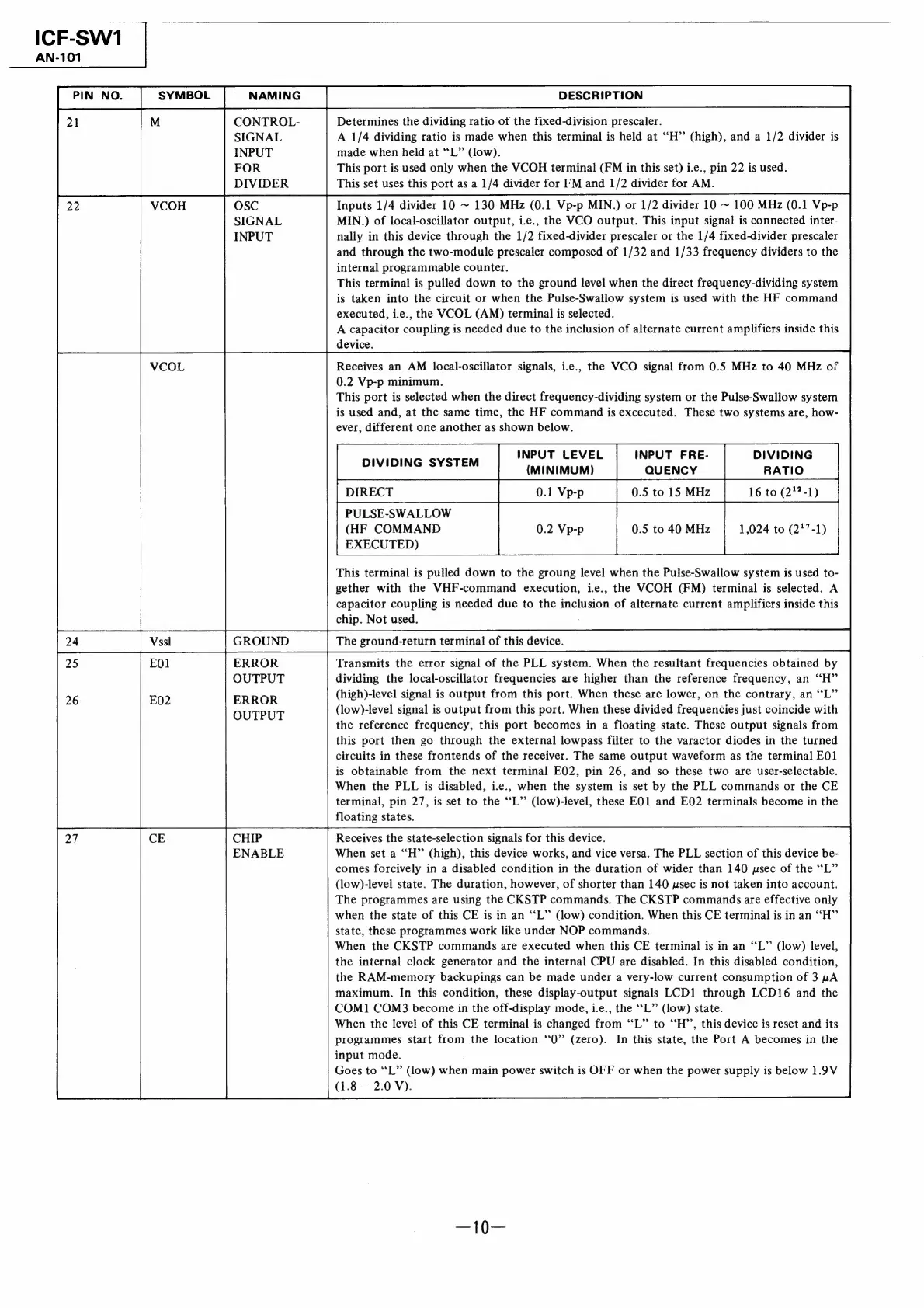
CONTROL-
SIGNAL
INPUT
FOR
DIVIDER
OSC
SIGNAL
INPUT
GROUND
ERROR
OUTPUT
ERROR
OUTPUT
Determines
the
dividing
ratio
of
the
fixed-division
prescaler.
A
1/4
dividing
ratio
is
made
when
this
terminal
is
held
at
“H”
(high),
and
a
1/2
divider
is
made
when
held
at
“L”
(low).
This
port
is
used
only
when
the
VCOH
terminal
(FM
in
this
set)
i.e.,
pin
22
is
used.
This
set
uses
this
port
as
a
1/4
divider
for
FM
and
1/2
divider
for
AM.
Inputs
1/4
divider
10
~
130
MHz
(0.1
Vp-p
MIN.)
or
1/2
divider
10
~
100
MHz
(0.1
Vp-p
MIN.)
of
local-oscillator
output,
i.¢.,
the
VCO
output.
This
input
signal
is
connected
inter-
nally
in
this
device
through
the
1/2
fixed-divider
prescaler
or
the
1/4
fixed-divider
prescaler
and
through
the
two-module
prescaler
composed
of
1/32
and
1/33
frequency
dividers
to
the
internal
programmable
counter.
This
terminal
is
pulled
down
to
the
ground
level
when
the
direct
frequency-dividing
system
is
taken
into
the
circuit
or
when
the
Pulse-Swallow
system
is
used
with
the
HF
command
executed,
i.e.,
the
VCOL
(AM)
terminal
is
selected.
A
capacitor
coupling
is
needed
due
to
the
inclusion
of
alternate
current
amplifiers
inside
this
device.
Receives
an
AM
local-oscillator
signals,
i.e.,
the
VCO
signal
from
0.5
MHz
to
40
MHz
of
0.2
Vp-p
minimum.
This
port
is
selected
when
the
direct
frequency-dividing
system
or
the
Pulse-Swallow
system
is
used
and,
at
the
same
time,
the
HF
command
is
excecuted.
These
two
systems
are,
how-
ever,
different
one
another
as
shown
below.
INPUT
LEVEL
INPUT
FRE-
DIVIDING
DIVIDING
SYSTEM
(MINIMUM)
QUENCY
RATIO
|DIRECT
0.1
Vp-p
0.5
to
15
MHz
16
to
(217-1)
PULSE-SWALLOW
(HF
COMMAND
0.2
Vp-p
0.5
to
40
MHz
1,024
to
(2'7-1)
EXECUTED)
This
terminal
is
pulled
down
to
the
groung
level
when
the
Pulse-Swallow
system
is
used
to-
gether
with
the
VHF-command
execution,
i.e.,
the
VCOH
(FM)
terminal
is
selected.
A
capacitor
coupling
is
needed
due
to
the
inclusion
of
alternate
current
amplifiers
inside
this
chip.
Not
used.
The
ground-return
terminal
of
this
device.
Transmits
the
error
signal
of
the
PLL
system.
When
the
resultant
frequencies
obtained
by
dividing
the
local-oscillator
frequencies
are
higher
than
the
reference
frequency,
an
“‘H”
(high)-level
signal
is
output
from
this
port.
When
these
are
lower,
on
the
contrary,
an
““L”
(low)-level
signal
is
output
from
this
port.
When
these
divided
frequencies
just
coincide
with
the
reference
frequency,
this
port
becomes
in
a
floating
state.
These
output
signals
from
this
port
then
go
through
the
external
lowpass
filter
to
the
varactor
diodes
in
the
turned
circuits
in
these
frontends
of
the
receiver.
The
same
output
waveform
as
the
terminal
E01
is
obtainable
from
the
next
terminal
E02,
pin
26,
and
so
these
two
are
user-selectable.
When
the
PLL
is
disabled,
i.e.,
when
the
system
is
set
by
the
PLL
commands
or
the
CE
terminal,
pin
27,
is
set
to
the
“‘L”’
(low)-level,
these
EO1
and
EQ2
terminals
become
in
the
floating
states.
CHIP
ENABLE
Receives
the
state-selection
signals
for
this
device.
When
set
a
“H”
(high),
this
device
works,
and
vice
versa.
The
PLL
section
of
this
device
be-
comes
forcively
in
a
disabled
condition
in
the
duration
of
wider
than
140
wsec
of
the
“L”
(low)-level
state.
The
duration,
however,
of
shorter
than
140
usec
is
not
taken
into
account.
The
programmes
are
using
the
CKSTP
commands.
The
CKSTP
commands
are
effective
only
when
the
state
of
this
CE
is
in
an
“‘L”’
(low)
condition.
When
this
CE
terminal
is
in
an
‘‘H”’
state,
these
programmes
work
like
under
NOP
commands.
When
the
CKSTP
commands
are
executed
when
this
CE
terminal
is
in
an
“‘L’’
(low)
level,
the
internal
clock
generator
and
the
internal
CPU
are
disabled.
In
this
disabled
condition,
the
RAM-memory
backupings
can
be
made
under
a
very-low
current
consumption
of
3
uA
maximum.
In
this
condition,
these
display-output
signals
LCD1
through
LCD16
and
the
COM1
COM3
become
in
the
off-display
mode,
i.e.,
the
‘““L”
(low)
state.
When
the
level
of
this
CE
terminal
is
changed
from
‘“‘L”
to
‘‘H’’,
this
device
is
reset
and
its
programmes
start
from
the
location
“0”
(zero).
In
this
state,
the
Port
A
becomes
in
the
input
mode.
Goes
to
“L”’
(low)
when
main
power
switch
is
OFF
or
when
the
power
supply
is
below
1.9V
(1.8
2.0
V).

Related product manuals