EasyManua.ls Logo

Sony PS-X7 - Page 34

Sony PS-X7
39 pages
Print Icon
To Next Page IconTo Next Page
To Previous Page IconTo Previous Page
Loading...
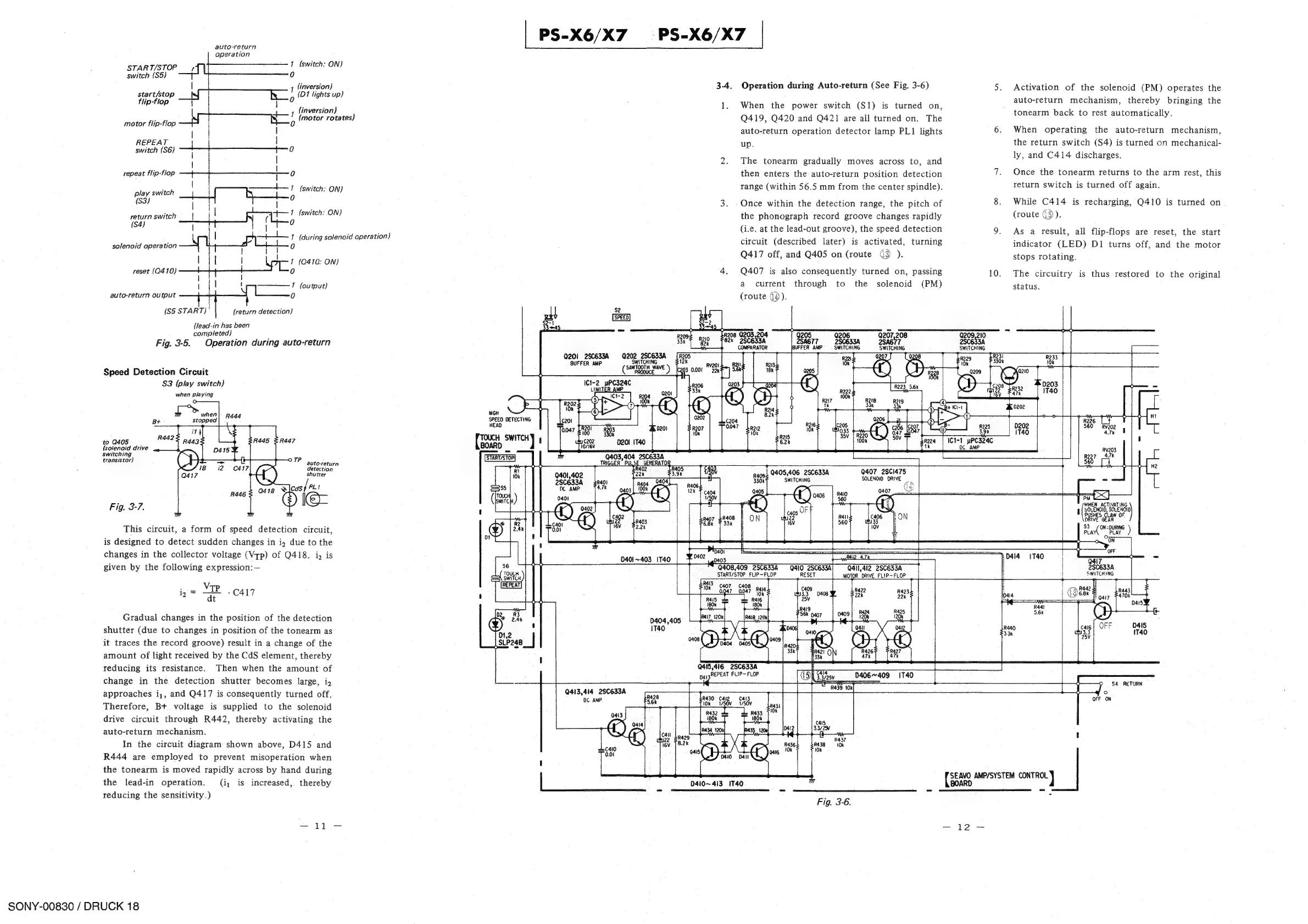
aute-return
operation
START/STOP
t
1
(switch:
ON)
switch
(S5)
0
|
1
(inversion)
start/stop
(D1
lights
up)
flip-flop
NN
|
Ro
(inversion)
:
N
ae
(motor
rotates)
motor
flip-flop
}
le
i
REPEAT
|
|
switch
(S6)
0
repeat
flip-flop
oo
ee
2
——
itch:
play
switch
oer
ae
a
(switch:
ON)
return
switch
|
|
"
-+-—
1
(switch:
ON)
(S4)
it
|
0
|
+t
1
(during
solenoid
operation)
solenoid
operation
|
i
0
|
|
|
|
h—1
(0410:
ON)
reset
(Q410)
7
0
I
|
!
7
(output)
:
0)
auto-return
ou
tput
.
(S5
START)
|
(lead-in
has
been
completed)
Operation
during
auto-return
(return
detection)
Fig.
3-5.
Speed
Detection
Circuit
S3
(play
switch)
when
playing
to
Q405
(solenoid
drive
switching
transistor)
P
suto-return
detection
Shutter
aarg
Scasy
PL!
Fig.
3-7.
This
circuit,
a
form
of
speed
detection
circuit,
is
designed
to
detect
sudden
changes
in
i,
due
to
the
changes
in
the
collector
voltage
(Vrp)
of
Q418.
i,
is
given
by
the
following
expression:—
i,
=
“2
-
C417
Gradual
changes
in
the
position
of
the
detection
shutter
(due
to
changes
in
position
of
the
tonearm
as
it
traces
the
record
groove)
result
in
a
change
of
the
amount
of
light
received
by
the
CdS
element,
thereby
reducing
its
resistance.
Then
when
the
amount
of
change
in
the
detection
shutter
becomes
large,
i,
approaches
i,,
and
Q417
is
consequently
turned
off.
Therefore,
B+
voltage
is
supplied
to
the
solenoid
drive
circuit
through
R442,
thereby
activating
the
auto-return
mechanism.
In
the
circuit
diagram
shown
above,
D415
and
R444
are
employed
to
prevent
misoperation
when
the
tonearm
is
moved
rapidly
across
by
hand
during
the
lead-in
operation.
(i,
is
increased,
thereby
reducing
the
sensitivity.)
SONY-00830
/
DRUCK
18
|
PS-X6/X7
PS-X6/X7
|
ust
Ee
3-4.
Operation
during
Auto-return
(See
Fig.
3-6)
5.
1.
When
the
power
switch
(S1)
is
turned
on,
Q419,
Q420
and
Q421
are
all
turned
on.
The
auto-return
operation
detector
lamp
PL1
lights
6.
up.
2.
The
tonearm
gradually
moves
across
to,
and
then
enters
the
auto-return
position
detection
7.
range
(within
56.5
mm
from
the
center
spindle).
3.
Once
within
the
detection
range,
the
pitch
of
8.
the
phonograph
record
groove
changes
rapidly
(i.e.
at
the
lead-out
groove),
the
speed
detection
9.
circuit
(described
later)
is
activated,
turning
Q417
off,
and
Q405
on
(route
G3
).
4.
Q407
is
also
consequently
turned
on,
passing
10.
a
current
through
to
the
solenoid
(PM)
(route
@).
Activation
of
the
solenoid
(PM)
operates
the
auto-return
mechanism,
thereby
bringing
the
tonearm
back
to
rest
automatically.
When
operating
the
auto-return
mechanism,
the
return
switch
(S4)
is
turned
on
mechanical-
ly,
and
C414
discharges.
Once
the
tonearm
returns
to
the
arm
rest,
this
return
switch
is
turned
off
again.
While
C414
is
recharging,
Q410
is
turned
on
(route
@)).
As
a
result,
all
flip-flops
are
reset,
the
start
indicator
(LED)
D1
turns
off,
and
the
motor
stops
rotating.
The
circuitry
is
thus
restored
to
the
original
status.
mG
Se
o
209
deze
20
9208,204
|
9205
9206
$207,208
paints
Eeeareasl
eter
fa
SWITCHING
SWITCHING
SWITCHING
Q201
2SC633A
ie
BUFFER
AMP
(sawTooTH
fave
)
ICi-2_
pPC324C
u
MGH
SPEEO
DETECTING
HEAD
[ree
SWITCH)
4
[START/STOP]
TOF
9403,4
404
2SC633A
SARIS
TO
TRIGGER
PULSE
GENERATOR
RI
4
10k
S355
TOUCE
IswiTc|
fol
ut)
&
i,
@)
'
01,2
|
SLP24B
0401~403
IT40
404,405
1T40
413,414
2SC633A
OC
AMP
‘0401
=
meres
|
eran
AES
AEE
SOREL
URE
REE
SITE)
Q408,409
2SC633A
=
Q410_
2SC
6334
Q411,412
2SC633A
START/STOP
FLIP-FLOP
RESET
MOTOR
ORIVE
FLIP-FLOP
3
cao,
cag
Q415,416
2SC633A
REPEAT
FLIP-FLOP
R430
C412
10k
0410~
413
1T40
paogs
0405,406
2SC633A
Q407
28CI475
330k
SWITCHING
SOLENOID
ORIVE
Rata
ooa7
RAN
_0406~409
1T40
C4i3
V/S50V__1/50V
A,
SS
PM
WHEN.
ACTIVATING
{
SOLENOID,
SOLENOIO
BE
CLAW
OF
ON:
tik
Bua
on
1T40
aN
Q4I7
2SC633A
SWITCHING
R442
¥
eer
8k
©
$4
RETURN
°
OFF
ON

Other manuals for Sony PS-X7

Related product manuals