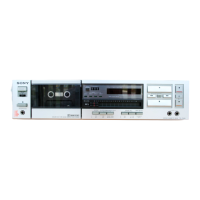
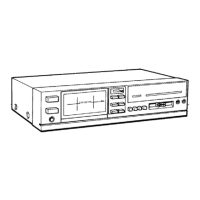
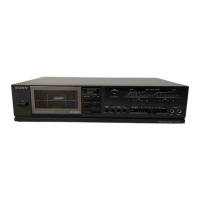
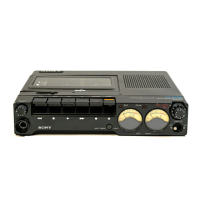
This document describes the Sony TC-FX600 Stereo Cassette Deck, a device designed for high-fidelity audio recording and playback using compact cassettes.
Function Description
The TC-FX600 is a stereo cassette deck that employs a newly-developed B-Type Dolby NR system, which significantly reduces tape noise, particularly in the high-frequency range, and also incorporates an anti-saturation network to improve high-frequency dynamic range. It features a newly-developed LA (Laser Amorphous) head for recording and playback, crafted from a special amorphous magnetic alloy developed by Sony, and its cores are solidly welded. This new head design provides a wider dynamic range and a more extended frequency response, especially in the high-frequency range, allowing for full advantage of the metal tape's potential.
The deck includes a digital linear counter and an automatic music sensor (AMS) system. The AMS allows users to quickly locate and play back specific tracks on a tape by detecting silent intervals between songs. The AMS also features a memory function, enabling the user to designate a specific location on the tape for repeated playback or to stop the tape after a particular number of selections.
For control, the unit features a power switch, eject button, timer switch, headphones jack, MIC jack, function buttons (including play, record, fast-forward, rewind, stop, and pause), REC LEVEL (recording level) controls, and a TAPE select button with an indicator for different tape types.
Important Technical Specifications
- Recording System: Compact Cassette Stereo
- Bias Frequency: 105 kHz
- Head: Erase head x 1 (F & F head), Record/playback head x 1 (LA head)
- Motor: Reel motor x 1 (DC motor), Capstan motor (DC servo motor)
- Wow and Flutter: ± 0.06% W. Peak, 0.04% W. RMS (NAB), 0.04% W. RMS (DIN)
- Fast-forward and Rewind Time: Approximately 90 seconds (with C-60 cassette)
- Frequency Response (DOLBY NR OFF):
- With TYPE IV cassette (Sony METALLIC): 30-17,000 Hz ±3 dB, 30-13,000 Hz (±3 dB, 0 VU recording), 20-19,000 Hz
- With TYPE III cassette (Sony DUAD): 30-17,000 Hz ±3 dB (NAB), 30-17,000 Hz ±3 dB (DIN), 20-19,000 Hz
- With TYPE II cassette (Sony UCX): 30-16,000 Hz ±3 dB (NAB), 30-16,000 Hz ±3 dB (DIN), 20-18,000 Hz
- With TYPE I cassette (Sony BHF): 30-15,000 Hz ±3 dB (NAB), 30-15,000 Hz ±3 dB (DIN), 20-17,000 Hz
- Signal-to-noise ratio (NAB, at peak level):
- DOLBY NR switch OFF:
- Type IV (Sony METALLIC): 59 dB
- Type III (Sony DUAD): 59 dB
- Type II (Sony UCX): 58 dB
- Type I (Sony BHF): 54 dB
- B-TYPE-ON:
- Type IV (Sony METALLIC): 66 dB
- Type III (Sony DUAD): 66 dB
- Type II (Sony UCX): 65 dB
- Type I (Sony BHF): 61 dB
- C-TYPE-ON:
- Type IV (Sony METALLIC): 72 dB
- Type III (Sony DUAD): 73 dB
- Type II (Sony UCX): 71 dB
- Type I (Sony BHF): 67 dB
- Total Harmonic Distortion: 1.0% (Sony DUAD and METALLIC)
- Inputs:
- Microphone input (phone jacks): Sensitivity 0.25 mV, for a low-impedance microphone
- Line input (phono jacks): Sensitivity 77.5 mV (50 kΩ)
- Outputs:
- Line outputs (phono jacks): Output level 0.43 V at load impedance 50 kΩ
- Headphone output: Output level 0.43 mW at load impedance 32 Ω
- Power Requirements:
- US/Canadian model: AC 120 V, 60 Hz
- AEP model: AC 240 V, 50 Hz
- UK model: AC 240 V, 50 Hz
- E model: AC 110, 120, 220, 240 V, 50/60 Hz
- Power Consumption: AC 26 W
- Dimensions: Approximately 430(w) x 105(h) x 275(d) mm (16 7/8(w) x 4 1/4(h) x 10 7/8(d) inches) including projecting parts and controls
- Weight: Approximately 5.5 kg (12 lbs 3 oz)
- Tape Transport Mechanism: TCM-110V13
Usage Features
- Dolby NR C-Type Noise Reduction System: In addition to the conventional B-Type Dolby NR system, the TC-FX600 employs the newly-developed C-Type Dolby NR system, which reduces tape noise twice as effectively as the B-Type system. The C-Type system also incorporates an anti-saturation network to improve the high-frequency dynamic range by 4 dB at 10 kHz.
- Newly-developed LA (Laser Amorphous) Head: This head provides a wider dynamic range and a more extended frequency response, especially in the high-frequency range, allowing for full advantage of the metal tape's potential.
- Digital Linear Counter: This counter indicates the recording or playback time elapsed on the tape so that the tape can be precisely indexed. While conventional displays can only indicate the elapsed recording time, this display can indicate with a minus sign how much recording time remains.
- Tape Programming Functions (AMS): The AMS (Automatic Music Sensor), Memory, Repeat, and Ending Control functions allow you to program the tape deck operation as you desire.
- AMS: For locating the beginning of a selection on the tape.
- Memory: For easily locating any point on the tape.
- Repeat: For repeating any selection any number of times.
- Ending Control: For stopping the tape after playing a particular number of selections.
- Full-logic "feather-touch" operation: At the slightest touch, the "feather-touch" function buttons control a microprocessor, enabling you to switch directly from one mode to another without going through the stop mode.
- Bright 16 segment peak program meters and wide-scale REC LEVEL (recording level) controls: The peak program meters follow the transient peaks of the music and maintain the peak readings for about 4 seconds. This double indication and the wide-scale REC LEVEL controls make it easy to set critical recording levels precisely.
- Timer-activated recording and playback: A timer switch is provided to turn the deck on and off at any number of times at preset times determined by an optional timer.
- Remote control operation: Using the optional RM-50 or RM-80 remote control unit, various operations—recording, playback, record muting operation, etc.—can be remotely controlled. When the RM-50 synchro remote control unit is used to connect this cassette deck with a turntable equipped with a synchro remote control jack or a TC-PB5 stereo cassette player, the operation of the cassette deck and the turntable or TC-PB5 will be synchronized.
Maintenance Features
- Safety Check-Out (US Model): After correcting any service problem, a safety check must be performed. This includes checking antenna terminals, metal trim, "metallized" knobs, screws, and all other exposed metal parts for AC leakage. Leakage current should not exceed 0.5 mA (500 microamperes) and can be measured using a commercial leakage tester, a battery-operated AC milliammeter, or by measuring the voltage drop across a resistor with a VOM or battery-operated AC voltmeter (limit indication 0.75 V).
- Mechanical Adjustments:
- Cleaning: Before any adjustments, clean the record/playback head, erase head, capstan, pinch roller, rubber belts, and idlers with a denatured-alcohol-moistened swab.
- Demagnetization: Demagnetize the record/playback head with a head demagnetizer.
- Screwdriver Usage: Do not use a magnetized screwdriver for adjustments.
- Locking Compound: After adjustments, apply suitable locking compound to the adjusted parts.
- Power Supply: Adjustments should be performed with the rated power supply voltage unless otherwise noted.
- Head Height Adjustment: Adjust the head heights using an adjustment screw to eliminate tape curl and tape twist at specific portions. This involves removing tape curl at the erase head guides and then at the record/playback head guides.
- FR Gear Height Adjustment: Adjust the FR gear assembly in stop mode to ensure a gap of 0.3-0.8 mm.
- Motor Pulley Height Adjustment: Adjust the motor pulley height in stop mode to 1.3-1.7 mm.
- Pinch Roller Pressure Adjustment: Clean the pinch roller and capstan. Set the unit to forward mode and measure the pinch roller pressure using a spring scale. The reading should be 260-360 g (16.3-22.5 oz) when the pinch roller stops rotating without contacting the capstan.
- Torque Measurement and Back Tension: Measure forward torque (30-60 g.cm) and back tension (2.5-4.5 g.cm) using a torque meter. If back-tension torque is not obtained, change the hooking position of the spring. Measure FF/REW torque (100-160 g.cm).
- Electrical Adjustments:
- Capstan Motor Speed Adjustment: Adjust the capstan motor speed to achieve a frequency difference between the beginning and end of the tape within 1% (30 Hz).
- Record/Playback Head Azimuth Adjustment: Adjust the head azimuth in playback mode using a test tape and VTVM to achieve specific LINE OUT levels and minimize level differences between channels.
- Playback Level Adjustment: Adjust playback level in playback mode using a test tape and VTVM to achieve a LINE OUT level of 0.44 to 0.49 V (-3.9 to -3 dB).
- Record Bias Adjustment: Adjust record bias in record mode using an AF oscillator, blank tape, and VTVM to achieve a LINE OUT level of 0 dB ± 0.5 dB for a 10 kHz signal relative to 1 kHz.
- Record Level Adjustment: Adjust record level in record mode using an AF oscillator, blank tape, and VTVM to achieve a LINE OUT level of 0.41 to 0.46 V (-5.5 to -4.5 dB).
- Level Meter Adjustment: Adjust the level meter in record mode using an AF oscillator and VTVM to ensure LEDs light up correctly at specified LINE OUT levels.
- Component Identification: Components identified by shading and a specific mark are critical for safety and must be replaced only with the specified part number.

 Need help?
 General

 To Next Page