EasyManua.ls Logo

Sorvall RT/T6000D - Page 111

Sorvall RT/T6000D
302 pages
Print Icon
To Next Page IconTo Next Page
To Previous Page IconTo Previous Page
Loading...
System
Descriptions:
Electrical
6-10.
Door
Interlock
Circuit
(continued)
SORVALL®
Centrifuges
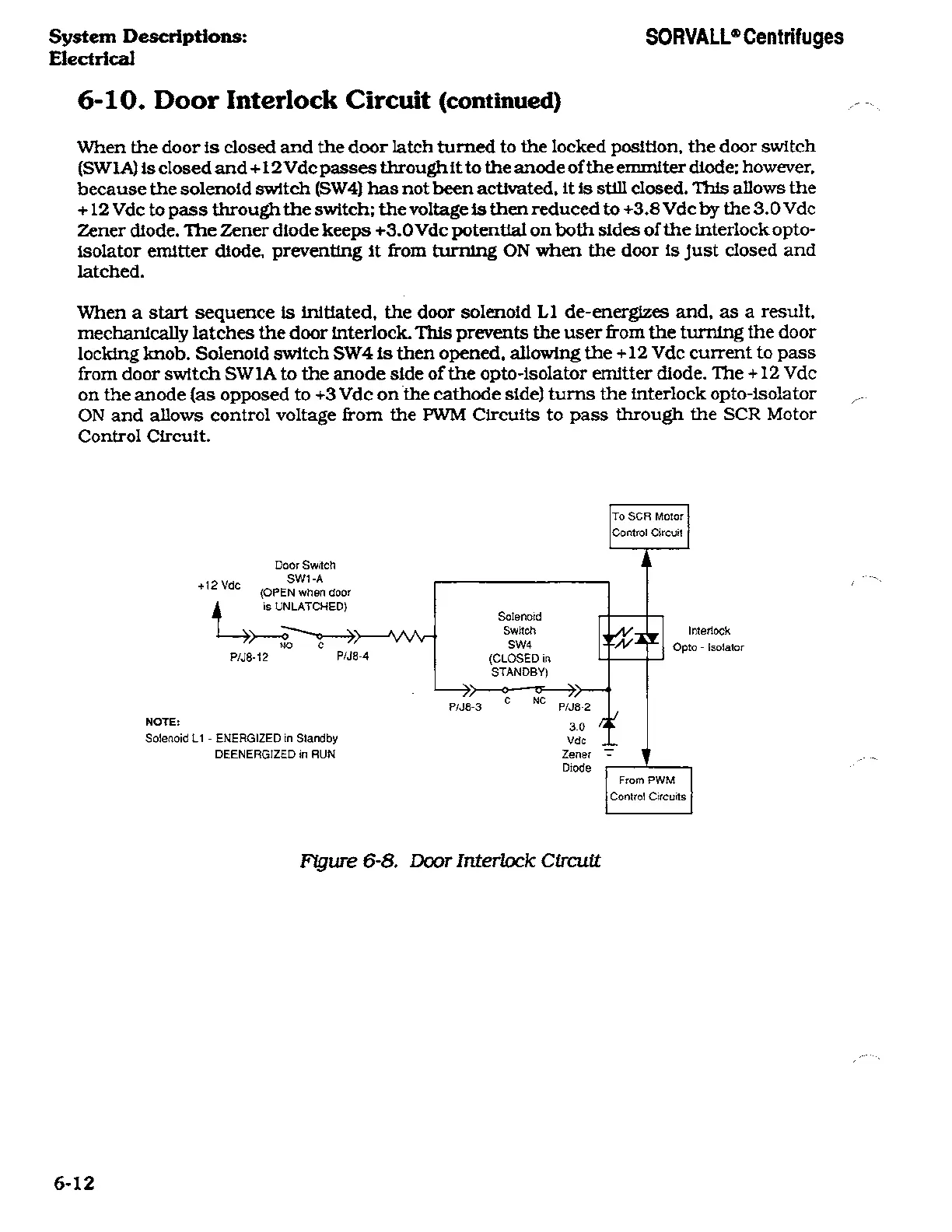
When
the
door is closed
and
the
door
latch
turned to
the locked
position,
the
door
switch
(SW 1A)
is closed
and
+12
Vdc
passes
through
it to the
anode
of
the
emmlter diode;
however.
because
the
solenoid
switch (SW4) has not been activated,
it
is
still
closed.
This allows
the
+12
Vdc
to
pass
through
the
switch;
the
voltage
is
then
reduced to
+3.8
Vdc
by
the
3.0
Vdc
Zener
diode. The
Zener
diode
keeps
+3.0
Vdc
potential on
both
sides
of the interlock
opto-
isolator emitter
diode,
preventing
it
from
turning
ON
when
the door is
Just
closed and
latched.
When
a
start
sequence
is initiated,
the
door solenoid
LI
de-energizes
and.
as a result,
mechanically latches
the
door interlock.
This
prevents
the
user
from the
turning
the
door
locking
knob.
Solenoid switch
SW4
is then
opened,
allowing
the
+12 Vdc
current
to
pass
from
door switch
SW1A
to
the
anode
side
of the
opto-lsolator emitter
diode.
The
+12 Vdc
on
the
anode
(as
opposed
to
+3
Vdc
on
the
cathode side)
turns
the Interlock opto-isolator
ON
and
allows
control
voltage
from the
PWM
Circuits
to
pass
through
the
SCR
Motor
Control
Circuit.
+12 Vdc
t
Door
Switch
SW1-A
(OPEN
when
door
is UNLATCHED)
->>-
7/^
P/J8-12
NO
->)—vw4
P/J8-4
NOTE:
Solenoid
L1 - ENERGIZED
in
Standby
DEENERGIZED in
RUN
Interlock
Opto
-
Isolator
Figure
6-8. Door Interlock Circuit
6-12

Related product manuals