SORVALL®
Centrifuges
System
Descriptions:
Electrical
6-13.
Temperature Control,
Refrigerated
Models
(refer to figure
6-11)
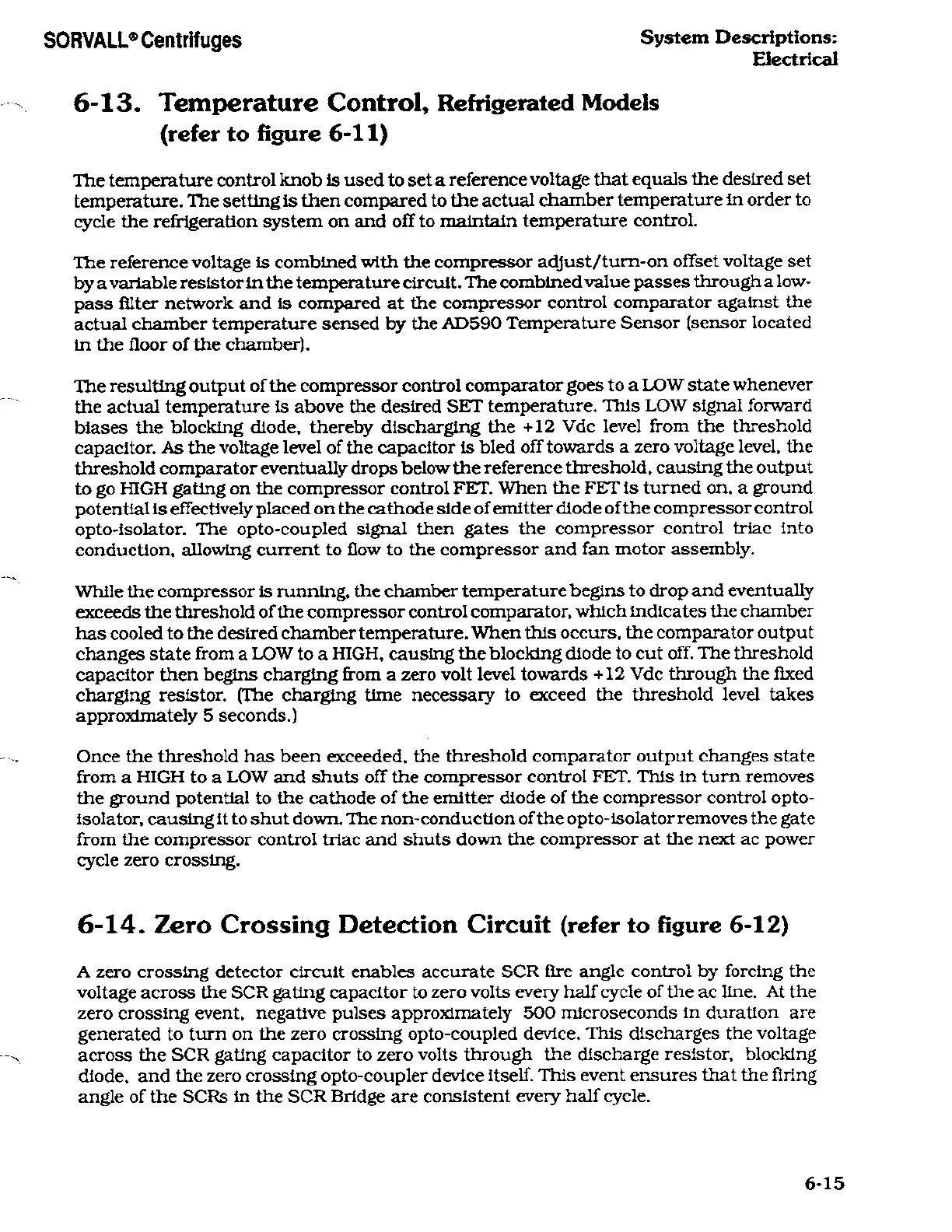
The
temperature control
knob is
used to set
a
reference voltage
that
equals
the
desired
set
temperature.
The
setting is
then
compared to
the
actual
chamber
temperature
in
order
to
cycle
the
refrigeration
system
on
and
off
to maintain
temperature
control.
The
reference
voltage
Is combined
with the
compressor
adjust/turn-on
offset
voltage
set
by
a
variable
resistor
in
the
temperature circuit.
The
combined
value
passes
through
a
low-
pass
filter
network and is
compared at
the
compressor
control
comparator
against
the
actual chamber
temperature
sensed
by
the
AD590
Temperature
Sensor (sensor
located
in
the
floor
of
the
chamber).
The
resulting
output
of the
compressor
control
comparator
goes
to
a
LOW
state whenever
the
actual
temperature
is above
the
desired
SET
temperature.
This
LOW
signal
forward
biases
the
blocking
diode, thereby
discharging
the
+12
Vdc level
from
the threshold
capacitor.
As the
voltage
level
of the
capacitor
is
bled
off
towards
a zero voltage level,
the
threshold
comparator
eventually
drops
below the
reference
threshold,
causing
the
output
to
go
HIGH
gating
on
the
compressor
control
FET.
When
the FET
is turned
on,
a ground
potential
is
effectively placed on
the cathode side
of emitter
diode
of the
compressor
control
opto-isolator.
The
opto-coupled signal
then
gates
the
compressor
control triac
into
conduction, allowing current
to
flow
to
the
compressor
and fan motor
assembly.
While the
compressor
is
running,
the
chamber temperature begins
to
drop
and
eventually
exceeds
the
threshold
of the
compressor
control
comparator,
which indicates
the
chamber
has cooled to the desired chamber
temperature.
When
this
occurs,
the
comparator
output
changes
state
from
a
LOW
to
a
HIGH,
causing
the blocking diode
to cut off.
The
threshold
capacitor
then
begins
charging
from
a zero
volt level
towards
+12 Vdc
through
the
fixed
charging
resistor.
(The
charging
time
necessary
to
exceed
the threshold
level takes
approximately
5
seconds.)
Once
the
threshold
has been
exceeded,
the threshold
comparator output changes
state
from
a
HIGH
to
a
LOW
and shuts
off the
compressor
control
FET.
This
in turn
removes
the
ground
potential to
the
cathode
of the
emitter
diode of the
compressor
control
opto-
isolator, causing
it
to shut
down.
The
non-conduction
of the
opto-isolator removes
the
gate
from
the
compressor
control triac and shuts down
the
compressor
at
the
next
ac
power
cycle
zero
crossing.
6-14.
Zero
Crossing
Detection
Circuit
(refer
to
figure
6-12)
A
zero
crossing
detector circuit enables
accurate
SCR
fire
angle
control
by
forcing
the
voltage
across
the
SCR
gating
capacitor
to zero
volts
every
half
cycle
of the
ac line.
At the
zero crossing
event,
negative
pulses approximately
500
microseconds
in duration
are
generated
to
turn on
the
zero crossing
opto-coupled device.
This
discharges
the
voltage
across
the SCR
gating
capacitor
to
zero
volts through
the
discharge resistor,
blocking
diode,
and
the
zero crossing opto-coupler
device itself.
This
event
ensures
that the
firing
angle
of
the
SCRs
in
the
SCR
Bridge
are
consistent
every
half
cycle.
6-15


 To Next Page
 Loading...