EasyManua.ls Logo

Sorvall RT/T6000D - Page 119

Sorvall RT/T6000D
302 pages
Print Icon
To Next Page IconTo Next Page
To Previous Page IconTo Previous Page
Loading...
System
Descriptions:
Electrical
SORVALL®
Centrifuges
+12Vdc +12Vdc
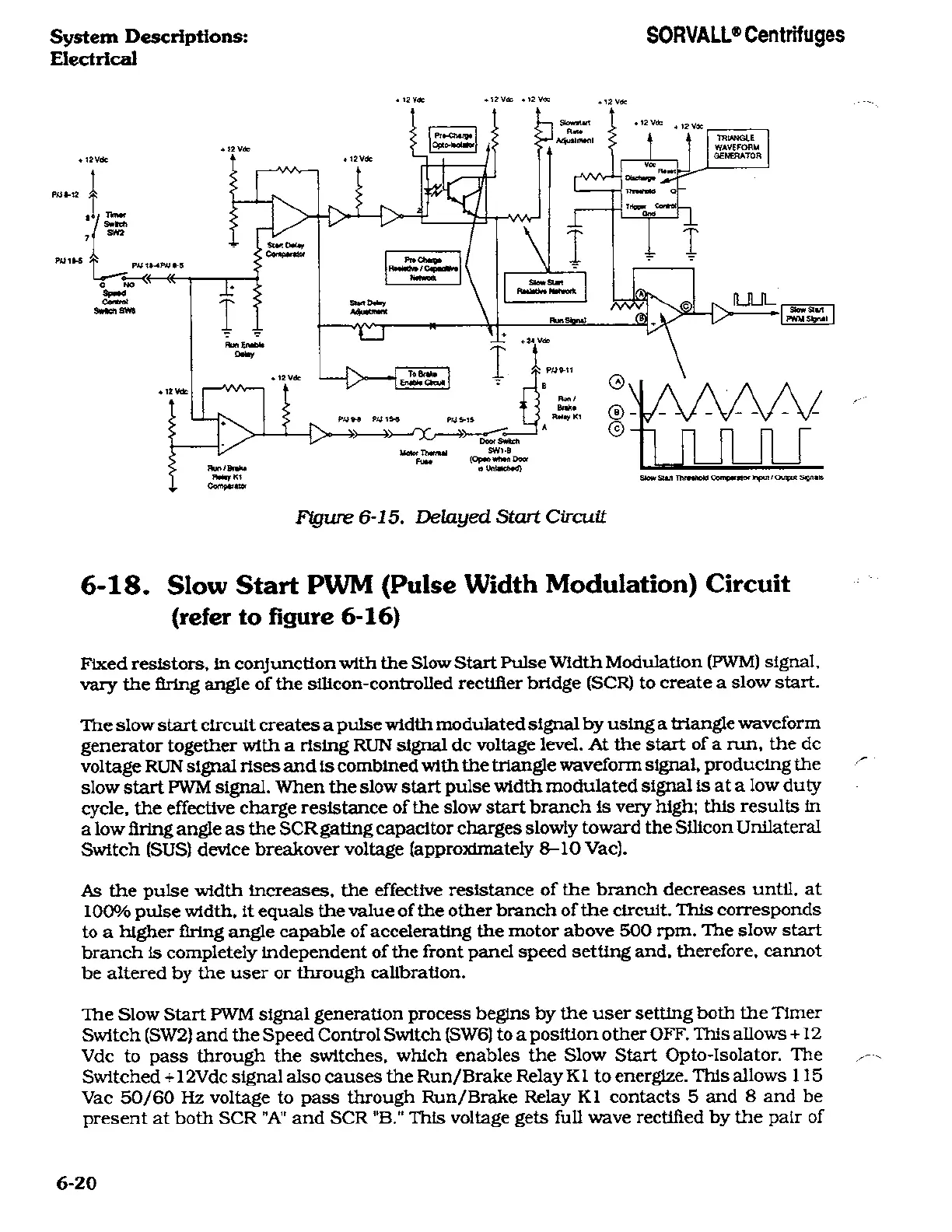
Figure
6-15.
Delayed
Start Circuit
6-18.
Slow
Start
PWM
(Pulse
Width
Modulation)
Circuit
(refer
to
figure
6-16)
Fixed
resistors,
in
conjunction
with the
Slow
Start Pulse
Width
Modulation
(PWM)
signal,
vary
the
firing
angle
of the
silicon-controlled rectifier
bridge
(SCR) to
create
a
slow
start.
The
slow start circuit
creates
a
pulse
width
modulated
signal
by
using
a
triangle waveform
generator together
with
a rising
RUN
signal
dc
voltage level.
At
the start of
a
run.
the
dc
voltage
RUN
signal
rises and
is
combined with
the
triangle
waveform
signal, producing
the
slow start
PWM
signal.
When the slow start
pulse
width
modulated
signal
is at
a
low
duty
cycle,
the
effective
charge resistance
of the
slow
start
branch is
very
high;
this
results in
a
low firing
angle as
the SCR
gating
capacitor charges slowly
toward the Silicon Unilateral
Switch
(SUS)
device breakover
voltage
(approximately
8-10
Vac).
As
the
pulse
width
increases,
the effective
resistance
of the branch
decreases until,
at
100%
pulse
width,
it
equals
the
value
of
the
other
branch of the
circuit.
This
corresponds
to
a
higher firing
angle
capable
of
accelerating
the
motor above
500
rpm.
The
slow start
branch is
completely independent
of the
front
panel speed
setting
and,
therefore, cannot
be altered
by
the
user or through calibration.
The
Slow Start
PWM
signal generation
process
begins
by
the
user setting
both the
Timer
Switch
(SW2)
and
the
Speed
Control
Switch
(SW6)
to
a
position
other
OFF.
This
allows +12
Vdc to
pass
through
the
switches,
which
enables
the
Slow Start
Opto-Isolator.
The
Switched
+12Vdc
signal also
causes
the
Run/Brake
Relay
Kl
toenergize.
This
allows
115
Vac
50/60
Hz
voltage
to
pass
through Run/Brake
Relay
Kl
contacts
5
and
8
and be
present
at
both
SCR
"A"
and
SCR
"B."
This
voltage gets
full
wave
rectified
by
the
pair
of

Related product manuals