System
Descriptions: SORVALL®
Centrifuges
Electrical
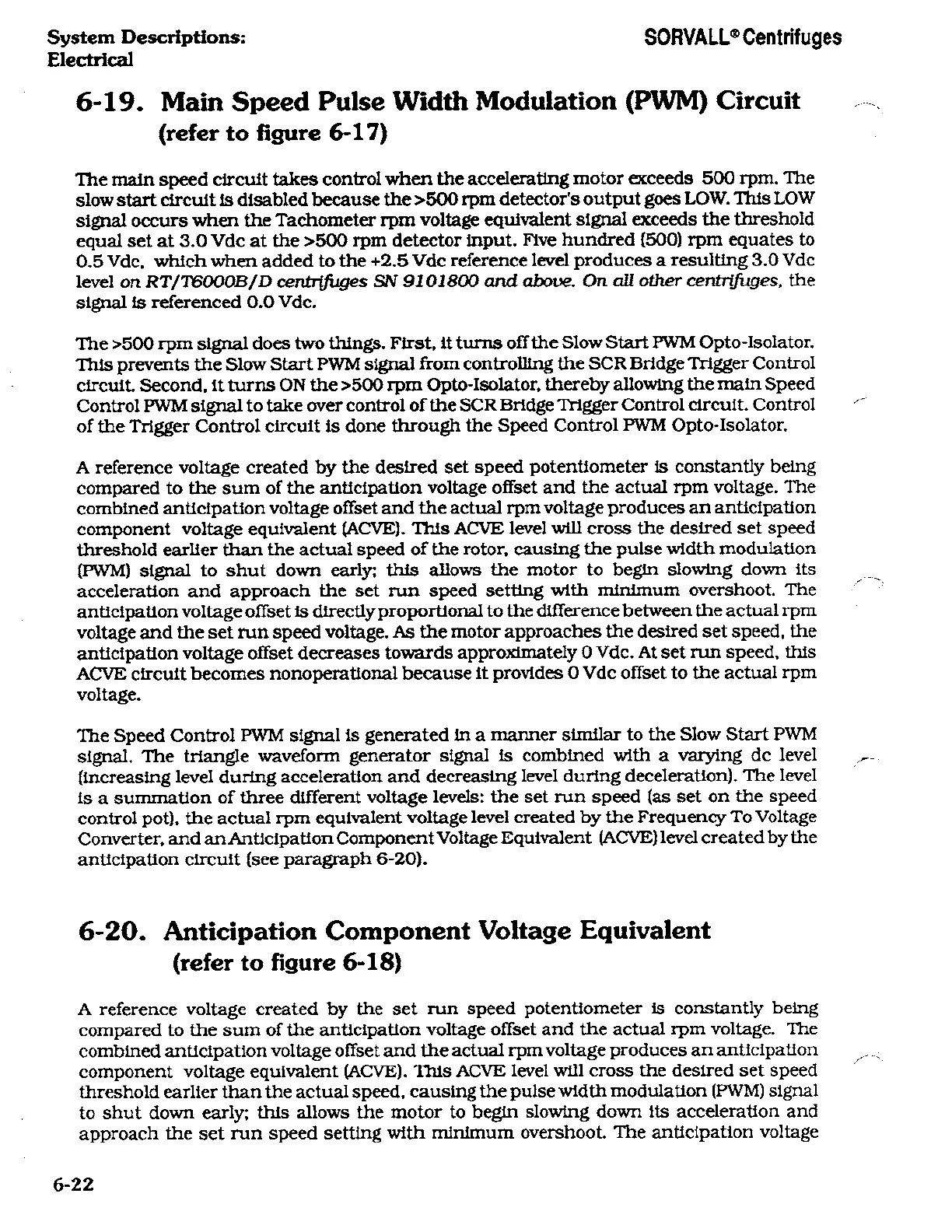
6-19. Main
Speed
Pulse
Width
Modulation (PWM)
Circuit
(refer
to
figure
6-17)
The
main
speed
circuit takes control
when
the
accelerating motor exceeds
500
rpm.
The
slow
start circuit
Is
disabled
because
the
>500
rpm
detector's
output
goes
LOW.
This
LOW
signal
occurs
when
the
Tachometer
rpm
voltage equivalent
signal exceeds
the
threshold
equal
set
at
3.0
Vdc
at
the >500
rpm
detector
input.
Five
hundred
(500)
rpm
equates
to
0.5 Vdc.
which
when added
to
the
+2.5
Vdc
reference
level
produces
a
resulting
3.0
Vdc
level
on
RT/T6000B/D
centrifuges
SN 9101800
and
above.
On
all
other
centrifuges,
the
signal
is referenced
0.0 Vdc.
The
>500
rpm
signal
does two
things.
First,
it
turns
off the Slow
Start PWM
Opto-Isolator.
This
prevents
the Slow Start
PWM
signal
from
controlling
the
SCR
Bridge
Trigger
Control
circuit.
Second,
it
turns
ON
the >500
rpm
Opto-Isolator, thereby allowing
the
main Speed
Control
PWM
signal
to
take over
control
of the
SCR
Bridge Trigger
Control
circuit.
Control
of
the
Trigger
Control circuit
is
done through
the
Speed
Control
PWM
Opto-Isolator.
A
reference voltage
created
by
the desired set
speed
potentiometer is constantly being
compared
to
the
sum
of
the
anticipation voltage onset
and
the
actual
rpm
voltage.
The
combined
anticipation
voltage
offset and
the
actual
rpm
voltage produces an
anticipation
component voltage equivalent
(ACVE).
This ACVE
level
will
cross
the
desired set
speed
threshold
earlier than
the
actual
speed
of the
rotor,
causing
the
pulse
width modulation
(PWM)
signal
to
shut
down
early;
this
allows
the
motor
to
begin slowing
down its
acceleration and
approach
the
set run
speed
setting
with
minimum
overshoot.
The
anticipation
voltage
offset Is
directly proportional to
the difference
between
the
actual
rpm
voltage
and
the
set run
speed voltage.
As
the
motor
approaches
the
desired
set
speed,
the
anticipation
voltage
offset
decreases
towards
approximately
0
Vdc.
At
set
run
speed,
this
ACVE
circuit becomes
nonoperatlonal
because
it
provides
0 Vdc
offset
to
the actual
rpm
voltage.
The
Speed
Control
PWM
signal
is
generated
in
a
manner
similar
to
the
Slow Start
PWM
signal.
The
triangle waveform
generator
signal
is combined
with
a varying
dc
level
(Increasing
level
during
acceleration and
decreasing
level
during deceleration).
The
level
is
a
summation
of three different
voltage
levels:
the
set run speed (as set on
the
speed
control
pot),
the
actual
rpm
equivalent
voltage
level created
by
the
Frequency
To
Voltage
Converter,
and
an Anticipation Component
Voltage Equivalent
(ACVE)
level created
by
the
anticipation
circuit
(see
paragraph
6-20).
6-20.
Anticipation
Component
Voltage Equivalent
(refer
to
figure
6-18)
A
reference voltage
created
by
the
set run
speed
potentiometer
is
constantly being
compared
to
the
sum
of
the
anticipation voltage
offset and
the
actual
rpm
voltage.
The
combined anticipation
voltage
offset and
the
actual
rpm
voltage produces an
anticipation
component
voltage equivalent
(ACVE).
This ACVE
level
will
cross
the
desired
set speed
threshold earlier than
the
actual
speed,
causing
the
pulse
width
modulation
(PWM)
signal
to shut down
early;
this
allows
the
motor
to
begin slowing
down
its
acceleration
and
approach
the
set
run
speed
setting
with
minimum overshoot.
The
anticipation voltage
6-22


 To Next Page
 Loading...