EasyManua.ls Logo

Sorvall RT/T6000D - Page 127

Sorvall RT/T6000D
302 pages
Print Icon
To Next Page IconTo Next Page
To Previous Page IconTo Previous Page
Loading...
System
Descriptions:
Electrical
SORVALL®
Centrifuges
6-25.
Zero
Speed
Detection
Circuit
(refer
to
figure
6-23)
The
zero speed
detection circuit de-energizes
the door
solenoid at
the
beginning
of
a run
to prevent
the
user
from
accidentally unlatching
the
door
while
the
rotor
is
spinning.
At
the
end
of
a
run,
the circuit
energizes
the
door solenoid, allowing
the
user to
unlatch the
door
and
gain
access
to
the
rotor chamber.
The circuit
also
illuminates the
zero
speed
indicator
lamp
when
the
rotor is
at
rest.
When the
rotor starts
turning,
such
as
at
the
beginning
of
a run,
the
motor tachometer
begins
producing pulses
that
are
fed
into
the
Frequency
To Voltage Converter U20.
This
device
converts
the
input frequency
into
an equivalent
dc
voltage
proportional
to
the
motor
speed,
then
applies
it
to
zero
speed comparator.
When
compared
to the
reference
input
and
the
threshold is
exceeded,
the
output
state
changes
from
a
HIGH
(while
at
zero speed) to
a
LOW.
This
LOW
signal
is then inverted
three
more
times before finally
becoming a
HIGH
at
the
door solenoid
driver.
This
HIGH
output
signal effectively
removes
the
ground
potential
from
the
+
24 Vdc
supply
and
de-energizes
the
door
solenoid
LI.
The
door
is
then
latched,
preventing
the
user
from
accidently unlatching
the
door
while
the rotor is
spinning. By
removing
this
ground potential,
the
zero
speed
indicator
lamp
is extin¬
guished.
When
the
rotor
reaches zero
rpm,
the
motor
tachometer's
output
is
not
producing
any
pulses; therefore,
the
Frequency
To
Voltage
Converter's
output
goes
to
zero
and the
effective
tachometer
converted
voltage
level (at
zero
rpm)
is
+
2.5
Vdc
on
RT/T6000B/D
centrifuges
SNs 9101800
ondoboucor
0.0
Vdc
on
all other
centrifuges.
The
zero
rpm
voltage
level, when
compared
to
the
zero
speed
detector, produces
a
HIGH
output
signal.
This
HIGH
output
is Inverted three
times
through
Hex Inverter
Drivers,
then
the
resulting
LOW
signal at
the
door solenoid driver
output
is used to
sink the
+24
Vdc
current
that
passes
through
the
door solenoid
LI.
The
current
energizes
the
door
solenoid, allowing
the
user
to unlatch
the
chamber
door.
At the
same
time,
the
LOW
signal is also used
to
sink
the
indicator
lamp
current
through
the
zero
speed
indicator
lamp
located
on
the front
panel;
this
causes
the
indicator
lamp
to
light.
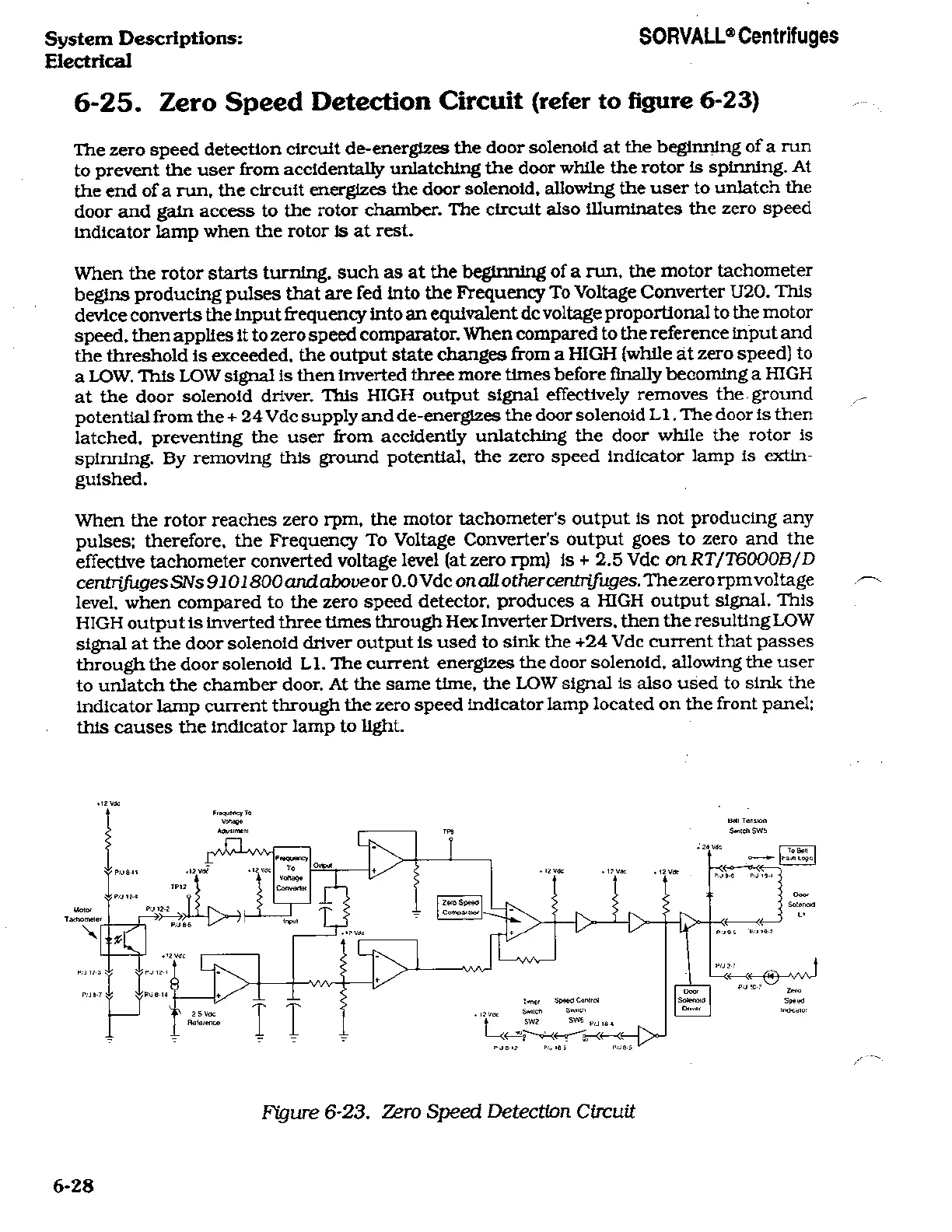
Figure
6-23.
Zero
Speed
Detection
Circuit
6-28

Related product manuals