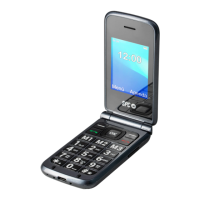
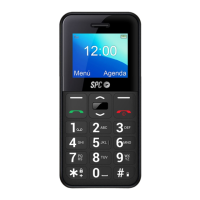
This document serves as a comprehensive user manual for the SPC HARMONY key-operated mobile phone, providing essential information for initial setup and a detailed overview of its various functionalities. The phone is designed for ease of use, offering a range of features to enhance communication and provide assistance in different scenarios.
Function Description
The SPC HARMONY is a mobile phone primarily designed for making and receiving calls and messages. It supports dual SIM cards, allowing users to manage two different numbers simultaneously. The phone includes a phonebook for storing contacts, a call history to review past communications, and a messaging function for sending and receiving SMS.
A key feature of the HARMONY is its SOS button, located on the back of the device. This physical button is designed for emergencies. When pressed and held for a few seconds, it automatically initiates a call and sends an emergency SMS to up to five pre-configured numbers. This functionality is crucial for users who may need immediate assistance, activating the loudspeaker during the emergency call and cycling through the SOS numbers until a response is received. The SOS message can also be customized.
The phone also integrates Smart Help functionalities, aimed at providing peace of mind for users and enabling family or loved ones to offer remote assistance. Smart Help includes several features:
- Smart Notification: Alerts designated helper contacts in case of a missed call or low battery (below 15%).
- Smart Care: Notifies helper contacts if there's a missed (unanswered) call or no activity on the phone for 24 hours (e.g., no keys pressed, lid opened/closed, or charging).
- Intelligent Doorbell: Automatically increases the ringer volume to maximum if the same person attempts to call multiple times within a short period (3 minutes) without an answer. The volume reverts to its previous setting after the call is answered.
- Synchronization Control: Allows remote configuration of certain phone settings via SMS from a designated helper phone. This includes activating/deactivating the SOS function and configuring SOS numbers, as well as adding contacts to the phonebook or quick memory, and adjusting the ringer, earpiece, and hands-free volume to maximum.
Beyond communication and safety features, the HARMONY includes a suite of multimedia functions. It has a built-in camera for taking photos and recording videos, with various settings for image size, quality, white balance, flash, and timer. Users can view images, send them via Bluetooth, set them as wallpaper, rename, or delete them. The phone also features an audio player for music, a voice recorder, and an FM radio that requires a standard 3.5mm headset to function. A file manager allows users to browse photos and videos stored on the device.
For organization and daily utility, the phone offers an Organiser menu with an alarm clock (up to 5 configurable alarms with snooze options, tones, and types), a calendar for managing events, and a tasks list for reminders with priority settings, dates, times, and repeat options. A basic calculator is also included.
Usage Features
The HARMONY is a key-operated phone, emphasizing tactile interaction.
- Navigation: The top left key provides access to the main menu from standby. The edges of the central key are used for navigating up and down menus and submenus. The top left and top right keys perform actions displayed at the bottom left and right of the screen, respectively. The central key confirms selections. To return to the home screen, the hang-up key is pressed.
- Calling: To make a call, users dial the number and press the call key. Incorrectly entered digits can be deleted. If two SIM cards are in use, the phone prompts for SIM selection before making a call. When a number is stored in the phonebook, the contact's name appears during a call. The hang-up key ends a call.
- Answering/Rejecting Calls: Incoming calls display the caller's number or name. The call key answers, and the hang-up key rejects.
- In-Call Options: During a conversation, "Speakerphone" activates hands-free mode. "Options" provides access to features like call waiting, ending the call, accessing the phonebook or call history, sending messages, starting a recording, or muting the call.
- Speed Dialling: The phone supports three direct memories (M1-M2-M3) and nine indirect memories (activated by holding down digits 1-9). These require a SIM card and can be configured through the Settings menu.
- Profiles: Ringtones, volume levels, and message tones can be customized under the "Profiles" option in Settings. Users can select from General, Silent, Meeting, and Outdoor profiles, and adjust alert types, ringing types, call volume, message tones, keyboard sounds, and power-on/off tones.
- Messages: New messages are indicated by a beep, an on-screen alert, and an envelope icon. Messages can be read, replied to, forwarded, deleted, or saved to the phonebook. Text input modes include predictive text, numeric, and touch, with options for capitalization and symbol insertion.
- SOS Button Usage: In an emergency, pressing the SOS button for a few seconds triggers calls to pre-defined numbers, sends an emergency SMS, and activates the loudspeaker. The calling cycle repeats three times if no response is received. The SOS function can be cancelled by pressing the hang-up key.
- Smart Help Configuration: Helper contacts for Smart Help features are configured in "Settings > Smart Helper number." Dialling codes (e.g., +34 for Spanish numbers) must be included for international contacts.
- Camera Usage: The camera is activated via the navigation key or through the Multimedia menu. The numeric keypad controls zoom, image size, picture quality, white balance, flash, and timer. The '8' key captures photos.
- FM Radio Usage: A standard 3.5mm headset must be plugged in. The M2 key toggles the radio on/off. M1/M3 keys search for stations automatically. Up/down navigation keys change frequency manually, and side volume keys adjust volume. Options include recording stations, manual/automatic search, and background playback.
- Settings: The "Settings" menu provides extensive customization options, including dual SIM configuration, time and date, language, display settings, aeroplane mode, shortcuts, vibration settings, network selection, call handling (call waiting, diversions, restrictions, blacklist, automatic redial, call time display, call duration warning, response mode), and security settings (SIM PINs, phone lock password).
- Connectivity: Bluetooth management allows activation/deactivation, visibility control, and searching for new devices.
- Default Values: The phone settings can be reset to factory defaults using a password (default is 1122).
Maintenance Features
- Battery Installation: The battery is inserted by matching its gold contacts with those on the phone. The battery cover is lifted using a tab at the bottom.
- Charging: The phone is charged by connecting the power supply to the charging cradle and then to a power socket. The phone is placed on the charging cradle. It's important to check the connector's orientation and avoid forcing the connection.
- Charging Time: A full charge typically takes about 2 hours.
- Battery Care: To prolong battery life, it's recommended not to leave the battery fully charged or very low for extended periods. An intermediate charge is preferred. The battery should not be left charging for long periods (e.g., during holidays) and should be fully discharged occasionally. If the phone is unused for a long time, the battery should be removed and stored with an intermediate charge.
- Low Battery Warning: When the battery is low, the indicator will be empty, a warning tone will sound, and a message will appear on screen, prompting the user to charge the device. If the battery is completely depleted, the phone will turn off, preventing calls.
- Troubleshooting Charging: If the phone doesn't charge properly, ensure the power supply is connected correctly and the battery is placed correctly. Check for a charging symbol on the display. If the charging cradle is suspected, connect the phone directly to the power supply using its standard micro USB port.
- SIM Card Insertion: For calls, a SIM card from an operator is required. Ensure the SIM card is correctly inserted into the slot, with the notch in the indicated position and metal contacts facing downwards. The phone supports micro SIM (SIM1) or mini SIM (SIM2); if a nanoSIM is used, an adapter is needed.
- Signal Strength: The mobile coverage icon at the top left of the screen indicates signal strength. A cross on the icon signifies no coverage.
- Ringer Settings: If the phone doesn't ring, check the ringer settings in "Profiles." Accidentally pressing the '0' key continuously can switch the phone to "Silent" mode; pressing it again continuously returns to the General profile.
- Call Volume Adjustment: In-call volume is adjusted using the side + and - buttons or the Up/Down selection buttons on the keypad.

 Need help?
 General
 Weight and Dimensions

 To Next Page