Solar panel "-"
interface
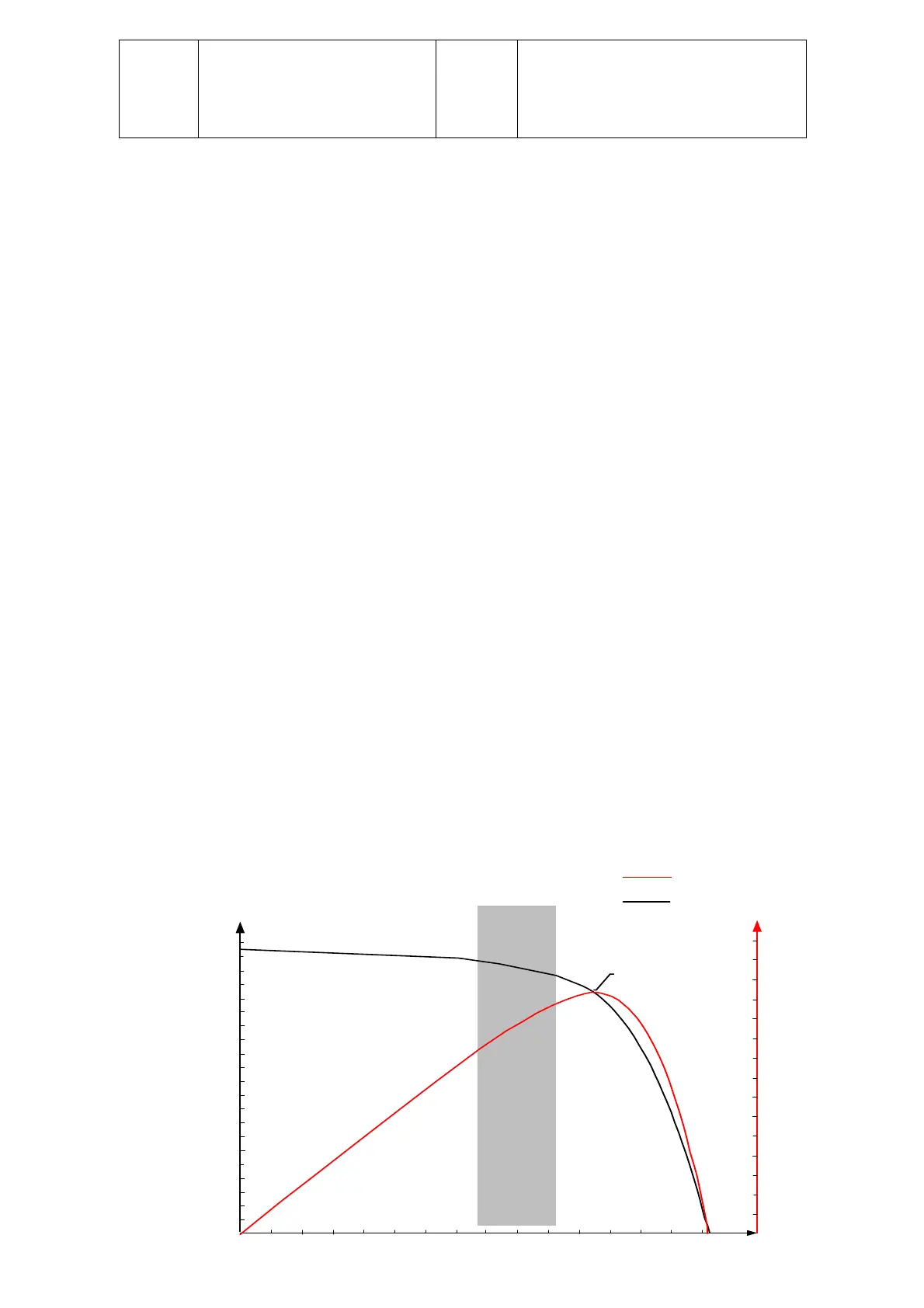
1.4 Introduction to Maximum Power Point Tracking Technology
Maximum Power Point Tracking (MPPT) is an advanced charging technology that
enables the solar panel to output more power by adjusting the electric module's
operating status. Due to the nonlinearity of solar arrays, there exists a maximum
energy output point (maximum power point) on their curves. Unable to continuously
lock onto this point to charge the battery, conventional controllers (employing
switching and PWM charging technologies) can't get the most of the power from the
solar panel. But a solar charge controller featuring MPPT technology can
continuously track arrays' maximum power point so as to get the maximum amount
of power to charge the battery.
Take a 12V system as an example. As the solar panel's peak voltage (Vpp) is
approximately 17V while the battery's voltage is around 12V, when charging with a
conventional charge controller, the solar panel's voltage will stay at around 12V,
failing to deliver the maximum power. However, the MPPT controller can overcome
the problem by adjusting the solar panel's input voltage and current in real time,
realizing a maximum input power.
Compared with conventional PWM controllers, the MPPT controller can make the
most of the solar panel's max. power and therefore provide larger charging current.
Generally speaking, the latter can raise the energy utilization ratio by 15% to 20% in
contrast with the former.
PWM充电
U(V)
I(A) P(W)
VP曲线
VI曲线
94.5
81.0
67.5
54.0
27.0
40.5
13.5
0.0
19.6
16.814.011.28.4
5.6
2.80.0
0.5
1.0
1.5
2.0
2.5
3.0
3.5
4.0
4.5
5.0
MPPT点
More information https://www.caravansplus.com.au


 To Next Page