Need help?
Do you have a question about the Spirax Sarco TD42 and is the answer not in the manual?
Defines the product's specific applications and compliance with directives.
Ensures safe access and working platforms for maintenance operations.
Highlights the need for sufficient lighting, especially for intricate work.
Advises consideration of hazardous liquids or gases present in the pipeline.
Addresses risks associated with the product's surrounding environment.
Evaluates the impact of proposed work on the overall system and personnel.
Emphasizes safe isolation and venting of pressure systems.
Advises allowing time for temperature normalization to prevent burns.
Stresses the use of suitable tools and genuine replacement parts.
Details the need for appropriate protective gear against various hazards.
Outlines procedures for competent supervision and work authorization.
Provides guidance on assessing risks and using proper methods for handling.
Warns about potential high surface temperatures and residual fluids.
Mandates protection against frost damage for non-self-draining products.
States the product is recyclable with no anticipated ecological hazard if handled properly.
Requires hazard information when returning products to Spirax Sarco.
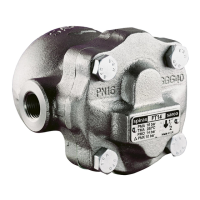
Describes the TD42 range, its variants, and key features like anti-air-binding discs.
Lists the available sizes and types of pipe connections for TD42 models.
Details the operational pressure and temperature ranges for TD42 traps.
Checks product suitability, materials, and removes protective covers before installation.
Determines the correct installation situation and direction of fluid flow.
Covers preferred horizontal installation, isolation valves, and slow opening.
Ensures checking for leaks and correct operation after installation.
General guidelines for maintenance, including isolation, cooling, and reassembly.
Detailed steps for disassembling, servicing, and reassembling the trap components.
Procedures for accessing, cleaning, or replacing the strainer assembly.
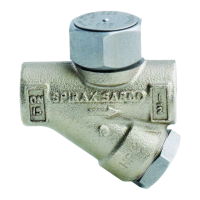
The TD42 Thermodynamic Steam Trap is a maintainable device designed for efficient condensate discharge in steam, air, or condensate/water systems. It operates with a blast-type action, releasing condensate at a few degrees below steam saturation temperature.
The TD42 range of thermodynamic steam traps are engineered to handle pressures up to 42 bar g and come with integral strainers and screwed body connections. These traps utilize the thermodynamic principle, where the difference in pressure created by flashing condensate and steam across a disc causes the disc to open and close, discharging condensate.
The TD42L and TD42LC models are specifically designed for lower capacity applications, making them ideal for tracing and mains drainage. The TD42 and TD42H models are intended for higher load applications.
For applications where air release is a concern, the TD42A, TD42HA, TD42LA, and TD42LCA versions are available, featuring an anti-air-binding disc. The "A" in the nomenclature indicates the presence of this anti-air-binding disc, which helps prevent air from accumulating and hindering trap operation.
Certain models, including the TD42L, TD42LA, TD42H, and TD42HA, feature electroless nickel preparation (ENP) on their body surfaces. This finish provides both energy-saving benefits and enhanced oxidation resistance. The TD42, TD42A, TD42LC, and TD42LCA models have black body surfaces.
The device is designed to comply with the European Pressure Equipment Directive 97/23/EC, falling within the 'SEP' category, which means it does not carry the CE mark.
The TD42 steam trap is suitable for a range of applications involving steam, air, or condensate/water. Its robust design allows for operation in systems with varying pressures and temperatures.
For optimal performance, the trap should preferably be installed in the horizontal plane, preceded by a small drop leg. This orientation helps ensure proper condensate collection and discharge.
Isolation valves are crucial for safe maintenance and trap replacement, allowing the system to be shut off without affecting the entire pipeline. When discharging into a closed return system, a non-return valve should be fitted downstream of the trap to prevent backflow.
Consideration should be given to testing the trap's operation. This can be achieved using a sight glass or a Spiratec system. If using sight glasses with blast-action traps, they should be positioned at least 1 meter (3 feet) downstream to prevent damage from the forceful discharge.
If the trap is to discharge to atmosphere, it must be directed to a safe location, as the discharged fluid can be at temperatures up to 100°C (212°F).
Optional extras are available to enhance the trap's functionality and adaptability. An insulating cover can be fitted to prevent excessive heat loss, which can unduly influence trap operation in low outside temperatures, wind, or rain. An integral blowdown valve (BDV1 or BDV2) can also be fitted to the strainer cap, or the strainer cap can be drilled, tapped, and plugged for a 3/8" BSP or NPT connection.
The TD42 is designed for maintainability, allowing for servicing and part replacement to extend its operational life. All maintenance work should be carried out by suitably competent personnel, adhering to safety information outlined in the manual.
Before any maintenance, the trap must be isolated from both the supply and return lines, and any pressure must be safely normalized to atmosphere. The trap should then be allowed to cool to prevent burns.
Maintenance can often be completed with the trap remaining in the pipeline. When reassembling, it is essential to ensure that all joint faces are clean. It is recommended to use new gaskets and spare parts whenever maintenance is undertaken to ensure optimal sealing and performance.
Servicing the trap involves removing the insulating cover (if fitted) and unscrewing the cap using a suitable spanner or socket. Stillsons or similar wrenches that could distort the cap should be avoided.
The seating faces on the body can be refaced if only slightly worn by lapping them on a flat surface with a grinding compound. However, if wear is significant, the seating faces must be ground flat and then lapped. The disc should always be replaced with a new one, and the total amount of metal removed during refacing should not exceed 0.25 mm (0.010"). When reassembling, the disc is typically placed with its grooved side in contact with the body seating face. The cap should be screwed on to the recommended tightening torque, and a suitable high-temperature anti-seize grease should be applied to the threads.
To clean or replace the strainer, the strainer cap is unscrewed, and the screen is withdrawn. The screen can then be cleaned or replaced if damaged. For reassembly, the screen is inserted into the strainer cap, which is then screwed back into place. A fine smear of 'Molybdenum Disulphide' grease should be applied to the first few threads, and care should be taken to ensure the gasket and gasket faces are clean. The strainer cap should be tightened to the recommended torque.
After any maintenance, isolation valves should be opened slowly, and the system checked for leaks and correct operation.
 General
| Type | Thermodynamic Steam Trap |
|---|---|
| Materials | Stainless Steel |
| Disc Material | Stainless Steel |
| Connection | Flanged |
| Maximum Operating Temperature | 400°C |
| Body Material | Stainless Steel |
| Application | Steam Systems |
| Connection Size | 1/2" |
| Maximum Operating Pressure | 42 bar g |

 To Next Page