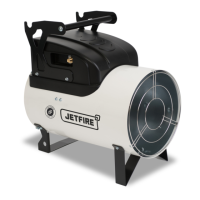
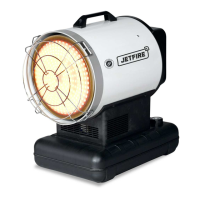
The document provided is an operating and maintenance manual for the JETFIRE IP110 Diesel Indirect Fired Space Heater, manufactured in Italy for Spitwater Australia Pty Ltd. This device is designed for commercial and industrial space heating applications and is not intended for domestic use.
Function Description
The JETFIRE IP110 is a diesel indirect fired space heater. This means that the combustion chamber is separate from the air being heated, preventing combustion by-products from mixing with the heated air. This design makes it suitable for environments where clean, fume-free heat is required, such as warehouses, factories, animal husbandry facilities, and greenhouses. The heater operates by drawing in ambient air, heating it over a heat exchanger, and then expelling the warm, clean air into the desired space. The exhaust gases from the combustion process are vented separately, typically through a chimney system.
Important Technical Specifications
The manual provides detailed technical specifications for two models, IS and II S, which appear to be different configurations or power settings of the IP110.
General:
- Combustion Type: Indirect
- Air Output: 5500 m³/h
Power Supply (Common to both IS and II S):
- Phase: 3
- Voltage: 400 V
- Plug: 15 A
- Frequency: 50 Hz
- Power Consumption: 1820 W
- Fuse: 15 A
Model IS Specifics:
- Max Heating Output:
- 80.00 kW
- 64553 kcal/h
- 275214 BTU/h
- Net Heating Output:
- 66.80 kW
- 57452 kcal/h
- 244941 BTU/h
- Fuel Consumption: 6.330 kg/h
- Nozzle: 2.00 USgal/h - 80° / W
- Pump Pressure: 8.5 bar
Model II S Specifics:
- Max Heating Output:
- 117.26 kW
- 94616 kcal/h
- 403387 BTU/h
- Net Heating Output:
- 99.02 kW
- 85155 kcal/h
- 363048 BTU/h
- Fuel Consumption: 9.278 kg/h
- Nozzle: 2.00 USgal/h - 80° / W (Note: The nozzle specification is identical for both models, which might indicate a typo or a common component, with pressure being the differentiator for flow rate).
- Pump Pressure: 12.5 bar
Physical Characteristics (Common to both IS and II S):
- Flue Diameter: 150 mm
- Tank Capacity: 135 L
- Noise Level at 1 m: 76 dBA
- Dimensions (L x W x H): 1918 x 731 x 1220 mm
- Weight: 149 kg
- Adjustment of Combustion Air Flap: A = 5 (This refers to a specific setting on the air flap diagram provided).
Usage Features
The JETFIRE IP110 is designed for ease of use and safety in industrial environments.
Operation:
- Control Panel: The heater features a control panel with a main switch, reset button, and various indicator lamps.
- Thermostat Control: It can be connected to an external room thermostat (plug 15) for automatic temperature control.
- Power Settings: The heater has a high-low thermal power switch (18) to select between two heating levels (IS or II S).
- Start-up Procedure: Before starting, operators must ensure the power supply matches specifications, the fuel tank is full, and the unit is placed on a flat, stable, and level surface. The heater is started by turning the main switch (14) to "I" (on) and then the burner motor switch (14) to "*".
- Stopping Procedure: To stop the heater, the main switch (14) should be set to "0" position, or the room thermostat can be set to a lower control level. The fan continues to work for approximately 90 seconds after the burner stops to cool the combustion chamber.
- Safety Devices: The heater is equipped with an electronic device that controls the flame and maximum safe temperature. It includes a reset button (13) for self-diagnosis and restarting after a safety shutdown.
- Indicator Lights: The control lamp (16) provides visual feedback on the heater's status:
- Steady Green: Heater functioning normally.
- Steady Red: Heater in safety stop.
- Flashing Orange: Heating interrupted due to excessive voltage variations (T>75V or T>265V); heating will resume automatically when voltage returns to range (180 V and 250 V).
- Flashing Orange (Self-diagnosis light): Indicates various issues such as false flame detection during restart, no flame during restart, or no flame during work cycle.
- Steady Orange (Self-diagnosis light): Internal error of electronic device.
Installation:
- Portability: The heater is designed to be portable, featuring wheels (11) and a support/handle (10). It can also be lifted by using a lift truck or similar equipment.
- Chimney System: An indirect fired heater requires a chimney for exhaust. The manual provides a recommended chimney lay-out, emphasizing the use of an anti-wind device (1) and a minimum upward slope (5°) for horizontal sections (2). The chimney must comply with local regulations.
- Safety Clearances: Maintain a minimum distance of 3 meters from flammable materials. Ensure sufficient fresh air for combustion and proper ventilation.
Maintenance Features
Regular inspection and maintenance are crucial for the safe, efficient, and reliable operation of the JETFIRE IP110.
General Recommendations:
- Read Manual: Operators must read and understand the manual before use.
- Qualified Personnel: Maintenance procedures, especially those beyond daily checks, should be performed by qualified service technicians.
- Original Parts: Use only original spare parts and accessories from Spitwater.
Daily Maintenance (Customer to Perform):
- Air Inlet/Outlet and Exhaust Stack: Inspect and remove debris.
- Air Ducts: Inspect for bends and kinks.
- Fuel Tank: Verify the fuel tank is full.
- Exhaust Stack: Verify it is properly installed.
Weekly Maintenance (Customer to Perform):
- Disassembly: Disassemble, inspect, and clean the fuel filter.
- Clean Fuel: Ensure clean fuel without water.
Every 50 Hours Maintenance (Qualified Spitwater Service Technician to Carry Out):
- Combustion Chamber: Remove top cover and clean the interior.
- Fan Blade and Interior Shell: Inspect and clean.
- Fuel Hose Assembly and Check: Inspect for any leaks.
- Burner: Inspect and test the burner.
Every Six Months Maintenance (Qualified Spitwater Service Technician to Carry Out):
- Burner Head: Disassemble and clean.
- Burner Diffuser: Inspect and clean, replace if necessary.
- Ignition Electrodes and Adjustments: Clean and adjust.
- Combustion Setting: Check air combustion setting.
- Overhead Thermostat: Check.
- Combustion Chamber and Burner: Inspect and clean.
- Electronic Board: Inspect electrical components and connections.
- Fuel Pump: Check fuel pressure setting.
Troubleshooting:
The manual includes a detailed troubleshooting guide with common problems, their causes, and remedies. It distinguishes between issues that can be resolved by the user (e.g., resetting the unit) and those requiring a qualified Spitwater service agent. The guide uses the "RESET BUTTON (13)" and the "SELF-DIAGNOSIS LIGHT" (steady green, flashing orange, steady red) to help identify the problem.
Safety Warnings:
The manual prominently features warnings regarding:
- Overheating: Never stop the machine by unplugging the electrical plug; this can cause overheating.
- Power Supply: Ensure the power line is earthed and fitted with a residual current circuit breaker.
- Fuel Leaks: Diesel may leak during handling and transport; the fuel tank cap must be secured.
- Combustion By-products: Indirect combustion heaters should only be used in well-ventilated areas to avoid carbon monoxide poisoning.
- Flammable Materials: Keep flammable material at a safe distance (minimum 3 meters).
- Fuel Type: Use only diesel fuel or kerosene.
- Restarting: Never do more than two restarts in a row if uncombusted diesel fuel accumulates in the combustion chamber.
Spitwater Australia emphasizes its commitment to providing superior quality portable industrial heaters and offers extensive after-sales service, spare parts, and accessories.

 Need help?

 To Next Page
 General