INSTALLATION, OPERATION and MAINTENANCE MANUAL | 39
9. ASSEMBLY
9.1. Handling
APV Plate Heat Exchangers are shipped either fully assembled and skid mounted, or if
required, unassembled in boxes. In either case, correct handling practices must be
followed. The weight of an assembled heat exchanger is listed on the customer
drawing. The skids and boxes are designed to be moved by standard forklift trucks of
sufficient capacity.
Plate heat exchangers that must be transported via cargo ship typically require special
procedures, including export packing and nitrogen purge and / or pressurization.
Document GPHE IOM-PACK provides generic details.
9.2. Lifting
All APV heat exchangers are provided with lifting holes, lugs, or eyebolts to simplify
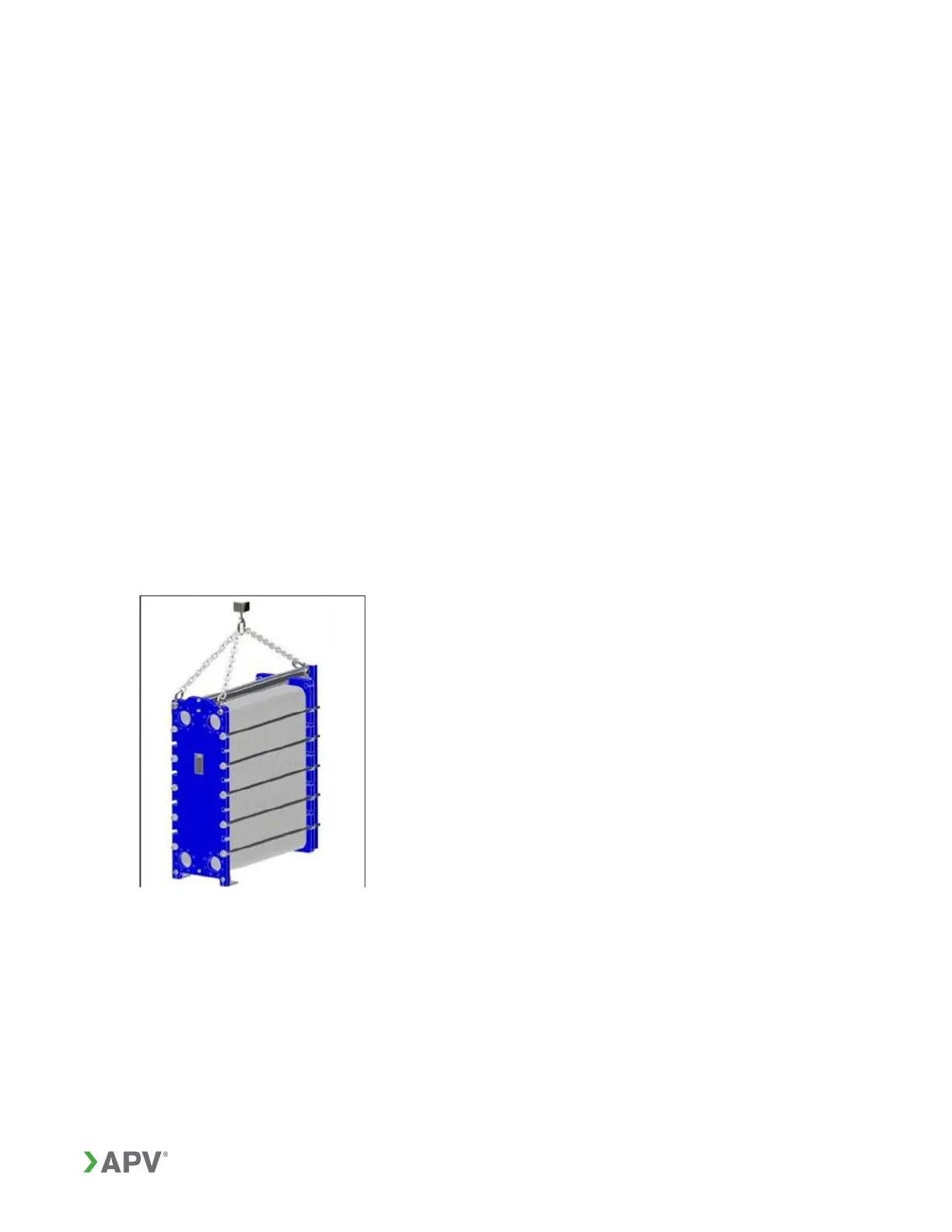
lifting. The customer drawing shows their size and location. When lifting an assembled
heat exchanger frame, ensure that the lifting point is approximately above the center of
the plate pack (Figure 32). SPX FLOW will specify the use of a spreader beam when
required for weight considerations. The customer may also specify that a spreader
beam is required for lifting. The spreader beam requirement will be indicated on the
customer drawing and a separate lifting drawing may be required.
Figure 32: Lifting point
If the APV GPHE is packed and transported lying flat on the head, care must be taken
during removal from the pallet, to avoid sliding and bending of the equipment base or
feet (Figure 33).
Note: Typically, the feet are removed from the GPHE and attached to the pallet.
Caution must be used during lifting to avoid damage to the studded or nozzle
connections.



 To Next Page