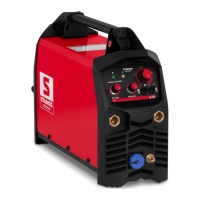
This document serves as a user manual for the STAMOS S-ALU 220 UK welding machine, part of the STAMOS WELDING GROUP. It provides essential safety warnings, operational instructions, technical specifications, and maintenance guidelines for the device.
Safety Warnings and Precautions
The manual emphasizes the importance of following basic safety precautions to reduce the risk of personal injury and equipment damage. Users are advised to read all instructions before operating the tool. Key safety points include:
- Work Area Precautions: Keep the work area clean, well-lit, and free of flammable materials. Avoid operating power tools in explosive atmospheres. Keep bystanders, children, and visitors away from the work area and use barriers or shields as needed.
- Electrical Safety: Grounded tools must be plugged into properly installed and grounded outlets. Never remove the grounding prong or modify the plug. Do not use adapter plugs. Double insulated tools with polarized plugs should be used correctly. Avoid body contact with grounded surfaces. Do not expose power tools to rain or wet conditions. The power cord should not be abused, kept away from heat, oil, sharp edges, or moving parts, and replaced if damaged. When operating outdoors, use outdoor-rated extension cords.
- Personal Safety: Stay alert, watch what you are doing, and use common sense. Do not operate the tool when tired or under the influence of drugs, alcohol, or medication. Dress properly, avoiding loose clothing, jewelry, or long hair that could get caught in moving parts. Ensure the power switch is off before plugging in. Remove adjusting keys or wrenches before turning on the tool. Maintain proper footing and balance. Always use safety equipment, including eye protection, dust masks, non-skid safety shoes, hard hats, or hearing protection.
- Tool Use and Care: Use clamps or other practical means to secure the workpiece. Do not force the tool; use the correct tool for the application. Do not use the power tool if the power switch does not turn it on or off. Disconnect the power cord plug from the power source before making adjustments, changing accessories, or storing the tool. Store idle tools out of reach of children. Maintain tools with care, keeping cutting tools clean. Check for misalignment, binding, or breakage of parts. Use only manufacturer-recommended accessories.
Specific Safety Rules
The manual outlines specific safety rules for the S-ALU 220 UK:
- Maintain labels and nameplates on the tool.
- Always wear approved safety impact eye goggles and heavy work gloves.
- Maintain a safe, well-lit, and obstruction-free working environment. Avoid using the tool near flammable chemicals, dusts, or vapors, or in damp/wet locations.
- Avoid unintentional starting; ensure readiness before turning on the tool.
- Never leave the tool unattended when plugged in.
- Always unplug the tool before inspection, maintenance, or cleaning.
- Prevent eye injury and burns by wearing appropriate personal safety clothing and devices, including a welding helmet with at least a number 10 shade lens, leather leggings, fire-resistant shoes/boots, and head/neck coverings. Use aprons, capes, sleeves, shoulder covers, and bibs designed for welding. Wear flame-resistant earplugs or muffs in confined spaces.
- Prevent accidental fires by removing combustible material from the work area, protecting combustibles with fire-resistant covers, or relocating the work. If relocation is not possible, designate a fire watch. Do not weld or cut on materials with combustible coatings or internal structures without approved methods for hazard elimination. Do not dispose of hot slag in combustible containers. After welding, thoroughly examine for fire. Avoid welding in atmospheres containing dangerously reactive or flammable gases, vapors, liquids, and dust. Provide adequate ventilation. Do not apply heat to containers that have held unknown substances or combustible materials without proper cleaning and purging.
- Inhalation Hazard: Welding and plasma cutting produce toxic fumes. Exposure can increase the risk of certain cancers and other diseases. Use natural or forced air ventilation and NIOSH-approved respirators. Keep your head out of the fumes and ensure adequate ventilation. In confined areas, work only with good ventilation or an air-supplied respirator. Follow OSHA and American Conference of Governmental Industrial Hygienists (ACGIH) guidelines for permissible exposure limits (PELs) and threshold limit values (TLVs). Have an industrial hygiene specialist check air quality and make recommendations.
- Keep hoses away from the welding/cutting spot and replace damaged hoses or cables immediately.
- Read and understand all instructions and safety precautions for the material being welded or cut.
- Secure cylinders to prevent falling. Use and store cylinders upright. Do not drop or strike cylinders. Use cylinder caps when moving or storing. Mark empty cylinders.
- Never use oil or grease on inlet/outlet connectors or cylinder valves.
- Use only the supplied torch for this Inverter Air Plasma Cutter.
- People with pacemakers should consult their physician before using this product due to electromagnetic fields.
- Use proper extension cords; ensure they are heavy enough to carry the current to prevent voltage drop and overheating. A 50-foot cord requires at least 12 gauge, and a 100-foot cord requires at least 10 gauge.
Provided Equipment
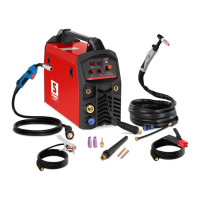
The S-ALU 220 UK comes with:
- Cable with mass clamp.
- Cable with TIG burner WP-26, including collets (1.6mm / 2.4mm / 3.2mm), ceramic nozzles (no 5, 6, 7), long cap, and tungsten.
- Cable with electrode holder MMA.
- Gas hose.
- Mask.
- Hammer.
- Brush.
Device Features and Technology
The S-ALU 220 UK is a STAMOS WELDING GROUP product, certified with CE and RoHS, ensuring high quality and long lifespan.
- MOSFET Technology: This welder utilizes MOSFET technology, which ensures high efficiency (93%). It provides a stable welding current and perfect fusion welds, making the machine light and compact.
- Standard Supply Voltage: The welder operates on a 230V single-phase socket (230V +/- 10%).
- Inert Gas: For WIG/TIG welding, inert gas (e.g., argon) is required.
- Fans: Efficient fans ensure optimal heat release during operation.
Legend of Controls (Front Panel)
- LED Display: Displays the current intensity value.
- Power Supply Indicator (2): Lights up when the machine is switched on.
- Overloading / Failure Indicator (3): Lights up in two cases:
- Machine failure, rendering it inoperable.
- The welder exceeds the standard overloading time, switching into emergency mode and turning off due to temperature and overheating control. The fan may continue to operate for cooling. Once the red lamp turns off, the device has cooled to working temperature and can be used again.
- Start Current (4): Initial current, active with 4T function, for proper electric arc initiation (10-220 A).
- Peak Current (5): Active with pulsation, switches current between main (CURRENT) and low current during pulsation welding (10-220 A).
- Base Current (6): Arc supporting current in PULSE mode (10-220 A).
- Final Current (7): Active with 4T function, for selecting proper end current to extract the fusion weld properly (10-220 A).
- Pulse Frequency (8): Frequency in time unit for impulse welding (0.5-5 Hz).
- Duty Cycle (9): Pulse fulfillment, ratio of pulse time duration to pulse period (10-90%).
- Post Gas (10): Gas access time after electric arc decay, adjusted in second intervals (1-10 s). Important for cooling and protecting the fusion weld against oxidation.
- Clean Width (11): Percentage difference of time between positive and negative current direction in one welding current period (-5 / +5).
- WIG/TIG (12): Welding method using an infusible wolframic electrode and neutral gases (argon or helium) for protection. Suitable for all welded metals. Current type, polarization, and curtain gas depend on the metal type. The device uses a WIG burner with a wolframic electrode, argon curtain gas release nozzle, and fluxing agent. Recommended wolframic electrodes: red for steel/precious steel, green for aluminum, black for steel/cast iron, gold/grey for universal applications. Recommended electrode sizes: 1.6mm, 2.4mm, 3.2mm for various plate thicknesses. Gas nozzle sizes: 7 for universal, 5 for precise welding.
- MMA (13): Electric arc welding (E-Hand/MMA), an early method still in use, where welding energy is generated by an electric arc between a consumable electrode and the welded element.
- AC/DC (14): Allows welding with direct current (DC) or alternate current (AC). AC is used for light metals (aluminum, titanium), while DC is used for most other metals (constructional steel, free-machining steel).
- 2T/4T Selection Button (15): Selects between "2T" (non-self lock) and "4T" (self lock) TIG welding procedures.
- Pulsation Function Switch-key (P): Additional pulsation function to provide more energy without significantly increasing the welded element's temperature.
- Switch-key / Breaker Switch (On/Off): Turns the device on or off.
- TIG/WIG Connector (17, 19): Connections for the TIG/WIG burner.
- MMA Connection (18): Connection for MMA welding.
- Foot-operated Connector (20): For foot pedal operation.
- Mass Conduit Connector (21): Connection for the mass clamp.
- Gas / Air Connection (22): Located at the rear side of the welder.
- Earthing (23): Bolt with earthing marking at the rear. The device must be earthed with a conduit of at least 6mm cross-section to protect against voltage loss.
Technical Specifications (S-ALU 220 UK)
- Supply Voltage: Single phase AC 230V±10%
- Frequency: 50/60 Hz
- Rated Input Current (A): TIG 23.7, MMA 36.3
- Output Current Regulation (A): TIG 10-220, MMA 10-220
- Rated Working Voltage (V): TIG 16.8, MMA 26.8
- No-load Voltage (V): 59
- Clean Width: -5/+5
- Pulse Duty Cycle (%): 10-90
- Post Gas (s): 1-10
- Pulse Frequency (low frequency) Hz: 0.5-5
- Base Value Current (A): 10-220
- Start Current (A): 10-220
- End Current (A): 10-220
- Pulse Current (A): 10-220
- Arc Ignition Mode: High-frequency
- Efficiency (%): 80
- Duty Cycle (%): 60
- Value of Current (A) at 100% Duty Cycle: TIG 170, MMA 170
- Power Factor: 0.73
- Class of Insulation: F
- IP Protection: IP21
Connection Diagrams
The manual provides diagrams for TIG welding and TIG welding with a foot pedal.
- TIG Connection:
- TIG burner
- Workpiece
- Mass clamp
- Gas
- Power supply
- TIG with Foot Pedal Connection:
- TIG burner
- Workpiece
- Mass clamp
- Foot pedal
- Gas
- Power supply
Start-Up and Operation
- Unpacking: Unpack all items and ensure they are present.
- Work Environment: Ensure good ventilation. The device is cooled by a fan, and guards should be installed so vent holes are at the front. Leave at least 15 cm space around the device for cleaning and cooling. Inadequate cooling reduces make-time.
- Conduits Connection: The device is equipped with a feeder cable for electric voltage. Connecting to a current source with voltage exceeding the rated supply or improper phase can damage the machine, which is not covered by warranty.
- WIG-Welding:
- Insert the wolframic electrode into the collet, then put the housing onto the collet and tighten the holder head (nozzle).
- TIG-welding Instruction: Clear the station before welding. TIG welding is sensitive to surface contamination; remove paint, grease, and oxidized layers from the surface to be welded.
- DC TIG-welding:
- Connect the gas hose to the welder supply socket and to the welding gun/argon supply.
- Connect the weld piece to the mass clamp in the welder, outlet (+).
- Connect the welding handle plug to the arc and argon control rod.
- Gas Test: Check electric supply connection and switch on. Open the argon bottle valve and flow meter. Press the gun switch-key to select appropriate gas flow. Release the switch-key to stop gas inflow automatically after several seconds. For high-frequency ignition, retract the wolframic electrode 2-3 mm from the weld piece. After switching on, the arc triggers. Switching off reduces current intensity and deactivates the arc. Gas must cool the fusion weld to prevent oxidation. After welding, switch off the argon supply button and welder supply. Do not pull the electric supply plug while the switch is on.
- Manual Welding with the Electrode (MMA):
- Connect the E-Hand conduit to the negative pole (-).
- Set the current intensity regulator at the proper intensity (impulse current regulator in lower position). Select current according to the empirical formula I=40d, where d is the electrode diameter.
- Ensure positive and negative connection during welding.
- Connect the welder to the electric supply socket and turn on the main switch; the control lamp will light.
- Pay attention to the relative intensity of welding current and the welder's make-time. Overloading can cause damage.
- After operation, leave the device to cool, then switch off the supply.
Maintenance
- The gun should be checked for wear, cracks, or bare conduits. Replace or repair worn elements. A worn gun nozzle can decrease welding speed, voltage drop, and cause uneven cutting lines. The external part of the electrode should not be deeper than 3.2 mm. Check screw threads if there are issues with tightening the protective cap.
- Weekly Maintenance: Check if the room ventilation works properly.
Used electrical and electronic devices must not be disposed of with unsorted household waste but must be collected separately according to European directives (WEEE 2012/19/EU). The symbol of a wheeled bin indicates the need for separate collection. Users are encouraged to contribute to environmental protection by returning devices to designated collection systems. In Germany, users are legally obligated to dispose of old devices separately from unsorted household waste. Public waste management authorities provide free collection points for old devices from private households. Local waste calendars or city/municipal administrations provide information on return and collection options. Incorrect disposal of electrical and electronic waste can be penalized.
expondo Polska sp. z o.o. sp. k.
ul. Nowy Kisielin-Innowacyjna 7
66-002 Zielona Góra | Poland, EU
e-mail: info@expondo.de

 Need help?
 General


 To Next Page