Need help?
Do you have a question about the Stannah 320 Outdoor and is the answer not in the manual?
Overview of essential parts for stairlift functionality, power, and movement.
Features for safe user access and obstacle detection.
Controls to call the stairlift from the opposite end of the staircase.
The main power switch located on the stairlift base.
Step-by-step guide to activating and deactivating the stairlift using the power key.
How to operate the optional controls to move the stairlift along the rail.
Instructions on how to fold the stairlift seat for space saving.
Guide to safely sitting, using the seatbelt, and starting the stairlift.
Detailed instructions on using the joystick to move the stairlift.
Instructions on how to swivel the seat for easier mounting and dismounting.
Steps to safely dismount from the stairlift.
Method for cleaning the stairlift rail and upholstery using a damp cloth.
Specifies the maximum weight capacity and technical specifications of the stairlift.
Guidance on the proper disposal and recycling of the stairlift product.
Instructions for manually moving the stairlift in case of a stoppage.
A comprehensive list of safety guidelines for proper stairlift operation and user conduct.
Detailed steps to diagnose and resolve issues when the stairlift fails to move.
Guidance on addressing beeping sounds, likely related to battery status.
Explanation of labels found on the stairlift, including model and weight limit.
This document is a user guide for the Stannah 320 Outdoor stairlift, providing comprehensive instructions on its operation, maintenance, and safety. The guide emphasizes Stannah's commitment to quality and customer care, ensuring users can maintain their independence and safety at home.
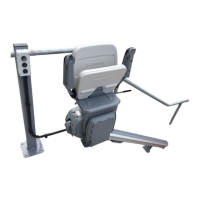
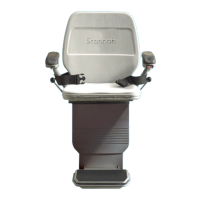
The Stannah 320 Outdoor stairlift is a device designed to transport a seated person up and down stairs safely, particularly for outdoor use. It incorporates a manual swivelling chair and is powered by batteries, ensuring operation even during a power cut. The stairlift is designed to be user-friendly, with controls that allow for easy movement along the rail. It also features additional calling controls, which are optional, to summon the stairlift from either the top or bottom of the staircase. A key safety feature is the delayed start, which ensures the user is ready before the stairlift begins to move. The chair can be folded away when not in use, providing more space on the stairs.
To use the stairlift, the user must first turn on the power key, located on the underside of the chair arm, and switch the on/off switch to the 'on' position. A green power light on the armrest will illuminate, indicating the stairlift is ready. The additional calling controls, if present, can then be used to call the stairlift to the desired end of the stairs. These controls will only work if the power key is on.
Before sitting, the user should ensure the on/off switch is in the 'off' position and the power light is off. To unfold the chair, both armrests, the seat, and the footrest should be lowered. Once seated, the user must pull the seatbelt across and fasten it securely. The guide strongly emphasizes the importance of always wearing the seatbelt and only undoing it when safely at the top or bottom of the stairs.
To start the stairlift, the user moves and holds the joystick in the direction they wish to travel. After a few seconds, the stairlift will begin to move. Releasing the joystick at any point will stop the stairlift. When the stairlift reaches the top or bottom of the stairs, it will stop automatically.
A key feature for getting on and off the stairlift is the swivel seat. At the top of the stairs, the user can push down the swivel levers on both sides of the seat to swivel the seat towards the landing, making it easier to dismount. This swivel action is a safety feature and only works in the direction of the top of the stairs. The seat can also be swivelled to make it easier to get on when going back down.
After dismounting, the user should ensure the on/off switch is off and the power light is off. They can then carefully get off the stairlift, swivel the seat back to its travelling position, and fold the chair away if desired to maximize space on the stairs.
In the unlikely event that the stairlift stops while travelling and causes an obstruction, a hand-winding tool is provided. To use it, the user must first switch off the master power switch (located on the back of the chair base), remove the plastic cap on the side of the chair base, and insert the hand-winding tool into the labelled hole. By pushing the safety edge and turning the handle as indicated on the chair base label, the stairlift can be manually moved. A critical safety notice warns against using the stairlift when the hand-winding tool is in the hole.
The guide recommends that Stannah stairlifts are serviced twice a year by a Stannah-trained service engineer to ensure safe operation. A "Service Log" is provided to record installation details and subsequent service visits, including the date, service details, and the engineer's name.
For general cleaning, the rail and upholstery can be cleaned with a damp cloth to remove dust and dirt. Users are explicitly warned against using solvent cleaners, bleaches, abrasives, synthetic detergents, wax silicone polishes, or aerosol sprays without first checking with their Stannah supplier, as these could damage the stairlift.
The stairlift is equipped with a battery charger that ensures the batteries are always charged and ready to travel, even during a power cut. The master power switch, located on the back of the chair base, should normally be left switched on. However, if the stairlift will not be used for more than a week (e.g., during a holiday), the master power switch can be turned off. Users are reminded to switch it back on upon their return.
The guide also addresses troubleshooting common issues. If the stairlift does not move and the power light is off, users should check that the master power switch is on and that the power key is inserted and turned to the 'on' position. If the power light is on but the stairlift doesn't move, users should check that the chair is swivelled back to its travelling position with the swivel levers fully pushed down, and ensure there are no obstructions contacting the safety edges. If an obstruction is found, the stairlift can be moved in the opposite direction to remove it.
If the stairlift still does not move after these checks, users are advised to turn the power key off and then back on, then move and hold the arm control in the downward direction. If the stairlift stops during this process, they should repeat these steps until they reach the bottom of the stairs. If these steps fail, users should contact their Stannah supplier.
If the stairlift is beeping, it indicates that the batteries are not being charged. The stairlift can still run on battery power, but users should check that the wall switch is on and that there hasn't been a power cut. If the fault cannot be corrected, the beeper can be turned off by switching the master power switch to the 'off' position, and the Stannah supplier should be contacted.
The document also includes information on recycling and disposal, advising users not to dispose of any part of the product as everyday rubbish and to contact their Stannah supplier for information on proper recycling and disposal.
 General
| Type | Outdoor Stairlift |
|---|---|
| Platform Width | Not applicable |
| Platform Depth | Not applicable |
| Rail Length | Custom made to fit the staircase |
| Power Supply | 24V DC battery powered, charged from a mains supply |
| Safety Features | Seat belt |
| Maximum Travel Height | Customizable to fit staircase |
| Motor Power | 24V DC motor |
| Operating Temperature | -10°C to 40°C |
| Environment | Outdoor |

 To Next Page