- 17 -
es
it
gb
p
cz
fr
and the chain sprocket. Remove any sawdust or wood
shavings.
3- Replace the cover and retighten the chain lever (5) and
secure it as indicated in the section Changing the chain/bar
in points 6, 7 and 8 (Figures F, G and H).
Cleaning the oil outlet
Particles and debris can accumulate in the chain lubrication
oil outlet, which can eventually reduce the oil ow and
shorten the service life of the tool and the chain.
1- Remove the bar cover (11) following points 1 and 2 of the
section Changing the chain / bar (Figures A and B).
2- The oil outlet is located next to the bar insertion shaft.
Use a toothpick or screwdriver to remove as much dirt as
possible from the oil outlet.
3- Insert the battery into the tool and operate it without a load.
This will cause the tool to pump oil automatically, ejecting any
dirt that may remain in the line.
4- Remove the battery, replace the cover and retighten the
chain lever (5) and x it as indicated in the section Changing
the chain / bar in points 6, 7 and 8 (Figures F, G and H).
Changing the chain nut
If you notice that the chain nut is worn from use, it must be
replaced.
To replace the chain nut, the retaining washer must rst be
removed. Both parts must be replaced at the same time.
After removing the old retaining washer and gear, rst install
the new gear and then the new retaining washer.
Sharpening the chain
The chain loses its sharpness as it is used. It is essential to
keep it sharp for optimum performance and long tool life.
If you nd that your cuts are generating too much dust or
sawdust instead of shavings, if your cuts are taking longer
than usual to complete, or if the cut is coarser than it should
be, sharpen the chain, have it sharpened or replace it.
HEDGE TRIMMER HEAD
Before any operation, and once for every hour of continuous
operation, apply a low viscosity lubricant along the length of
the bar.
After work, use a wire brush to remove dirt, carefully wipe the
bar with a dry cloth and if necessary use a cloth dampened
with soapy water. Finally, lubricate the guide bar with low
viscosity oil.
Never use petrol, alcohol or ammable liquids to clean the
tool.
Never wash the guide bar with water directly, as this could
rust and damage the tool.
BatteryWhen the battery is no longer operative, please refer
to an authorised aftersales service agent for Stayer power
tools.
If the machine should fail despite the care taken in
manufacturing and testing procedures, repair should be
carried out by an aftersales service centre for Stayer power
tools.
TRANSPORT
he contained lithiumion batteries are subject to the
Dangerous Goods Legislation requirements. The user can
transport the batteries by road without further requirements.
When being transported by third parties (e.g.: air transport
or forwarding agency), special requirements on packaging
and labelling must be observed. For preparation of the item
being shipped, consulting an expert for hazardous material
is required.
Dispatch batteries only when the housing is undamaged.
Tape or mask o open contacts and pack up the battery in
such a manner that it cannot move around in the packaging.
Please also observe possibly more detailed national
regulations.
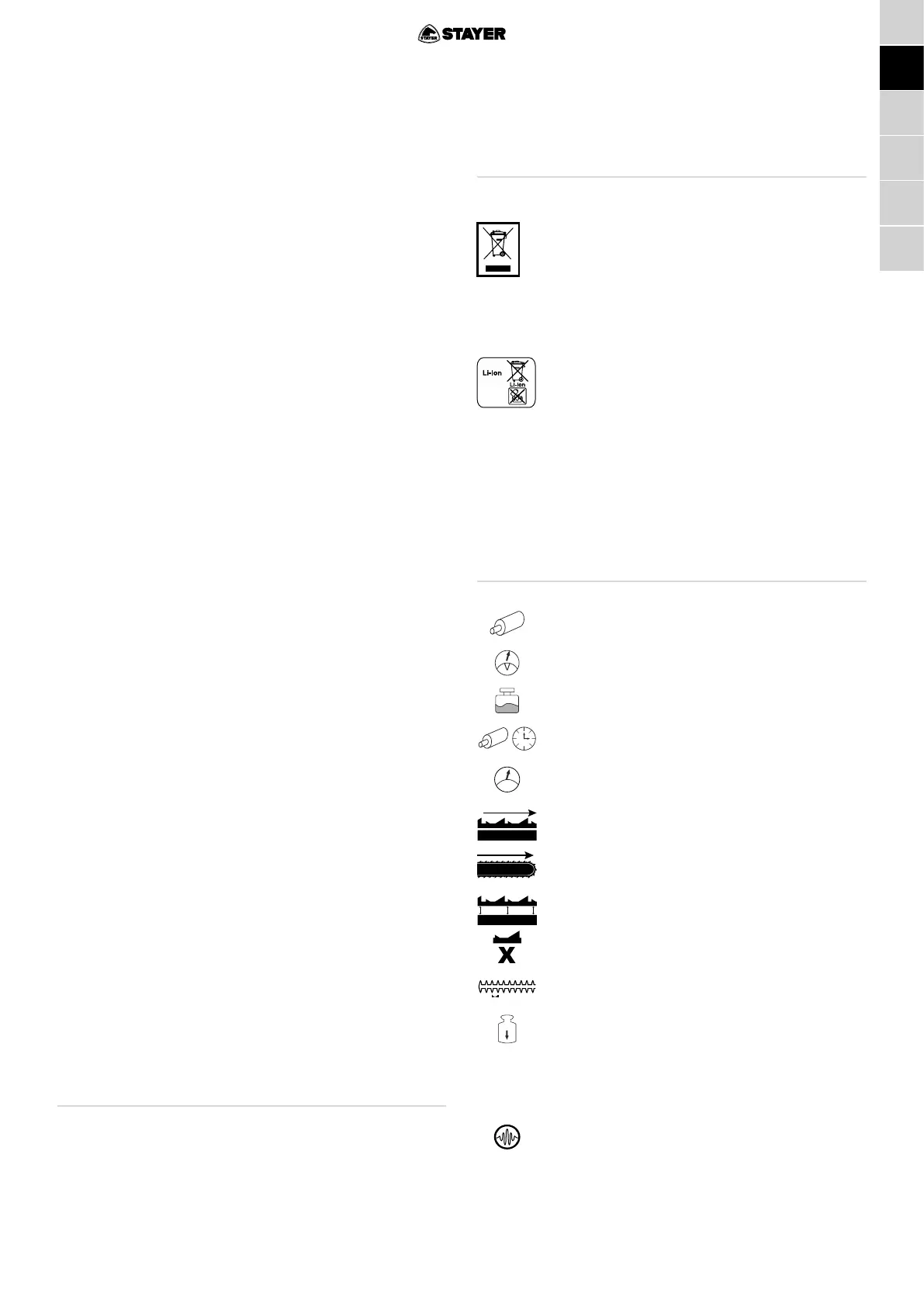
DISPOSAL
The machine, accessories and packaging should be sorted
for environmental-friendly recycling.
Only for EC countries:
Do not dispose of power tools into house-hold waste!
According the European Guideline 2012/19/EU
for Waste Electrical and Electronic Equipment and its
implementation into national right, power tools that a re no
longer usa-ble must be collected separately and disposed of
in an environmentally correct manner.
Battery packs/batteries:
Li-Ion:
Please observe the instructions in section
“Transport”. Do not dispose of battery packs/batteries into
household waste, re or water. Battery packs/batteries should
be collected, recycled or disposed of in an environmental-
friendly manner.
Only for EC countries:
Defective or dead out battery packs/batteries must be
recycled according the guideline 2006/66/CE.
TECHNICAL SPECIFICATIONS
L
PA
L
WA
rp
m
= Battery
= Voltage
= Battery power
= Charging time
= Idle speed
= Chain speed
= Bar size
= Chain thickness
= Number of links in the chain
= Sprocket spacing
= Weight
= Sound power level.
= Sound pressure level.
= Vibration
The values given are valid for nominal voltages [U]230/240
V-50/60 Hz - 110/120 V - 60Hz. For lower voltage and
models for specic countries, these values can vary.


 To Next Page
 Loading...