2
INSSDHX1018
COIL
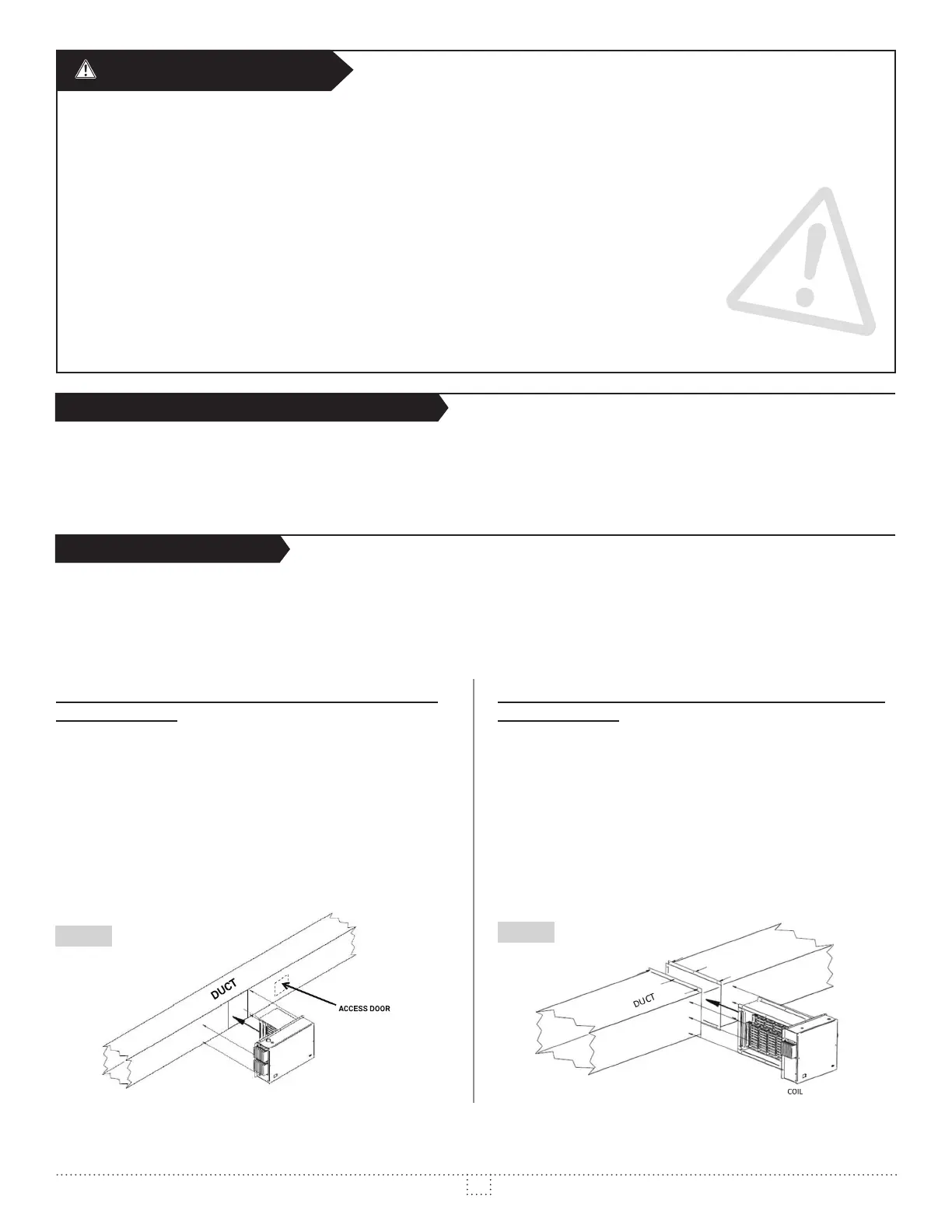
FIG. 1
FIG. 2
Minimum of 24 inches
between the heating coil
and the access doors or
circulators, except if a
metallic screen is
supplied with the coil.
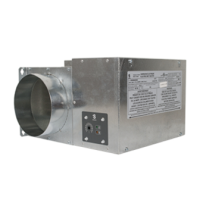
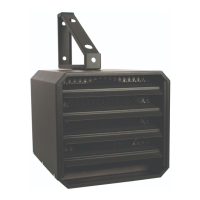
MECHANICAL INSTALLATION OF THE SDHI(T)
DUCT HEATER – FIG. 1
• The ventilation ducts on both sides of the duct heater must be
sufciently supported, based on the weight of the unit.
• Cut an opening in the duct according to the dimensions of the duct
heater. Allow for a 1/8 in. tolerance for the opening you have cut out.
• Fix the duct heater using metal screws and seal the joints and
openings.
• For the maintenance or repair of the duct heater and to permit
removal of the duct heater or its elements, keep a distance equal
to or greater than the depth dimension W+ control box + 12 in.
between the control box and obstructions.
MECHANICAL INSTALLATION OF THE SDHF(T)
DUCT HEATER – FIG. 2
• On the two duct openings that face each other, bend the anges
outward so as to x the corresponding anges of the duct heater.
• Fix the anges of the duct heater to those of the duct by using
metal screws.
• Seal the joints.
This product should not come into contact with a water source and must be protected from splashes. Do not use the unit if any part has been submerged. Also, do
not activate or disable the unit when you have your feet in water or wet hands.
Since this unit runs hot, there are risks even when the unit is functioning normally. Use caution, judgement and diligence when using it. To avoid burns, do
not let bare skin touch hot surfaces. Allow the unit to cool slightly before handling (it stays warm for a time after functioning).
Never block the air inlets and outlets of the unit. This obstruction could lead to overheating, which could cause a re.
Do not insert foreign objects into the air inlets and outlets of the unit, as this may cause damage and lead to electrical shock or re.
The unit includes hot working components that can produce electrical arcing (sparks). It is not designed to be used or stored in a wet location, or a location containing
ammable liquids, combustible, corrosive, abrasive or chemical materials or explosives such as, but not limited to, paint, gasoline, chlorine and cleaning products.
Some areas are dustier than others. It is therefore the responsibility of the user to evaluate whether to change the lter according to the amount of dirt
accumulated on it. There is a risk of re if the product is not installed and maintained in accordance with these guidelines.
Activation of the thermal protection indicates that the unit has been subjected to abnormal operating conditions. If it remains activated or is turned on and off repeatedly, it
is recommended to have the unit inspected by a qualied electrician or a certied repair centre to ensure that it is not damaged (refer to the limited warranty beforehand).
If the unit is damaged or defective, cut off its power at the breaker/fuse and have it repaired at a certied repair centre (refer to the limited warranty beforehand).
Identify the wiring before unplugging the unit, so as to make sure you can reconnect the unit later on. Incorrect connections may cause a malfunction and pose a danger.
WARNING
• The duct heater must be handled with care.
• Remove the protective packaging right before installation.
• Verify the condition of the elements, ceramics and components.
• Notify the manufacturer if the duct heater has been damaged.
RECEPTION AND HANDLING OF THE DUCT HEATER
CAUTION: NEVER USE A STANDARD DUCT HEATER FOR AN APPLICATION WITH A RISK OF EXPLOSION.
The air owing through the duct, where is installed the duct heater, must not contain any combustible and/or ammable material.
SDHx(T) units must always be installed with their heating elements placed horizontally (+/-15 DEGREES). The duct heater must be installed in
the duct in accordance with the applicable codes in your area.
MECHANICAL INSTALLATION


 To Next Page
 Loading...