
 Need help?
Do you have a question about the STIEBEL ELTRON DHF 13 C and is the answer not in the manual?
Details on intended audience and key information for users and contractors.
Guidelines and warnings for safe operation and hazard prevention.
Explanation of how safety instructions are presented with keywords and risk types.
Definition of symbols used for different types of risks like electrocution or burns.
Explanation of keywords like DANGER, WARNING, CAUTION and their severity.
Identification of symbols used for general information and required actions.
Information on the units of measurement used throughout the documentation.
Describes the proper and intended applications of the appliance for domestic and non-domestic use.
Key safety warnings regarding high temperatures, user age, and frost protection.
Instructions to refer to the appliance's type plate for test symbols.
Details about the tubular heater heating system and its suitability for soft water areas.
Guidance on selecting output stages for different usage scenarios.
Advice on adjusting tap settings for optimal water temperature and flow.
Steps to recommission the appliance after a water supply interruption.
Identifies common problems, their causes, and suggested remedies.
Essential safety precautions for installation, commissioning, maintenance, and repair.
Importance of using original accessories and spare parts for reliable function.
Requirement to observe all applicable national and regional regulations and instructions.
List of items included in the standard delivery of the appliance.
Details on optional accessories such as taps, valves, and installation sets.
Guidelines for selecting a suitable installation location, considering frost risk and orientation.
Diagram showing required clearances around the appliance for proper operation and maintenance.
Instructions for connecting the water supply, emphasizing not to use preheated water.
Requirements for pressure taps and suitable thermostatic pressure valves.
Specifies allowed materials for cold water inlet and DHW outlet pipes.
Diagram illustrating undersink installation setup with cold water inlet and DHW outlet.
Steps for electrical and water connections for standard installation on unfinished walls.
Instructions on how to open the appliance cover for installation access.
Diagram showing how to prepare the power cable with specific dimensions.
Instructions on how to fit the wall mounting bracket and attach the appliance.
Adjusting wall clearance and securing the back panel with offset tiles.
Procedure for connecting the water supply to the appliance.
Instructions for fitting the strainer and plastic profile washer into the shut-off valve.
Procedure for fitting the cable grommet into the appliance cover.
Guidance on routing the power cable through the appliance cover for finished walls.
Instructions for connecting a load shedding relay for priority control with other appliances.
Steps for water installation on finished walls, including fitting water plugs with gaskets.
Final steps to complete the installation, such as opening shut-off valves.
Guidelines for commissioning the appliance, to be performed by a qualified contractor.
Steps for the initial start-up and functional check of the appliance.
Guidance on explaining appliance functions and safety to the user.
Instructions for recommissioning the appliance, referring to other chapters.
Steps to safely shut down the appliance, including power isolation and draining.
Identifies common faults, their potential causes, and recommended remedies.
Procedure for draining the appliance for maintenance or frost protection.
Instructions for cleaning the strainer located in the 3-way ball shut-off valve.
Detailed diagrams of appliance dimensions and water/electrical connections.
Electrical wiring diagrams for different voltage configurations and priority control.
Tables showing DHW output in liters per minute at various temperatures and loads.
Pressure drop values for different tap types at a specified flow rate.
Recommendation for appliance pressure drop when sizing pipework.
Product data on energy consumption complying with EU regulations.
Detailed technical data including electrical, hydraulic, and dimensional information.
Details on guarantee applicability and conditions for appliances acquired outside of Germany.
Request to help protect the environment by disposing of materials according to regulations.
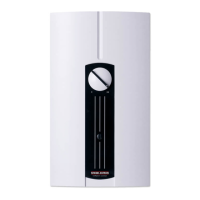
This document outlines the operation, installation, and maintenance of a hydraulically controlled instantaneous water heater, designed for domestic use but also suitable for non-domestic environments like small businesses, provided it's used in the same manner. The appliance is engineered to heat domestic hot water (DHW) and can serve one or multiple draw-off points.
The instantaneous water heater operates by heating water as it flows through the appliance. When a tap is opened, the unit automatically begins heating at the selected output once a minimum start-up volume is exceeded. The hot water volume and temperature can be adjusted at the tap by mixing in cold water. The device offers two output stages, which are hydraulically controlled in relation to the flow rate. A flow meter compensates for pressure fluctuations, ensuring largely stable temperatures. The control unit limits the flow rate to guarantee an adequate increase in DHW temperature at all times. The heating system features a pressure-tested copper cylinder with tubular heaters, suitable for soft water areas.
The appliance is designed for safe use by individuals aged 3 and up, as well as persons with reduced physical, sensory, or mental capabilities, or a lack of experience and know-how, provided they are supervised or have received instructions on safe usage and understand the associated risks. Children must not play with or clean the appliance unless supervised.
The water heater offers two output settings:
Users can select the desired output by clicking the output selector into the appropriate position. When using a thermostatic valve, it is recommended to set the output selector to full power. If the outlet temperature is not high enough with the draw-off valve fully open at full power, it indicates that more water is flowing than the heating system can handle, and the water volume at the draw-off valve should be reduced. A low draw-off rate results in a high outlet temperature, while a high draw-off rate leads to a low outlet temperature. For twin lever taps, the partial load is suitable for washbasins, and the full load for baths, showers, and sinks. If the temperature is too high, cold water can be mixed in. For mono lever mixers, the full load is suitable for all applications. To adjust the temperature, turn the tap lever to the highest temperature, fully open the tap, then slowly close it to increase the outlet temperature, or add cold water/open the tap further to reduce it.
Regular maintenance ensures the longevity and efficient operation of the water heater.
Installation, commissioning, maintenance, and repair should only be carried out by a qualified contractor. The appliance must be installed in a frost-free room, vertically, and near the draw-off point. It is suitable for both undersink and oversink installations. The wall must have sufficient load-bearing capacity. Minimum clearances must be maintained for trouble-free operation and maintenance. The appliance should never be operated with preheated water. The water line must be thoroughly flushed before installation. Appropriate pressure taps must be used, and open taps are not permitted. Thermostatic pressure valves must be suitable for hydraulically controlled instantaneous water heaters. The shut-off valve in the cold water inlet is for shutting off the appliance, not for reducing flow rate. Permissible water pipe materials include galvanized steel, stainless steel, copper, or plastic for the cold water inlet (with a 1m metal pipe section before the appliance for plastic pipes). The DHW outlet line should use stainless steel or copper pipe, as plastic pipework is unsuitable. The back panel should be secured with an additional screw at the bottom. Electrical connection must be permanent, with an isolator disconnecting all poles with at least 3mm contact separation. The appliance must be earthed, and the specified voltage must match the mains voltage. A load shedding relay can be installed for priority control with other electric appliances.
 General
| Type | Instantaneous water heater |
|---|---|
| Power Rating | 13 kW |
| Voltage | 400 V |
| Temperature Range | 30 - 60 °C |
| Frequency | 50 Hz |
| Water connection | G 1/2" |
| Protection class | IP 25 |




 To Next Page

