12
The saddles in the column provide a large surface
area to maximise the contact between the liquid and
vapour flows in the column, which accelerate the
refluxing action.
The T500 Reflux Condenser has been carefully
engineered to provide a continuously compensating
reflux rate. As the distillation process progresses,
the alcohol concentration in the wash reduces. To
maintain high purity of alcohol being produced, the
refluxing ratio will increase to compensate and the
alcohol production will slow. This slowing is most
noticeable after two hours of alcohol production.
Towards the end of the distillation the alcohol purity
remains high, but output will slow until it stops
altogether. At this point the water vapour will keep
rising and condensing part way up the column, but
nothing will reach the top of the column to pass into
the condenser. The alcohol extraction is finished at
that point.
HOW MUCH ALCOHOL WILL I GET?
With a 6 kg (13 lb) sugar, Turbo Classic Yeast wash,
you will get approx 3.2-3.6 L (0.8-1.0 US Gal) of 93%
ABV alcohol, that’s the equivalent of 7-8 L (1.8-2 US
Gal) of 40% ABV spirit.
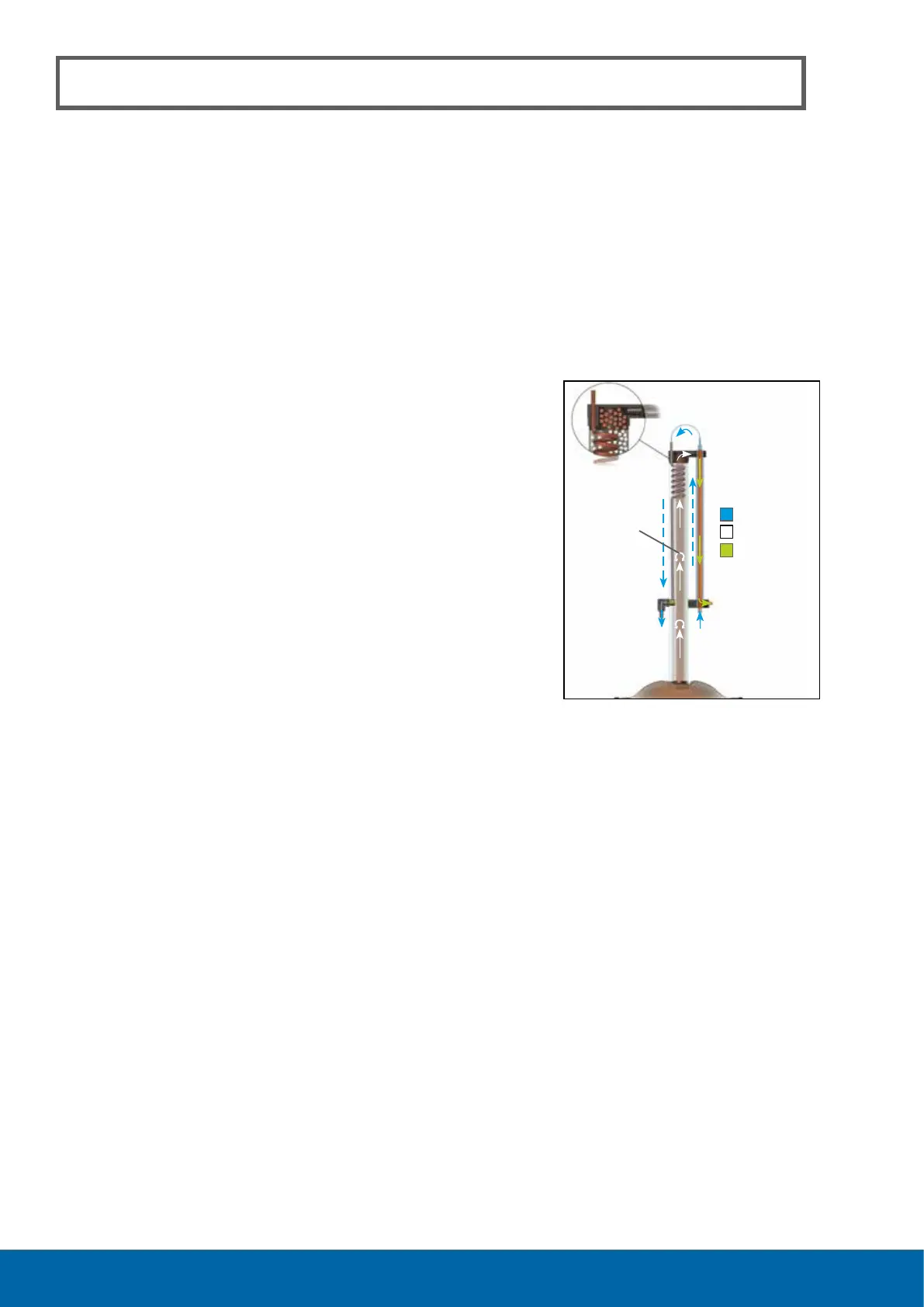
HOW DOES DISTILLATION IN THE T500 REFLUX
DISTILLATION SYSTEM WORK?
The wash is heated in the boiler to boiling point and kept
at boiling point throughout the distillation process. The
vapour boiled o from the wash rises up the column,
in which the vapours of the heavier liquids (water and
heavier undesirable molecules) condense and fall
back down. The alcohol vapour, being lighter than
water vapour, is rising up to the top of the column and
condenses back in the condenser into a liquid alcohol.
This cycle of evaporation, rising and condensing, is
continuous and is described as refluxing.
water flow
alcohol vapour
alcohol liquid
refluxing
water
out
water
in
distillate out
WHAT IS THE BLACK STUFF I ADD IN MY WASH?
It’s activated carbon, designed to absorb unwanted
flavours produced during fermentation (see question:
Is it normal that my wash smells funny?). It comes in
dierent formats: powder, granules or liquid.
The carbon will turn the liquid black and won’t
dissolve. It will not harm the fermentation process.
The carbon is removed when the wash is cleared.
I’VE ADDED MY YEAST IN A WASH AT 40°C (104°F),
WILL IT STILL WORK?
Yes, yeast can be safely added in a wash between
20-40°C (68-104°F) maximum. Above 40°C (104°F),
yeast will die very promptly if the wash is not cooled
down quickly. This can be done by resting the
fermenter in a basin or bath of cold water.
HOW LONG IS THE FERMENTATION?
A wash usually takes between 4 and 10 days to
ferment depending on the yeast used
and temperature.
IS IT NORMAL THAT MY WASH SMELLS FUNNY?
During fermentation, yeasts produce alcohol, CO2,
as well as hundreds of by-products, which have
dierent smells, some pleasant (like pear, apple,
banana), others less pleasant (like rotten egg). This
will not taint your distilled spirit and will disappear
after distillation. Carbon filtration will further remove
those unwanted smells.
HOW DO I KNOW WHEN THE FERMENTATION
IS FINISHED?
A few ways:
1. Measure your SG with a hydrometer: start
of fermentation reads around 1.100 and end of
fermentation reads about 0.990. When your SG has
read 0.990 for two consecutive days, fermentation
is complete.
2. Look for fizziness, bubbles rising to the surface:
while it’s fermenting there are lots of bubbles coming
to the surface and at the end of fermentation there
are almost none.
3. Look for the haze in the wash: at the beginning
of fermentation, the wash will be very murky and
hazy, towards the end, it will start to become more
‘transparent’.
WHAT’S IN THE CLEARING AGENT AND HOW DOES
IT WORK?
The Still Spirits Turbo Clear is made of silica (Part A)
which charges floating particles and chitosan (Part
B) attracts all particles (with its opposite charges) to
eventually make them all settle on the bottom of
the fermenter.
SUPPLEMENTARY INFORMATION AND FAQS



 To Next Page
 Loading...