The device described in this manual is a set of CLICKLINE Instruments 10 mm manufactured by KARL STORZ. These instruments are designed for use in minimally invasive surgical procedures. The manual, identified as TBF107_EN_V1.0_10-2021_IFU_CE-MDR, was last updated in October 2021 and carries the CE 0123 marking, indicating conformity with applicable EU directives.
Function Description:
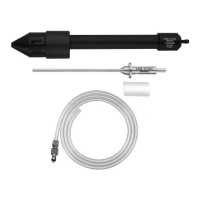
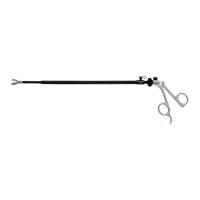
The CLICKLINE instruments are modular, take-apart operating instruments, primarily consisting of handles, inner and outer sheaths, and working inserts (forceps or scissors).
- CLICKLINE forceps (complete instrument): These are surgically invasive instruments intended for short-term use. Their primary functions include grasping, preparing, dissecting, and, if necessary, coagulating tissue during minimally invasive procedures.
- CLICKLINE scissors (complete instrument): These are also surgically invasive instruments meant for transient use. They are used for cutting and, if necessary, coagulating tissue in minimally invasive procedures.
- Handle: Handles are non-invasive and designed for short-term use. They serve as the guiding mechanism for the take-apart operating instruments. The manual illustrates two types: an insulated handle with an HF connection and an uninsulated handle without a surgical ratchet or HF connection.
- Inner and outer sheath: These are surgically invasive components intended for short-term use. They guide the working inserts during minimally invasive procedures. Both insulated (with an irrigation port) and uninsulated outer sheaths are available.
- Forceps insert: These are surgically invasive components for short-term use, used for grasping, preparing, and dissecting tissue.
- HF forceps insert: Similar to forceps inserts, but with the added capability for coagulating tissue. These are also surgically invasive and for short-term use.
- Scissor insert: Surgically invasive components for transient use, specifically for cutting tissue.
- HF scissor insert: Similar to scissor inserts, but with the added capability for coagulating tissue. These are surgically invasive and for transient use.
- Handle accessories: These are non-invasive and for short-term use, supporting the function of the corresponding handles. An example is the rotating wheel, which facilitates the rotation of the outer sheath.
Important Technical Specifications:
- Size and Length: The CLICKLINE instruments are 10 mm in size and available in a length of 36 cm.
- HF Application: For instruments with HF capabilities, the application type is Unipolar.
- Max. Peak Voltage Output: For insulated instruments, the maximum permissible peak voltage output is 3 kVp. Users are warned to select the generator setting to ensure this limit is not exceeded, as doing so could damage the product and cause injury.
- Interfaces:
- Outer sheath – working insert: Connects via a bayonet lock. Only working inserts and outer sheaths of the same length and size can be combined.
- Outer sheath - handle: HF handles combine with insulated outer sheaths. Uninsulated sheaths can only be assembled with metal handles without an HF connection. Insulated sheaths can also be assembled with metal handles.
- HF handle – HF cable: A unipolar connecting cable (specified in recommended accessories) connects to the HF connection on the handle, which then connects to an HF generator. The permissible peak voltages must be observed.
- Instrument – access systems: The outer sheath with working insert can be inserted percutaneously or through an access system. The outer diameter of the outer sheath determines the size of the access system needed.
- LUER plug connector with inner cone - LUER plug connector with outer cone: This interface is primarily for cleaning hoses during reprocessing and serves exclusively as a cleaning connector.
Usage Features:
- Intended Use: The medical devices are tool-like instruments suitable for minimally invasive examinations and treatments.
- Contraindications: Must not be used for procedures in direct contact with the central nervous system (CNS) and central cardiovascular system. No other product-specific contraindications are listed.
- Target User Populations: Only doctors and medical assistants with relevant specialist qualifications should use the device.
- Patient Groups: No restrictions on patient groups are specified.
- Assembly: The instruments are modular and require assembly. The working insert is introduced into the outer sheath and locked by a quarter turn. The outer sheath with closed jaws is then introduced into the handle until it locks. Handles with an HF connection can only be connected to insulated outer sheaths for safety reasons.
- Rotating Wheel: The rotating wheel (Art. no. 33120 or 33120 G) can be fitted on any CLICKLINE handle to facilitate rotation of the outer sheath.
- HF Current Application: When using HF accessories, they must only be connected to an HF generator with a type CF (Cardiac Floating) applied part or defibrillation-proof type CF applied part. Residues of cleaning agents, disinfectants, solvents, or flammable gases must be removed before HF applications. KARL STORZ recommends using CLICKLINE instruments with AUTOCON® series HF devices.
- Disassembly: Disassembly involves opening the handle, pressing and holding the locking button to pull out the outer sheath, and then rotating the outer sheath by a quarter turn to open the bayonet lock and pull out the working insert. If HF electrodes were used, they must be allowed to cool down before disassembly to prevent burns.
Maintenance Features:
- Reprocessing: The product is delivered unsterile and must be reprocessed according to the reprocessing instructions before initial use and every subsequent use. Reprocessing instructions are available for download from www.karlstorz.com/ifu.
- Product Testing: Before and after every use, the product must be inspected for functionality, damage, changes to the surface, completeness, and correct assembly. Damaged products must not be used and should be disposed of properly.
- Tissue Deposits: Tissue deposits from coagulation on HF applied parts should be removed with a sterile, moist surgical pad to maintain function.
- Repair: Repair work must only be performed by KARL STORZ or an authorized company. Contaminated devices must be decontaminated before shipping for repair.
- Disposal: Products must be decontaminated prior to disposal, and country-specific national laws and regulations must be observed. Pointed and sharp products must be disposed of in suitable waste containers to prevent injury and infection.
Ambient Conditions:
- Storage/Transport:
- Temperature: -29°C to +50°C (-20°F to +122°F)
- Relative humidity (non-condensing): 5% to 85%
- Operating:
- Ambient temperature: +10°C to +35°C (+50°F to +95°F)
- Relative humidity (non-condensing): 30% to 75%
The manual emphasizes safety, including warnings about serious incidents, unsterile products, Creutzfeldt-Jakob disease, correct handling, working in the field of vision, peak voltage output, electrical contacts, HF applied parts, tissue deposits, hot HF electrodes, and the risk of explosion and fire. It also provides a list of subsidiaries for support and service.

 Need help?
 General

 To Next Page