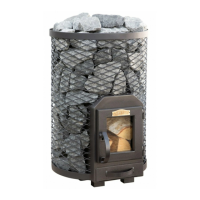
2. Installation instructions
2.1. Before installation
We recommend performing the rst heating outside without heater stones
before installing the heater, because the nal curing of the external heat-
resistant paint of sauna heaters is completed only after heating and the
curing process may give off an unpleasant burning smell. Before that avoid
scratching the metal parts of the heater. If necessary, connect a smoke pipe
to the ue outlet of the heater to get draft.
Before installation, make sure that all requirements of safety distances are met.
There should be no electrical devices, wires or combustible materials around the
heater in the distances as provided by the requirements. During installation, also
chimney pipe safety requirements must be followed.
• Installation of the sauna heater must comply with all respective applicable
national and EU regulations and standards. The heater is also suitable for use
in case when several re chambers have a joint ue pipe, provided that all
requirements necessary for the operation of the heater are met. The chimney
with joint ue pipe must be designed and built in compliance with technical
requirements of all heating appliances connected to the joint ue and taking
into account their possible simultaneous operation.
• Please ask for further information on the re safety rules from local re safety
ofcials and representatives of relevant supervising authorities.
• The heater must be installed in such a way that ensures an access to the
heater ue pipe and chimney ue for cleaning.
2.2. Sauna room ventilation
Sauna room ventilation can be designed and built as a natural or mechanically
forced ventilation.
Natural ventilation can be designed in two ways:
1) Fresh air inlet is located near the heater close to the oor and its outow as
far as possible from the heater, near the ceiling.
2) Fresh air inlet is located above the heater approximately 500 mm above the
upper surface of the stones, and the outlets are located as far away from
the heater as possible so that the core outlet is placed 50-100 mm higher
from the oor and the opening required for adjusting comes from the same
channel drawn out under the ceiling.
The grilles installed on the inlet(s) should not impede the necessary amount of
air ow.
Mechanical (forced) ventilation fans may cause problems.
Forced ventilation systems may only be designed and built by qualied
specialists.
2.3. Protecting the oor (See Fig. 2)
N.B. Stoveman heater must be installed onto a oor made of non-ammable
material or on a special protective base.
A. Concrete oor without tiles.
If the concrete layer is at least 60 mm thick, the heater can be installed directly on
the concrete, without applying any additional special precautions. Make sure that
there are no electrical cables or water pipes in the concrete beneath the heater.
B. Tile oor and oor made of combustible material.
Tile adhesives and mortars, as well as waterproong materials used under tiles
do not tolerate heat radiation coming from the heater. Protect the oor with a
plate made of stone or insulated metal. If the oor in front of the heater is made
of combustible material, a oor protection of non-combustible material must be
installed.
The oor under the heater must be able to withstand the pressure generated
by the legs of the heater with stones and chimney. If the existing oor cannot
withstand the weight of the heater, additional measures must be applied - for
example, using a load distributing plate.
2.4. Safety distances to ammable materials (See Fig. 3)
Safety distances apply for a heater lled with heater stones.
- Ceiling. The minimum safe distance from the surface of heater stones to the
ceiling is 1140 mm.
- Walls, benches, doors, partitions, and sauna stand made of ammable
materials.
The minimum safe distances to ammable materials are:
• sides 190 mm;
• back 250 mm;
• front (from the re chamber door) 900 mm.
- Stone walls (SW). Between the side walls and the heater we recommend
leaving at least 50 mm wide air gap, provided that air can circulate to the front
and one side of the heater.
2.5. Connecting the heater to the smoke ue
Stoveman heaters have the ue gases outlet on top of the re chamber. The
heater will be connected to the smoke ue with proper (temperature class T600)
pipe tting with inner diameter of at least 115 (+2) mm. When performing the
connection with smoke ue it is important to make sure that in the direction of
chimney outlet the connection won’t be in any part at declining angle, in order to
avoid any obstructions that could impede the ue gas ow.
- Place the connector to the heater’s ue gas output and make sure that the
connector ts tightly.
- Perform the connection until the reproof ue outlet.
- Push the heater into place.
N.B. Avoid pushing the pipe connector too far into the ue not to obstruct the
draft in the ue. If necessary, shorten the respective pipe section.
-Seal the connecting pipe and the connection of the re-resistant ue using
re-resistant mineral wool, for example. Make sure the entire connection of the
smoke ue is sealed properly. If necessary, add re-resistant mineral wool.
The connection between the heater and the chimney ue must be
inspected by a person with relevant expertise.
2.6. Installation of a heater with re chamber expansion
(heated from another room) (See Fig. 4)
The heater must be installed into an opening of a concrete or brick wall. The
recommended dimensions of the opening are:
Height H 445 mm
Width L 260 mm
Thickness/Depth P 140 mm
If the oor in front of the re chamber door is made of ammable material, a
oor protection must be installed.
3. Instructions for use
Please read carefully all instructions.
3.1. Warnings
• Direct exposure of a human body to heated stones or other parts of the
heater is harmful to health.
• Do not throw water onto the stones (generate steam), when someone is in
the immediate vicinity of the heater as hot steam can cause him/her burns.
• Do not use sea water for throwing onto the stones.
3.2. Preparation for use
Hopefully, it is possible for you to perform the initial heating outdoors as said in
section 2.1. If it is not possible to heat the heater outdoors, you must perform
the rst heating of the already installed heater in a well ventilated sauna room.
In such a case, the nal curing of the cover paint will generate a lot of fumes in
the sauna room. Heat the heater, using only half the load of rewood, until the
paint on the outer wall of the re chamber becomes entirely mat and does not
emit smoke any more.
3.3. Fuel
The heater can be heated with dry wood logs with a moisture content below
16%. Moisture content of wood affects the cleanliness of combustion and heater’s
overall efciency. Different types of wood have different caloric value. You can
start the re with birch bark, a dry newspaper or specic ignition material (e.g.
hexamine fuel tablet).
Do not use the following materials for heating the heater:
- Materials with high combustion temperature (such as chipboard, plastic, coal,
briquettes, pellets, etc.);
- painted or impregnated wood;
- waste (such as plastic lm, textiles, leather, rubber, disposable diapers);
- garden waste (such as grass, leaves);
- liquid fuels and materials suffused with them.


 To Next Page
 Loading...