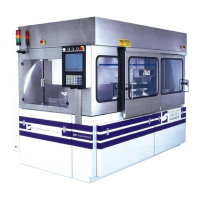
Strasbaugh Control System Description
Version 4.0 - February 1998 5 - 5
DC MOTOR CONTROLLER
The 6DS-SP has five DC drive motors driven by complete control boards. Each
controller receives an analog voltage input and drives the 90 VDC motor to a
corresponding velocity. The five DC drive motors power the slurry 1, slurry 2,
pump 3, conditioning brush sweep, and conditioning brush rotate functions. The
first four receive an analog input command for motor speed from the control
computer through the I/O interface system, respectively, channels 14, 15, 16, and
24. The conditioning brush rotate drive motor operates at a constant speed. The
motor speed adjustment for the brush's rotational speed is a potentiometer mounted
below its control board. The velocity profile for each control board is adjusted by
several potentiometers on the board.
SERVO AMPLIFIER
Refer to engineering drawings 217946E2 through 217946E9 and 217946EA
through 217946EE for the following discussion. For each of the motors
discussed above in the Servo Controller section, an amplifier module mates
between the motion control board and the brushless DC servo motor. The
amplifier modules are identified as 1BSC through 12BSC for axes 1 through 12
respectively. The axes 1-4 amplifier modules are supplied with three phase 208
VAC, and wired to the motor's windings through a motor contactor. The motor
contactor is enabled when the fault line output of the amplifier module is low.
This low output energizes an inline relay coil which in turn closes its contacts to
energize the motor contactor coil, completing the power source path to the DC
servo motor. Whenever the fault line voltage is high, the motor contactor is
disabled, and all power to that DC servo motor is cut off.
The amplifier module receives an analog velocity command signal from the
servo module of the motion control board. In response to the velocity command
input, the amplifier module uses pulse width modulation (PWM) for exciting the
motor windings, to ramp the motor up or down to constant velocity. The axis 1-
4 encoder emulator, mounted on the amplifier module, translates the resolver
feedback signals from the motor into the encoder signals required by the motion
controller system. These signals provide data on the motor's absolute position
and velocity.


 To Next Page
 Loading...