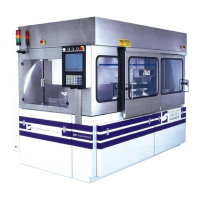
Maintenance Model 6DS-SP Planarizer
5 - 4 Version 4.0 - February 1998
SERVO CONTROLLER
The 6DS-SP has up to 15 (depending upon machine configuration) brushless DC
servo motors controlled by brushless DC servo amplifiers and control boards.
Brushless DC servo motors offer the best features of both AC and DC motors--
the linear characteristics of DC motors and the motion produced by rotating
magnetic fields characteristic of AC motors. The motor field windings are
excited with three-phase high DC voltages at pulse width modulated (PWM)
frequencies. This scheme creates a moving magnetic field which the permanent
magnet armature follows by rotating. The rotation is shaft motion regulated by
the servo controller for velocity, position, and direction.
Four servo motors are labeled axis 1 through 4, respectively, for left spindle
motor, right spindle motor, bridge motor, and table motor. Eight servo motors,
axis 5 through axis 12, provide motion for the elevators and for robot movement.
Five additional servo motors support the second table option; the programmable,
servo-controlled conditioning arm (linear actuator and brush rotation); and the
enhanced cleaning stations. Each motor, with the exception of the cleaning
stations motor, has its own servo module interface, referred to below as the servo
module. (Note that the brushless servo motor for the enhanced cleaning stations
has no DCX board.) Together the servo modules are mounted on two common
motherboards plugged into control computer expansion slots.
Each motor is individually programmed for velocity, acceleration, or position.
Instructions for motion of each servo motor, which originate from the main
program of the control computer, are received by the motor's servo module
through a communications port on the motherboard. The servo module's internal
hardware interprets the computer's digital instructions and outputs an analog
velocity command signal to the motor's amplifier module (see Servo Amplifiers--
below). Some use an encoder emulator to feed back motor position at all times to
the servo module. Others use optical encoder feedback. Together this system
forms a complete closed loop motion control system.


 To Next Page
 Loading...