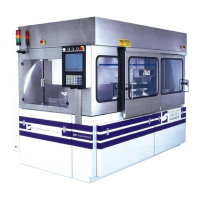
Maintenance Model 6DS-SP Planarizer
10 - 100 Version 4.0 - February 1998
Procedure
1. Estimate whether the linear (side to side) positioning or the radial
(in/out) positioning error is greater.
a. Correct the axis position of greater error first by following the
appropriate correction procedure, below.
b. When the axis position of greater error has been corrected, perform
the correction procedure for the axis position of lesser error by
following the appropriate correction procedure, below.
Linear (Side to Side) Positioning Correction
Notes:
The linear positioning is corrected by increasing or decreasing the value of the
variable by .1-inch or smaller increments as needed. Make coarse adjustment
by changing the variable value in .1-inch increments; make fine adjustments with
.01-inch increments.
As noted earlier, home for the robot’s linear axis is 0. Positions at the load
stations are always expressed in negative numbers.
• If the arm is too far away from the polish table, move the arm toward
the polish table by increasing the current value of the variable by .01 to
.1-inch increments.
• If the arm is too near the polish table, move the arm away from the
polish table by decreasing the current value of the variable by .01 to .1-
inch increments.
1. Note whether the arm is positioned too near the polish table or too far
away from the polish table.


 To Next Page
 Loading...