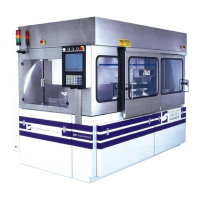
Strasbaugh Machine Description
Version 4.0 - February 1998 2 - 27
ROBOT ASSEMBLY
Supported by a slide assembly, the robot travels between the left elevators
and the right load station, stopping at each elevator and load station (a range
of approximately three feet). The slide assembly is comprised of two
hardened steel rails and a lead screw supported at both ends. On the right
end of the lead screw, a brushless DC motor is connected by direct drive
through a flexible coupling to the lead screw.
Four linear pillow block bearings mounted underneath the robot base slide
on the hardened steel rails. The lead screw is rotated within a stationary
polymer nut located underneath the robot base, causing linear movement of
the robot. Encoder feedback monitors position and speed.
The robot’s Z-axis provides up and down linear travel. Located inside the
rectangular housing, the Z-axis has a backplate mounted with three linear
bearings mounted on a spine shaft at the center of the housing. A stationary
lead screw (located inside a nut mounted in two bearings on the framework
of the robot) is rotated by a brushless DC motor driving a tooth belt and two
pulleys, causing upward and downward movement of the robot. Encoder
feedback monitors position and speed. The Z-axis has a single inductive
sensor located at the middle range of travel and functioning as a “home”
switch.
The robot rotational (theta) axis is belt driven by a brushless DC motor
(mounted inside the robot assembly), two pulleys, and a tooth belt. An
inductive sensor located inside the housing “homes” the theta axis. Encoder
feedback monitors position and speed.
The robot radial axis (also belt driven by a brushless DC motor, two pulleys,
and a tooth belt) is mounted on a spindle located in the end of the theta axis
housing. The spindle is driven by two pulleys and a belt. The belt and
pulleys are driven by a shaft (driven by two more pulleys, a belt, and a
motor) extending down inside the robot assembly. An inductive sensor
located on the underneath side of the housing “homes” the radial axis.
Encoder feedback monitors position and speed.
The robot’s radial and theta axes permit it to reach into wafer cassettes and
out over the load stations, positioning an end effector located on the theta
axis over a wafer. The end effector is a vacuum chuck fitted into the end of
the theta axis. The vacuum chuck picks up and deposits wafers to and from
elevators and load stations. The end effector is equipped with a vacuum
switch, located inside the housing, to sense when the robot has taken vacuum
on a wafer.


 To Next Page
 Loading...