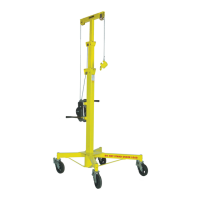
The Sumner R-Series Roust-a-Bout is a material handling lift designed for elevating and positioning loads. This operator's manual provides essential information for safe and effective operation, maintenance, and troubleshooting of the device.
Function Description:
The Roust-a-Bout is primarily used for lifting and positioning various loads, particularly in construction and industrial settings. It features a mast assembly that can be elevated to different heights, a winch system for raising and lowering loads, and a stable base with casters for mobility. The device is designed to be operated on solid, level surfaces and requires operators to be thoroughly familiar with its safety precautions and operating procedures. It is crucial to read and understand the entire operator's manual before using the Roust-a-Bout to prevent personal injury or damage to the equipment.
Important Technical Specifications:
The R-Series Roust-a-Bout comes in several models, each with specific maximum lifting capacities and maximum heights:
- R-100: Maximum Lifting Capacity of 1500 lbs (680 kg), Maximum Height of 15' 2-1/2" (4.6 m).
- R-150: Maximum Lifting Capacity of 1500 lbs (680 kg), Maximum Height of 15' 2-1/2" (4.6 m).
- R-180: Maximum Lifting Capacity of 1500 lbs (680 kg), Maximum Height of 17' 11-5/8" (5.5 m).
- R-250: Maximum Lifting Capacity of 1500 lbs (680 kg), Maximum Height of 25' 3/8" (7.6 m).
All models have a 1,000 lb (455 kg) limit when using the optional Tee Head Extension Bar.
The device's dimensions vary by model, with "A" representing the fully recessed height, "B" the width, "C" the depth, and "D" the base dimensions. For example, the R-100 has a fully recessed height of 79" (200 cm), a width of 20" (50 cm), a depth of 12" (30 cm), and base dimensions of 32 x 40 (80 x 100 cm), with a shipping weight of 311 lb (140 kg). The R-250, being the largest, has a fully recessed height of 119" (302 cm), a width of 30" (75 cm), a depth of 17.5" (44 cm), and base dimensions of 60 x 60 (150 x 150 cm), with a shipping weight of 381 lb (170 kg).
A critical safety feature is the Shear Pin, located on the front sheave of the "Tee Head." This pin is designed to protect the lift in the event of an overload, and a spare is located underneath the Winch Assembly.
Usage Features:
- Assembly: The assembly process involves attaching casters to the base, inserting the mast assembly, engaging the base latch, and attaching the counterweight and line shackle to the lift cable.
- Mobility: For moving the Roust-a-Bout without a load, the load line shackle should be attached to the winch mount bracket to prevent cable swing. Winch handles can be used as handlebars for steering. Caster brakes must be released, and a forward "S" motion helps align casters for movement. When transporting a load, the load should be placed on the base legs for positive control, and the unit should only be moved in the forward direction.
- Elevating Mast: The mast is elevated by turning the handle on the left side of the winch counterclockwise. It is important to ensure the lift cable loop, counterweight, or line shackle does not contact the "Tee Head" during elevation, as this can cause the "Tee Head" to bend. For the R-250 model, a red line on the center mast indicates the need to use "Guy Lines" when elevated over 20 ft (6.1 m) for stability.
- Attaching Lift Cable to Object: With the mast elevated, the lift line can be lowered to the load by pushing up and holding the Free Fall Lever on the left side of the winch. The cable is then pulled from the lower spool until it is long enough to securely attach to the load using approved rigging practices.
- Elevating Load: Loads are raised by turning the winch handle in a clockwise direction. The appropriate shaft and winch handle socket should be selected based on the weight chart.
- Lowering Load: Loads are lowered by using the lower shaft on the right side of the winch and turning the handle counterclockwise. The Free Fall Lever should never be used to lower a load.
- Lowering Mast: The mast is lowered by installing the winch handle onto the lower shaft on the left side of the winch and turning the handle clockwise. The mast should be lowered without a load whenever possible and never with a load exceeding 500 lb (225 kg).
- Removing Mast: Caster brakes should be locked. The base latch is released, and a crowbar is used to raise the mast from the base until the locating ring rests on top of the base, allowing for removal.
- Caster Brakes: Brakes are set by pressing down on the brake lever and released by lifting it up.
- Handle Storage: Handles can be stored by aligning sockets with holes in the storage plate, sliding them in until they contact the spring-loaded pin, pressing the pin, and continuing to slide.
- Optional Tee Head Extension Bar: This accessory allows for handling bulky loads but reduces the lift's stability as the load center is only 4” (10 cm) behind the front casters.
- Guy Lines (for R-250): When operating the R-250 above 20 ft (6.1 m), Guy Lines must be used. This involves attaching wire ropes to the Top Mast and chains to the rear legs, then elevating the mast to a specific height before attaching the chains to the wire ropes and elevating until the Guy Lines are taut.
Maintenance Features:
- Before Each Use:
- Inspect the cable for kinks, frays, or broken wire strands. If damaged, the cable must be replaced.
- Ensure the winch operates freely and the cable is not tangled.
- Inspect masts, legs, and base for bends or damage.
- Verify caster wheels move freely.
- Recommended Inspection Every 6 Months:
- Inspect the cable for frays and kinks.
- Ensure the winch works freely and that there are no loose or damaged parts.
- Winch Maintenance:
- Refer to winch assembly drawings in the manual.
- Ensure both winch covers are on.
- Check the ratchet dog and brake ratchet for wear and replace if visible.
- Inspect gear teeth for wear and brush with 50-wt. Motor oil if no wear is visible.
- Adjust brakes as per the "Troubleshooting" section.
- Replacing Cables: Detailed instructions are provided for replacing the Load Lifting Line, Mast Elevating Line, and Equalizing Line, including steps for disengaging parts, removing old cables, and reeving new ones.
- General Maintenance:
- Check winch handles for wear or bends.
- Examine all bolts and nuts for tightness.
- Ensure legs, braces, and base are dent-free.
- Check pulley housings for damage that could restrict pulley rotation.
- Verify all lines are seated in pulleys and that pulleys rotate without obstruction.
- Check all rollers for free rotation.
- Raise mast sections to inspect for free, smooth sliding action, ensuring wire slide ways are free of dust and oxidation, and applying silicone lubrication.
- Ensure caster wheels rotate freely and are undamaged.
- Troubleshooting: A table outlines common problems (e.g., masts not rising, Roust-a-Bout not holding the load), their causes (e.g., lifting over capacity, worn brake pads, damaged cable), and corresponding solutions (e.g., removing load, cleaning rollers, replacing parts).
- Brake Adjustment: Specific instructions are given for adjusting the CS2000 winch, emphasizing the correct positioning of the pinion and drive shaft when the lock nut is tightened against the O.D. Brake Disc to 15 ft lb.
- Maintenance Record: A dedicated section is provided for recording service actions and dates, allowing for a comprehensive maintenance history.
Safety Warnings:
The manual frequently uses "WARNING," "CAUTION," and "IMPORTANT" to highlight critical information.
- WARNING: Indicates hazards or unsafe practices that could result in severe personal injury or death. Examples include never allowing anyone under an elevated load, not using the free fall lever with a load, and the necessity of Guy Lines when the R-250 mast is elevated over 20 ft (6.1 m). Modifying the Roust-a-Bout in any way is strictly prohibited due to the risk of injury or death.
- CAUTION: Indicates hazards or unsafe practices that could result in minor personal injury, product, or property damage.
- IMPORTANT: Indicates information or instructions necessary for proper operation and/or maintenance.
Operators are advised to wear proper clothing, including a hard hat, safety shoes, and gloves. Horseplay is prohibited, and bystanders, especially children, must be kept away from the work area. The Roust-a-Bout should never be operated during storms or in gusty winds. It is also crucial to inspect the cable before each use and not operate if it is frayed, worn, or damaged. The device should only be used on a solid, level surface, with the work area clear of clutter and debris. The Roust-a-Bout should never be left unattended with an elevated load. Load balance must be tested before lifting, and rated load capacity should not be exceeded. Two Roust-a-Bouts should not be used to lift a load exceeding the capacity of a single lift. Climbing on the Roust-a-Bout or applying side loads to the mast is forbidden. Loads should not be pulled or dragged, and the Roust-a-Bout should not be moved by pulling on the load line. Raising or lowering loads over 500 lb (225 kg) by raising masts is not permitted. Only manufacturer-supplied accessories should be used.

 Need help?
 General

 To Next Page