EasyManua.ls Logo

Sun Microsystems MCS 2000 SL - Page 70

Sun Microsystems MCS 2000 SL
84 pages
Print Icon
To Next Page IconTo Next Page
To Previous Page IconTo Previous Page
Loading...
CATALYTIC CONVERTER
A
catalytic
convertor is
a device which
resembles
a silencer,
and is
fitted
into the
exhaust system between
the manifold
and
the silencer.
It consist
of
a chamber
in which
a
chemical
reaction
takes
piace
to change
toxic and
harmful
gases
into less
harmful
ones. The
most
common
use
for
emission
control is a three-way
catalytic converter which
will change approx'imately
90 %
of the
CO,
HC
and
NOx from
the
engine
into
CO2, N
(Nitrogen)
and
H2O
(Water)
at
the tail
pipe.
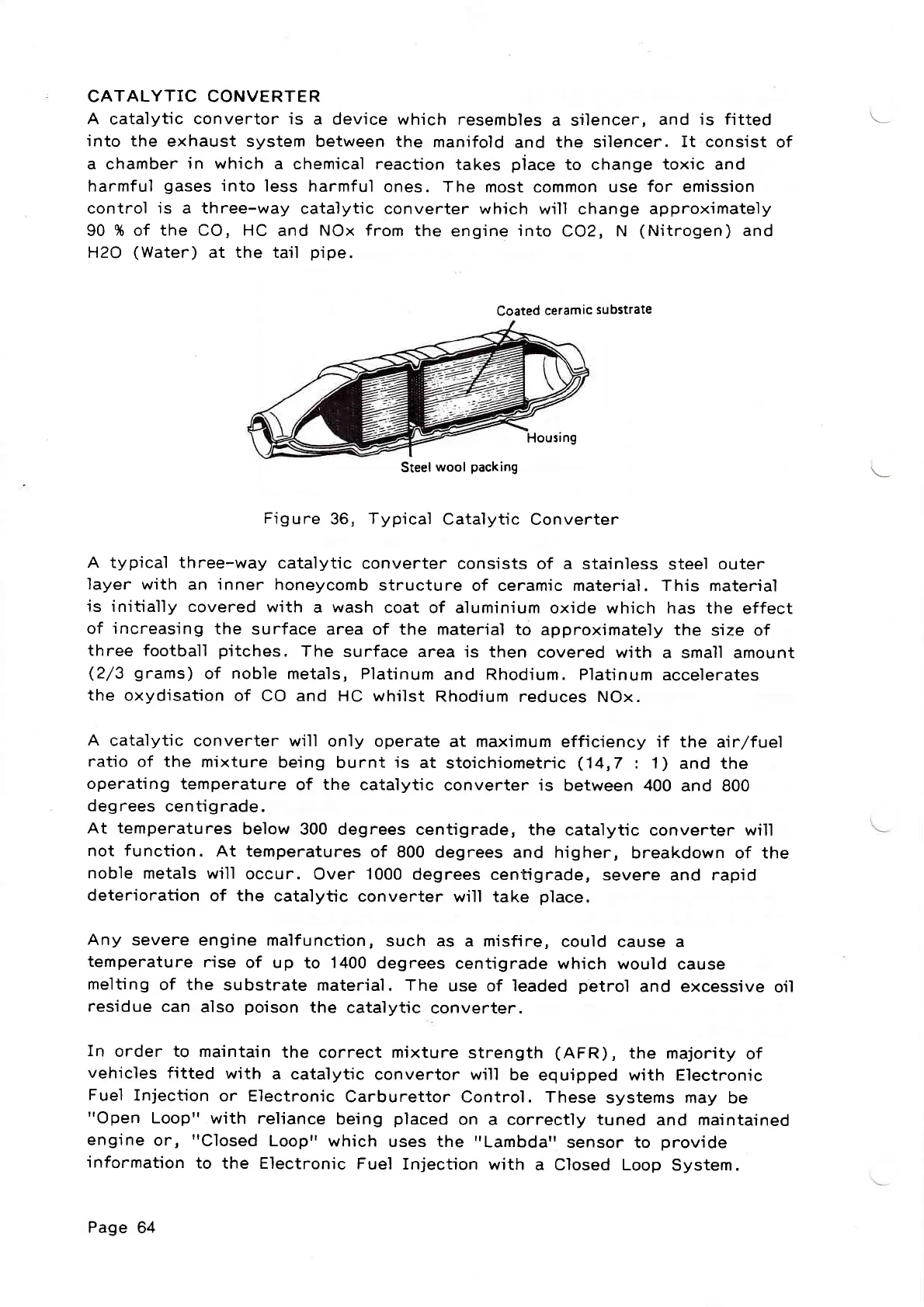
Coated
ceramic
substrate
Housing
Steel
wool
packing
Figure
36,
Typical
Catalyt'ic
Converter
A typical three-way
catalytic
converter
consists
of a stainless
steel
outer
layer
with an inner honeycomb
structure
of ceramic material. This material
js
initially
covered with
a wash
coat of aluminium
oxide which has the
effect
of increasing
the
surface area
of
the
material to
approximately
the size
of
three football
pitches.
The
surface area is then
covered with
a small amount
(2/3
grams)
of
noble
metals, Platinum
and Rhodium.
Platinum
acce'lerates
the
oxydisation
of CO and HC whilst
Rhodium
reduces NOx.
A
catalytic
converter will
only operate
at maximum
efficiency if the
air/fuel
ratio
of the
mixture
being
burnt
is
at
stoichiometric
(14,7
:
1)
and
the
operating temperature
of
the
catalytic
convertelis
between 400
and 800
degrees
centigrade.
At temperatures
below
300 degrees centigrade,
the
catalytic converter will
not function.
At
temperatures
of
800 degrees
and
higher,
breakdown of the
noble
metals will
occur.
Over'1000
degrees cent'igrade,
severe and
rapid
deterioration
of the
catalytic
converter will take
place.
Any
severe
engine ma'lfunction,
such
as a
misfire,
could cause a
temperature
rise
of up
to
1400
degrees
centigrade
which would
cause
melting
of the
substrate material.
The
use of
leaded
petrol
and excessive
oil
residue
can also
poison
the
cata'lytic
converter.
In
order to maintain
the
correct mixture
strength
(AFR),
the
majority
of
vehicles
fitted
with
a catalytic
convertor w'ill
be
equipped with
Electronic
Fuel
Injection
or Electronic
Carburettor
Control. These
systems may
be
"Open
Loop"
with
reliance
being
placed
on a
correctly tuned and maintained
engine
or,
"Closed
Loop"
which
uses the,,Lambda"
sensor to
provide
information
to
the
Electronic Fuel
Injection
with
a Closed Loop
System.
Page
64

Related product manuals