
 Need help?
Do you have a question about the Sundown Audio SDX 400.1 and is the answer not in the manual?
The Sundown Audio SDX Series Amplifier is a versatile audio device designed to enhance your car audio system. It comes in both mono-block and multi-channel configurations, catering to various audio setups and power requirements. This manual serves as a comprehensive guide for understanding, installing, and maintaining your SDX amplifier, though professional installation is recommended for optimal performance and safety.
The SDX Series Amplifiers are high-efficiency digital Class-D amplifiers, engineered to deliver powerful and clear audio output. Whether you choose a mono-block for dedicated subwoofer power or a multi-channel amplifier for a full-range speaker system, these units are designed to provide robust amplification. They feature a dual MOS-FET PWM power supply, ensuring stable and efficient power delivery to your speakers. The amplifiers are built to handle various load impedances, with mono-blocks being 1 Ohm stable and multi-channel units supporting different impedance configurations depending on the model and wiring.
A key function of these amplifiers is their advanced crossover system. Both mono-block and multi-channel models include variable low-pass filters (12 dB/Octave), allowing you to precisely control the frequencies sent to your speakers. Multi-channel amplifiers further offer variable high-pass filters (12 dB/Octave), providing comprehensive frequency management for a full-range sound system. This flexibility in filtering ensures that each speaker receives the appropriate frequency range, optimizing sound quality and protecting your speakers from damage.
The SDX amplifiers also incorporate several intelligent features to enhance user experience and system integration. The DC Auto Sense feature allows the amplifier to turn on automatically when it detects a signal, simplifying the turn-on process, especially in systems without a dedicated remote turn-on wire. For bass enthusiasts, a variable bass boost (0 to 12dB) is included, enabling you to fine-tune the low-frequency response to your preference.
Protection is a paramount function of the SDX Series. These amplifiers are equipped with a 4-way protection circuit that guards against thermal overload, voltage fluctuations, speaker shorts, and DC offset. This multi-layer protection system ensures the longevity of your amplifier and connected speakers by preventing damage from misuse or faulty conditions. In the event of an issue, a protection indicator light will illuminate, signaling a problem and prompting you to troubleshoot.
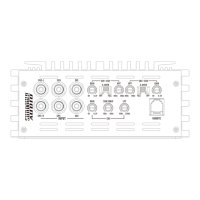
The SDX amplifiers offer a range of controls and inputs designed for flexible and user-friendly operation. For power connections, the amplifiers feature dedicated terminals for B+ (positive battery connection), REM (remote turn-on), and GND (ground). It is crucial to connect these properly, with appropriate in-line fusing on the positive power wire, to ensure safe and stable operation.
Input signal management is facilitated through various options. The amplifiers include RCA inputs for standard signal sources, allowing you to connect your head unit or other audio source. For systems without RCA outputs, high-level inputs are provided, enabling you to connect directly to your vehicle's speaker-level signals. When using high-level inputs, the "AUTO SENSE" feature can detect the signal and turn on the amplifier. Alternatively, you can use the "REM" (remote) turn-on option, which is typically controlled by your source unit. The "DC" turn-on option is available for installations where the battery/power is disconnected when not in use, allowing the amplifier to turn on with B+.
For multi-channel amplifiers, signal duplication features are available. Buttons for "5/6 CH INPUT" and "3/4 CH INPUT" allow you to duplicate signals from CH1 and CH2 to other channels, simplifying wiring for multiple speakers or bridged configurations. This means you don't necessarily need to use all RCA inputs if your source unit has fewer outputs.
Output connections are straightforward, with clearly labeled speaker output terminals for each channel. For mono-block amplifiers, these are dedicated to a single output, while multi-channel units provide outputs for multiple speakers. Some models may also include an "OUTPUT RCA" passthrough, allowing you to send the audio signal to a secondary amplifier.
The amplifier's sound shaping capabilities are controlled by several knobs and switches. The "LEVEL/GAIN" knob, often mistakenly referred to as a volume knob, is used to set the input signal levels, ensuring the amplifier receives an optimal signal without clipping. The "FILTER" switch allows you to engage or bypass the internal crossover. When engaged, the "LPF" (low pass filter) and "HPF" (high pass filter) knobs allow you to set the crossover frequencies. The "RANGE" multiplier further refines the crossover point, offering flexibility in frequency selection. For subwoofers, a "SUBSONIC" filter is available to protect them from playing frequencies lower than their design limit. Some models may also include a "PHASE" adjustment, useful for aligning the phase of subwoofers with other speakers.
A wired remote control port is available for connecting an external bass knob, providing convenient control over the bass level from the driver's seat. This allows for on-the-fly adjustments without needing to access the amplifier directly.
Maintaining your SDX Series Amplifier primarily involves ensuring proper installation and addressing any issues promptly. The multi-layer protection features are designed to prevent damage, but understanding their indicators is key to effective maintenance. If the protection indicator light turns red, it signifies an issue such as overheating, a short circuit, or voltage problems. In such cases, the manual recommends turning down all levels, powering off the unit, and carefully checking the installation for wiring mistakes or shorts.
For overheating issues, allowing the unit to cool down for about 30 minutes is advised. If the problem persists, consider relocating the amplifier or ensuring it has adequate ventilation to dissipate heat. Regular inspection of power and ground connections is crucial, as loose or corroded connections can lead to performance issues or protection mode activation. The manual emphasizes the importance of a solid ground connection, recommending sanding the contact point to ensure a clean metal-to-metal connection.
Troubleshooting common issues is made easier with a dedicated section in the manual. If the amplifier doesn't turn on or has no output, checking the fuses (visually and with a continuity meter), verifying all 12+ volt, remote, and ground connections, and measuring the input signal voltage from the source unit are recommended steps. If the amplifier goes into protection mode, checking for shorts on speaker wires, verifying impedance against the minimum load specifications, and ensuring the input voltage is within the working range are essential.
For distorted, attenuated, or noisy sound, the manual suggests checking chassis ground connections of all audio equipment, reviewing amplifier control settings (input level, crossover), inspecting speaker wires for shorts or reverse polarity, and verifying the nominal load impedance. If a pulsing sound is heard, it often indicates overdriving, which could be due to a gain set too high or a speaker impedance being too low.
The SDX Series Amplifiers are designed for durability, but proper care and adherence to installation guidelines are vital for their long-term performance. While the manual provides comprehensive troubleshooting steps, professional assistance is recommended for complex issues or if you are unsure about any aspect of installation or repair. Sundown Audio also offers a "discounted replacement" policy for five years from the purchase date, providing an option for replacement at a reduced cost even if user-induced damage occurs, highlighting their commitment to product longevity and customer support.
 General
| Bass Boost | 0 - 12 dB |
|---|---|
| Subsonic Filter | 10 Hz - 50 Hz |
| Phase Control | 0 - 180 Degrees |
| Crossover Range | 250 Hz |
| Low Pass Filter | 250 Hz |


 To Next Page