Need help?
Do you have a question about the Sungrow PVS-24MH and is the answer not in the manual?
Specifies the PV array combiner boxes for which this manual is valid.
Identifies the intended audience for this manual, focusing on operators and maintenance personnel.
Provides guidance on how to effectively read and use the information presented in the manual.
Provides additional information and context, using PVS-24MH as an example.
Explains the meaning of various safety and informational symbols used throughout the manual.
Clarifies that figures are based on standard configurations and may differ from the actual product.
Explains the role of DC combining devices in large-scale PV systems and the PVS function.
Lists the key functionalities and characteristics of the PV Array Combiner Box.
Details how to interpret the model naming convention for the combiner box types.
Presents the physical dimensions of the PVS, using PVS-24MH as an example.
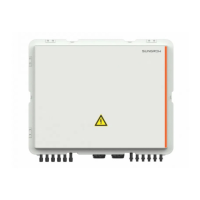
Shows how to identify the PVS unit and its components, using PVS-24MH as an example.
Lists the items included in the package for the PVS, including optional accessories.
Provides guidelines for storing the combiner boxes under specific environmental conditions.
Outlines the necessary conditions and considerations for selecting an appropriate installation location.
Lists the general and specific tools required for the installation process.
Describes the overview and steps for physically installing the PVS unit onto a mounting surface.
Details the internal components and layout of the PVS, showing two versions.
Explains the types and specifications of waterproof terminals used for input, output, and communication.
Outlines the necessary steps and precautions before commencing wiring operations.
Describes the procedures and safety precautions for connecting the PV strings to the PVS input terminals.
Details the preparation and wiring procedures for connecting the PVS output to the inverter or other components.
Explains the importance and methods for properly grounding the PVS for safety and protection.
Provides instructions for connecting the PVS to a monitoring system or network via communication cables.
Offers guidance on how to organize and lay out cables within the PVS and cable trenches for safety and maintenance.
Details the step-by-step process for setting the communication address for the PVS.
Guides users on how to set the number of PV strings connected to the PVS.
Describes how the combiner box operates automatically and can be shut down manually.
Explains the necessity of periodic maintenance due to environmental factors affecting PVS components.
Provides instructions and safety warnings for replacing a blown fuse in the PVS.
Instructs on how to replace the sealing strip on the PVS internal door cover if damaged.
Lists important precautions and checks to perform before starting the troubleshooting process.
Details common issues, their possible causes, and methods for resolution, categorized by indicator and other faults.
Presents detailed technical specifications for different models of the PV Array Combiner Box.
Specifies the types, lengths, and torque requirements for various cables used with the PVS.
Outlines the warranty terms, conditions, and exclusions for the PVS product.
Provides contact details for Sungrow support in various regions for assistance with product issues.
 General
| Brand | Sungrow |
|---|---|
| Model | PVS-24MH |
| Category | Controller |
| Language | English |

 To Next Page