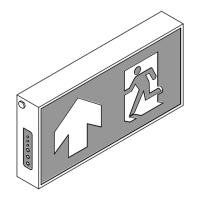
This document outlines the features, installation, operation, and maintenance of the Emergency Exit Sign Light Series 6, designed to provide clear guidance for safe and effective use. The series includes various models, such as the EX Series (Type C, W, F) and SL Series (Type C, W, R), each offering different mounting options to suit diverse installation environments.
Function Description
The Emergency Exit Sign Light Series 6 serves as a crucial safety device, illuminating an emergency exit symbol to guide occupants during power outages or emergencies. It operates on both AC power and an internal battery, ensuring continuous functionality even when the main power supply is interrupted. The device is equipped with status indicators and testing buttons to monitor its operational status and facilitate regular checks.
Usage Features
Installation:
The installation process is designed to be straightforward, with specific instructions provided for different mounting types, including ceiling, recessed, wall, and suspended installations. Users are advised to secure the fixture properly to prevent accidents and ensure its stability. For ceiling and recessed installations, anchor bolts and slide rails are used, while wall-mounted units involve fastening screws directly into the wall. Suspended installations require additional mounting accessories and hanger rods. Detailed diagrams and step-by-step instructions are provided for each model (SLS6-10LED C, R, W, and EXS6-10LED C, W, F), ensuring that the device is correctly positioned and secured. The manual emphasizes the importance of reading the instructions carefully before installation to ensure optimal performance and safety.
Power Connection:
Once installed, the device's power plug should be connected to a 220-240VAC/50Hz power outlet. Upon connection, the emergency exit sign lights will illuminate, and the device will begin its operational cycle.
Status Indicators:
The device features several LED indicators that provide real-time feedback on its status:
- AC (Orange Light): A continuous orange light indicates that the unit is receiving a normal AC power supply. If the orange light turns off, it means the unit is not receiving AC power.
- Charge/Full (Red Light): A continuous red light signifies that the battery is charging. When the red light turns off, the battery is fully charged.
- On/Test (Green Light): A continuous green light indicates that the unit is ready for use. This light also serves multiple functions related to the automatic battery test system. A slow blinking green light (every 2 seconds) indicates that the automatic battery test system has been turned off via the remote. A fast blinking green light (every 1 second) indicates that the automatic battery test system has been turned on via the remote, or that the unit is performing a battery test (Auto Test).
- IR: This indicates the infrared signal receiver, used for remote control functions.
- Fail: This indicator signals a problem with the battery or charging system. A red light blinking three times every 15 seconds indicates a "Battery Fail," meaning the emergency light unit supplies backup lighting for less than 120 minutes or less than the time tested with a remote control. A red light blinking four times every 15 seconds indicates a "Charging Fail," which occurs when the battery charging system is not functioning correctly, the charger does not cut off, the charging circuit cuts off, or the battery charge decreases too quickly.
The device includes an "Off/Test" button on the fixture itself, which can be pressed to turn off the lamp and the system (when power is off or the unit is not plugged in) or to test the device's availability (during normal operation when plugged in).
Remote Testing:
For enhanced convenience, the device can be tested using a remote control. The remote offers several testing options:
- 5 secs button: Tests the device's function for 5 seconds.
- 30 mins button: Tests the device's function for 30 minutes.
- 60 mins button: Tests the device's function for 60 minutes.
- On button (Auto Test): Turns on the automatic battery test system.
- Off button (Auto Test): Turns off the automatic battery test system.
- Light On/Off button: Turns the light bulb ON/OFF during normal circumstances when the unit is plugged in. It also deactivates the light bulb during a power outage.
Operational Tests:
Once the unit is operational, users can perform tests by pressing the Off/Test button on the fixture. This action will cause the light from the sign to illuminate continuously. To turn off the light without unplugging the fixture, the Off/Test button should be pressed again.
Maintenance Features
Important Usage Notes:
To ensure the longevity and proper functioning of the unit, several guidelines must be followed:
- Indoor Installation: The unit should be installed indoors, away from direct sunlight and humidity.
- Temperature Limits: Avoid installing the unit in environments where temperatures exceed 50 degrees Celsius.
- Storage Conditions: If the unit is to be stored, it should be kept at temperatures below 25 degrees Celsius.
- Battery Maintenance: The battery should be charged every 3 months to maintain its operational life.
Troubleshooting:
The manual provides a comprehensive troubleshooting guide to address common issues:
- Power not getting to the unit (LED AC light off): This could be due to a power socket issue, a loose junction, or a blown AC fuse. Solutions include checking the power supply, inspecting the junction, and contacting customer service.
- Unit and lamp not illuminating when power goes out: Possible causes are a faulty lamp, loose circuit wiring, or a blown DC fuse. Users should contact customer service for these issues.
- Lamp only turns on for a short duration after power outage: This indicates that the battery is not fully charged or has deteriorated. The unit should be charged until the "LED Charge" indicator turns off. If the problem persists, customer service should be contacted to replace the battery.
Warranty and Service:
The warranty covers the unit's internal parts, with specific conditions and durations for each component. To validate the warranty, customers must complete and mail the "warranty registration form" within 7 days of purchase. The warranty is void if the product is used improperly, with non-compliant accessories, or if it shows signs of physical damage, unauthorized repairs, or a torn "Warranty Void" sticker. Battery-related issues due to careless use, incorrect maintenance (e.g., overcharging, short-circuiting, complete discharge without immediate recharge, or improper storage), or environmental factors (moisture, water vapor) are also not covered. Damages from faulty AC power supply (overvoltage, surges, lightning strikes), natural causes (fire, fluids, humidity, chemicals, force majeure), or damage by insects/animals are excluded from the warranty.
The manual emphasizes reading the instructions carefully before installation and operation to ensure proper use and to understand the warranty terms. For any further questions or assistance, customers are encouraged to contact SUNNY's customer service department via phone or email.


 To Next Page
 General