www.sunrotor.com Page 10
5.6 SEASONAL TILT OF THE SOLAR ARRAY
The sun is highest in the sky during the summer and lowest in winter. To maximize pumping during
both seasons, adjust the tilt angle periodically. Nearly all currently manufactured mounting racks
can be adjusted. It is sufficient to perform the adjustment only twice per year, at the spring and
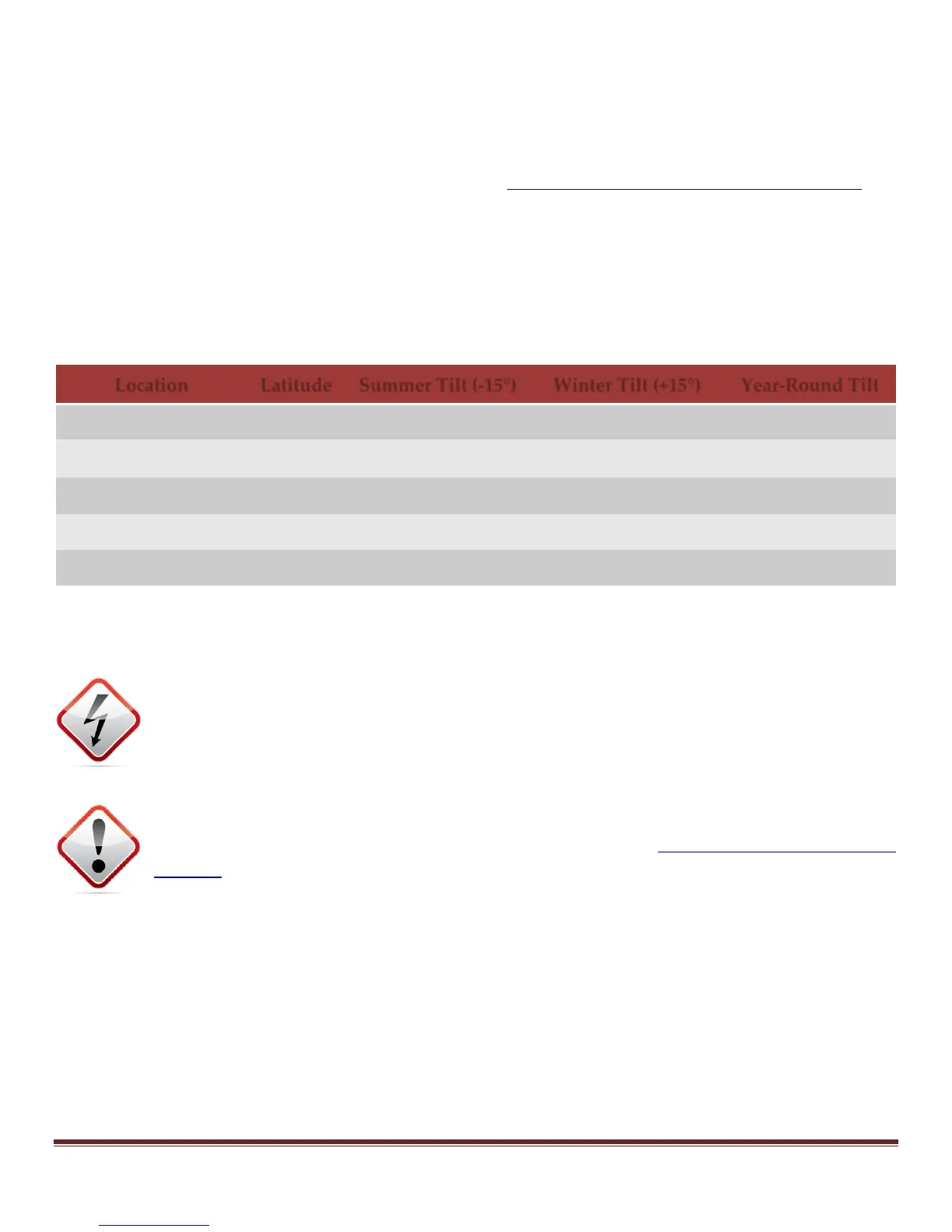
autumn equinoxes, to the angles indicated below. See Figure 5-2 Solar Array Tilt Angles by Latitude.
If season adjustments are unwanted or unnecessary, set the tilt angle to the latitude of the pump
location, as a compromise. Do not set the array absolutely horizontal, or dust and debris will
accumulate.
Ideal angles are: Summer optimum = latitude -15° Winter optimum = latitude +15°
FIGURE 5-2 SOLAR ARRAY TILT ANGLES BY LATITUDE
For additional tilt angles not listed, please consult the Mounting Rack Manual or Authorized SunRotor
®
Dealer
5.7 SOLAR ARRAY WIRING
WARNING: Photovoltaic arrays generate hazardous voltages. A 48 Volt (nominal) array
can generate nearly 100 volts when disconnected from load. All wiring MUST be done
by qualified personnel, in compliance with local, state, and national electrical codes.
To prevent shock hazard while working on array wiring, leave one wire disconnected
between two modules to break the circuit, or cover array to shade it.
ATTENTION: Wiring the panels in the wrong configuration (series or parallel) can damage
the controller. Be certain of the wiring configuration (See Figure 5-3 Solar Panel Wiring
Diagram for examples) prior to connecting the array to the controller. Additionally, it is
recommended to cover or shade the panels when connecting them to the controller. This
prevents electrical discharge from damaging the equipment. Any damage caused by disregarding
these warnings will NOT be covered under the warranty.
If the system uses a single panel, simply plug the MC4 connectors on the solar panel to the male and
female connectors on the controller; however, if more power or voltage is needed to meet the pump
requirements, multiple panels will have to be wired in either series, parallel, or a combined
series/parallel configuration. Examples are provided below to better explain the differences between
parallel and series.



 To Next Page